 By Emre Erel
Live Meeting Translation vs Human Interpreters for Business Calls
A buyer-friendly framework to compare live meeting translation tools and human interpreters across real-time communication quality, risk, cost, and—most importantly—how well each option supports transcripts, summaries, decisions, and follow-up actions after the call.
Live Meeting Translation vs Human Interpreters for Business Calls
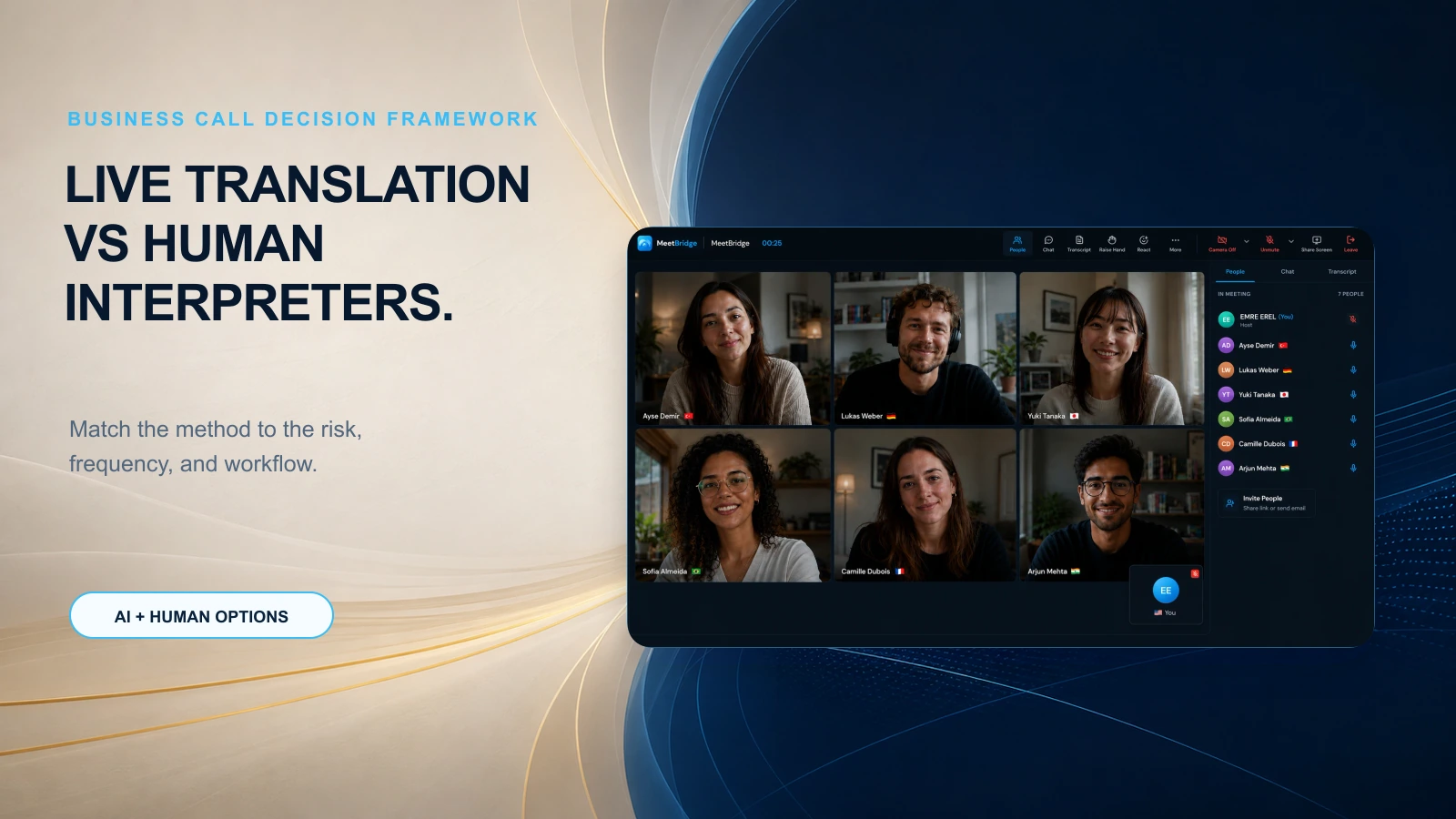
Operations Managers in multilingual organizations often get pulled into the same urgent problem: a revenue-critical customer call, supplier negotiation, or internal rollout meeting can’t wait—but language gaps slow decisions, create misunderstandings, and turn follow-up into a mess of partial notes and contradictory email threads.
If you’re evaluating live meeting translation for business teams, you’re not just choosing how people understand each other in the moment. You’re choosing how reliably your company can capture decisions, assign owners, and execute across languages afterward.
This guide gives you a practical framework to compare real-time meeting translation tools vs human interpreters for multilingual meetings, with concrete B2B scenarios and an immediately usable checklist.
Who Each Option Fits Best (Quick Decision Guide)
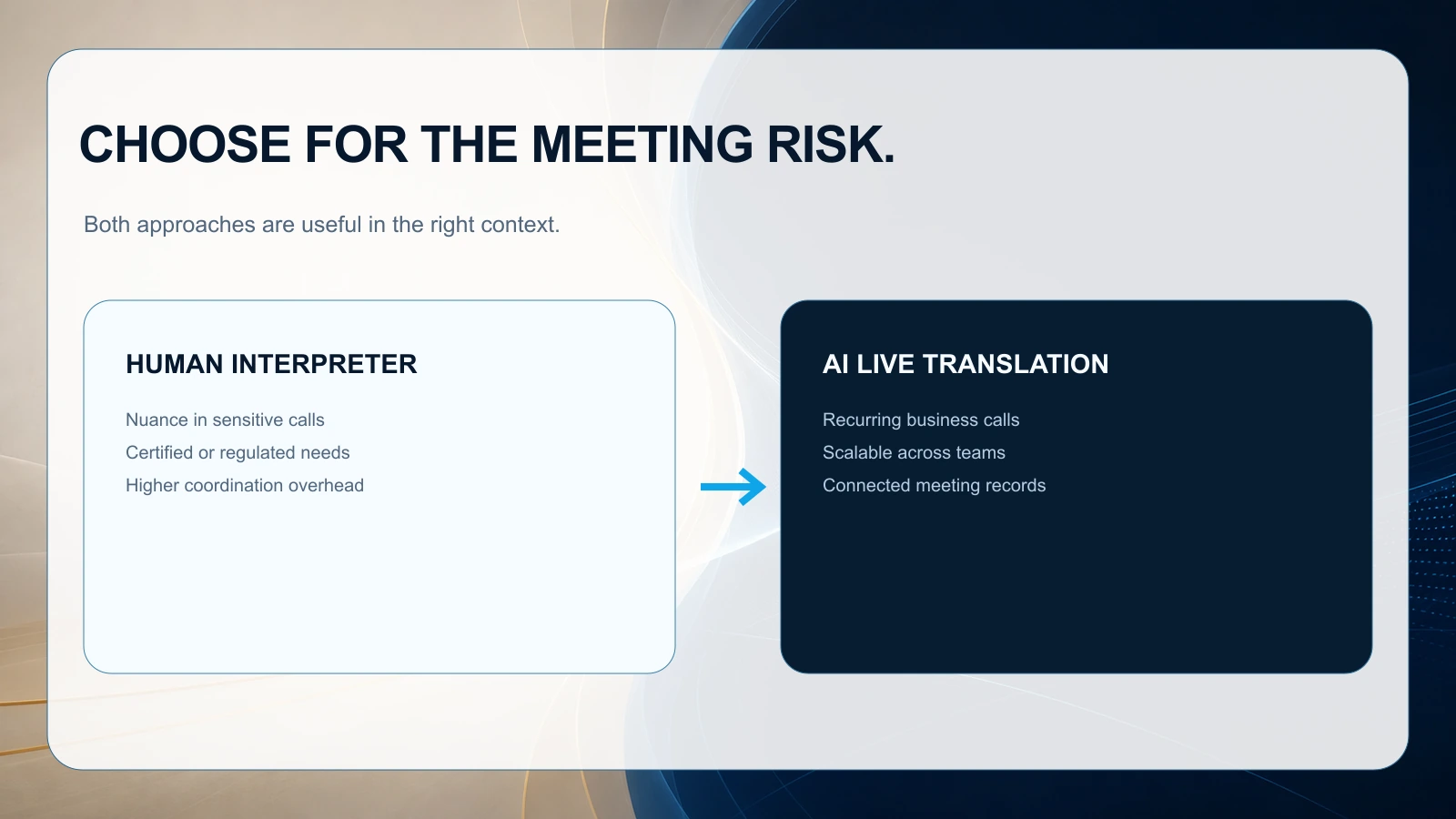
Both approaches can work. The best fit depends on meeting type, risk level, and how much follow-up depth you need.
Human interpreters are usually best when:
- High-stakes nuance is critical (legal language, union negotiations, crisis communications)
- You need cultural mediation and the ability to interrupt, clarify, and reframe diplomatically
- The meeting involves emotionally sensitive topics (HR investigations, terminations, conflict resolution)
- You require certified interpreting or strict compliance requirements that specify human interpretation
Live meeting translation tools are usually best when:
- You run frequent, recurring multilingual calls (weekly customer check-ins, partner enablement, distributed team standups)
- Speed and scalability matter more than perfect nuance (most operational meetings)
- You need consistent documentation: transcript, summary, decisions, action items, and follow-up in multiple languages
- You want to reduce scheduling friction and cost for routine meetings
Hybrid is best when:
- The call is high stakes, but you still need robust documentation
- You use an interpreter for live delivery, and an AI-native platform for transcript + summary + action tracking
A useful mental model: if the meeting outcome must stand up in court or hinges on subtle persuasion, lean human. If the outcome hinges on execution across teams, lean toward an AI meeting platform that strengthens follow-through.
Live Meeting Differences That Matter on Business Calls
Buyers often compare “accuracy” in a vacuum. In business calls, what matters is whether participants can make decisions confidently in real time.
1) Turn-taking and meeting flow
Human interpreter:
- Often introduces a deliberate cadence (speaker pauses, interpreter relays)
- Works well for structured negotiations and formal presentations
- Can slow dynamic collaboration, brainstorming, or rapid Q&A
Live meeting translation:
- Can keep meetings moving, especially for cross-functional calls with many speakers
- Better fit for agile teams and fast-paced customer calls
- Requires participants to speak clearly, avoid crosstalk, and use good audio
Scenario: Customer escalation call (SaaS vendor + Japanese customer + US engineering)
- With an interpreter, the call is controlled and precise, but engineering Q&A can drag.
- With live translation, engineering can ask/answer faster; the risk is subtle misinterpretation of severity or timelines.
Practical takeaway: if the meeting has lots of back-and-forth technical clarification, real-time meeting translation often improves speed—provided you also capture a transcript to verify specifics later.
2) Domain vocabulary and “business meaning”
Human interpreter:
- Can ask clarifying questions midstream
- Can adapt to industry jargon, acronyms, and local business conventions
Live meeting translation:
- Can perform well for common business language and many technical terms, but may struggle with:
- company-specific acronyms
- product codenames
- ambiguous phrases (“ship it”, “push back”, “on the bubble”)
Scenario: Manufacturing supplier negotiation (terms, lead times, quality issues)
- An interpreter can catch implied meaning and negotiate tone.
- Live translation can handle the bulk discussion but you’ll want a written recap of commitments (quantities, dates, penalties).
Practical takeaway: the more your meeting depends on implied meaning and negotiation tactics, the more you benefit from an interpreter. The more your meeting depends on tracking commitments, the more you benefit from AI-native follow-up artifacts.
3) Confidentiality and access control
Both options can be secure, but the operational reality differs.
Human interpreter:
- Adds a third party to the call
- May require NDAs, vendor onboarding, and procurement cycles
- Trust is personal; risk is concentrated in one person’s access
Live meeting translation:
- Data handling depends on the platform (retention, encryption, access controls)
- Can reduce the number of external attendees
- Creates stored artifacts (transcripts/summaries), which is both a benefit and a governance responsibility
Practical takeaway: if you can’t store meeting content, you’ll need a tool that supports strict retention controls—or stick with human-only and internal note-taking.
4) Availability and scheduling friction
Human interpreter:
- Scheduling can be a bottleneck (time zones, short notice)
- Cost increases for last-minute bookings, long sessions, or rare language pairs
Live meeting translation:
- Always available, scales across teams
- Better for “we need to talk now” moments (support escalations, incident response)
Scenario: Logistics disruption (port delay + customs + customer comms)
- If you need immediate multilingual coordination, live meeting translation is often the only practical option.
Record and Follow-Up Differences (Where Most ROI Lives)
Many multilingual meetings fail not during the conversation, but after it—when teams try to execute across languages with incomplete notes.
1) What you can prove later
Human interpreter:
- Unless you record (and even then), you often lack a searchable, shareable record
- Follow-up depends on someone’s notes, which are rarely bilingual
Live meeting translation:
- Typically pairs translation with transcripts and searchable history
- Makes it easier to confirm what was said when disputes arise (scope, dates, responsibilities)
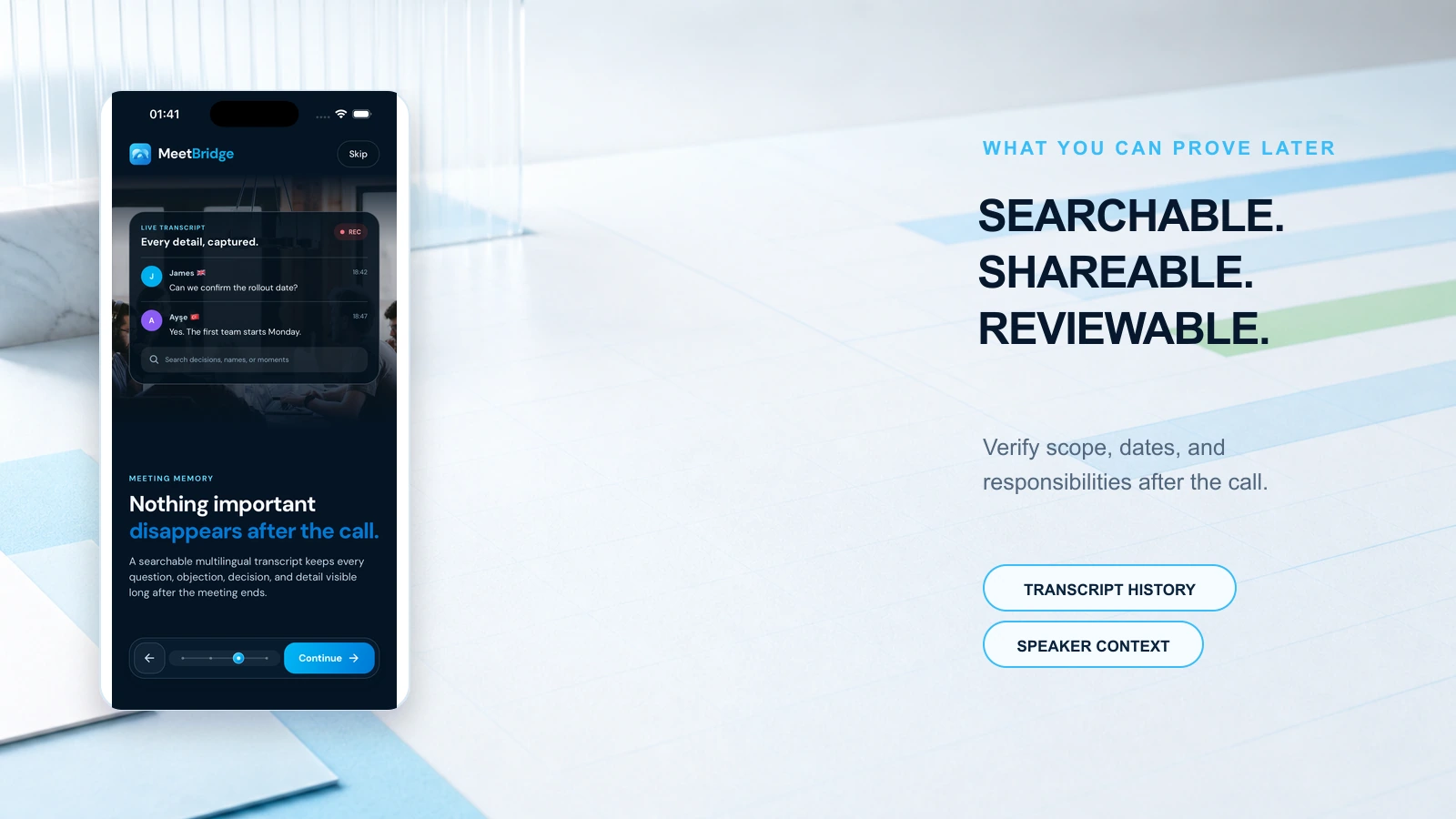
In B2B operations, “what we agreed to” becomes a deliverable. A transcript plus summary reduces rework and prevents silent misalignment.
2) Turning conversation into execution
The follow-up question isn’t “did we understand each other?” It’s “did we assign owners and close loops?”
Human interpreter:
- Strong for the live moment
- Follow-up still requires manual work: recap email, action items, task creation, stakeholder updates
Live meeting translation (AI-native):
- Can create meeting summaries, identify decisions, and extract action items
- Enables consistent post-meeting workflows across languages
Scenario: Regional sales handoff (EMEA AE → APAC implementation team)
- Interpreter helps the handoff meeting.
- But the real risk is what gets lost afterward: requirements, stakeholders, promised timelines.
- A translated transcript + structured summary + action list reduces onboarding time and prevents delivery surprises.
3) Multilingual knowledge sharing
When a meeting involves multiple regions, the follow-up audience is often larger than the attendee list.
Human interpreter:
- Produces understanding for attendees, not necessarily for the broader org
Live meeting translation:
- Creates artifacts that can be shared with teams who couldn’t attend
- Helps standardize internal comms: “Here’s the summary in your language, with owners and deadlines.”
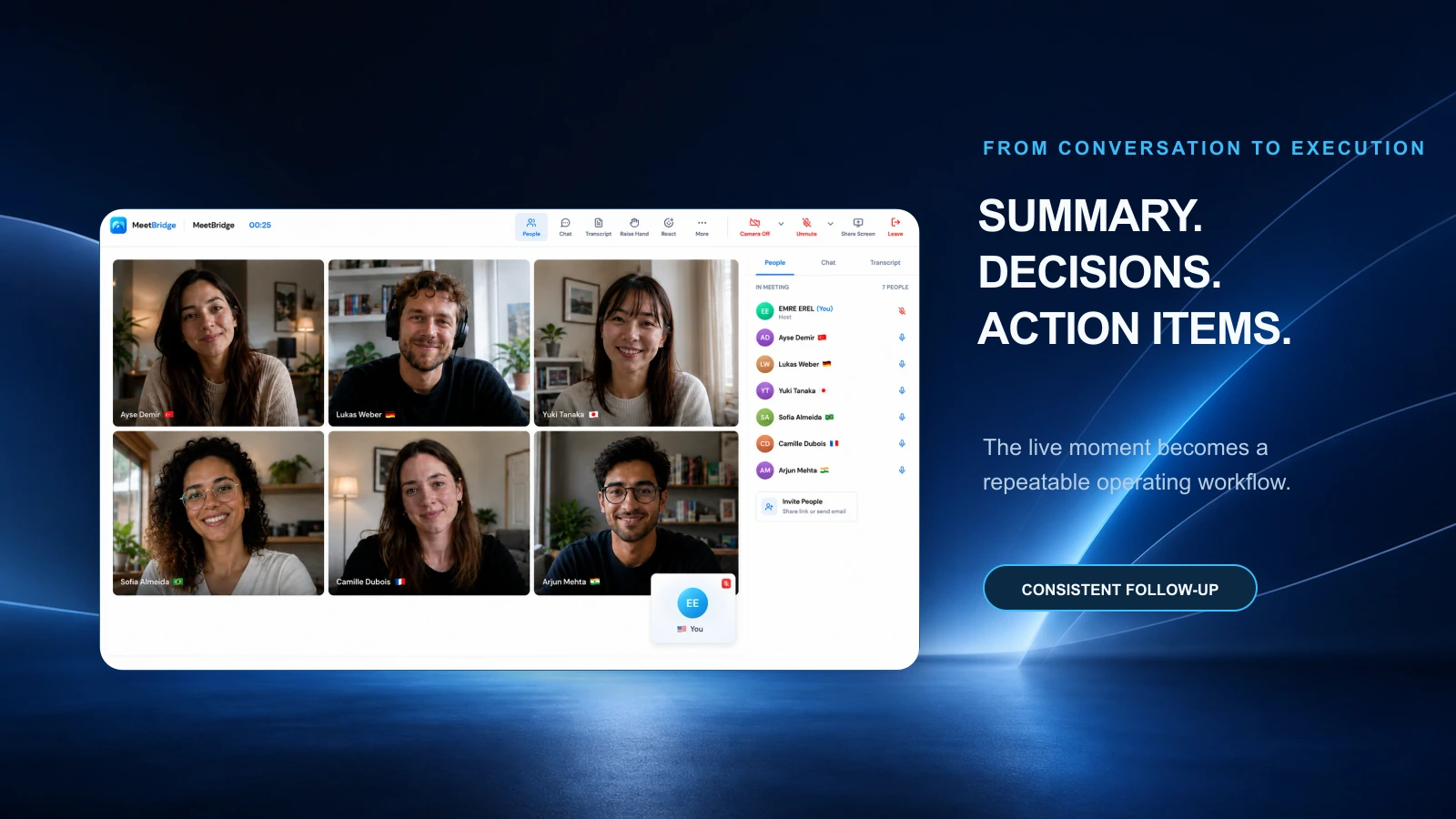
This is where platforms like MeetBridge are designed to help: not just translating speech, but converting meetings into durable, multilingual execution assets.
Trade-offs: Cost, Quality, Risk, and Scale
Here’s a practical way to compare options without getting stuck in abstract debates.
The 5-factor evaluation framework
Score each meeting type from 1–5 (low to high) on these factors:
1) Stakes of nuance (legal/HR/brand risk) 2) Frequency (how often this meeting happens) 3) Speed requirement (can you wait to schedule?) 4) Follow-up complexity (number of actions, teams, dependencies) 5) Need for auditability (do you need a record of decisions?)
Guidance:
- If (1) is high, favor human interpreters or a hybrid.
- If (2), (3), (4), and (5) are high, favor live meeting translation with strong documentation.
Typical cost dynamics (what buyers overlook)
Human interpreters:
- Direct cost per hour/session
- Indirect costs: scheduling time, procurement, rescheduling, longer meetings due to interpreted cadence
Live meeting translation:
- Subscription/platform cost
- Indirect benefits: reduced cycle time, fewer follow-up meetings, less rework, faster onboarding
The hidden cost in multilingual operations is rarely the interpreter fee—it’s the downstream cost of misalignment and repeated meetings.
Quality risks to plan for
With interpreters:
- Availability constraints
- Variability by interpreter (domain expertise differs)
- Dependency risk (key interpreter unavailable)
With live translation:
- Audio quality sensitivity
- Occasional mistranslation of idioms, acronyms, or names
- Overconfidence risk: people assume the translation is perfect and don’t verify key commitments
Mitigation for either approach: confirm critical details at the end (dates, quantities, owners) and send a structured recap.
Best Fit by Meeting Type (Concrete B2B Scenarios)
Use these examples to map your own use cases.
Customer success QBR (multinational customer)
- Goal: align on outcomes, risks, roadmap, renewal path
- Best fit: live meeting translation for scale + strong follow-up
- Why: QBRs generate many commitments; transcript + summary + action items are valuable across regions
Contract negotiation (complex terms)
- Goal: negotiate price, liability, SLAs, termination clauses
- Best fit: human interpreter or hybrid
- Why: nuance and legal language matter; you still benefit from a structured written recap afterward
Internal program rollout (policy/process change)
- Goal: ensure consistent understanding across countries
- Best fit: live meeting translation
- Why: you need repeatable sessions, consistent artifacts, and multilingual summaries for those who missed it
Incident response / production outage bridge
- Goal: restore service quickly, coordinate teams
- Best fit: live meeting translation
- Why: speed and availability matter; a transcript supports post-incident review and accountability
HR employee relations meeting
- Goal: handle sensitive issues fairly and accurately
- Best fit: human interpreter
- Why: emotional nuance, confidentiality, and careful phrasing are critical
Practical Workflow: A Buyer’s Checklist for Multilingual Meetings
Use this checklist to evaluate any live meeting translation tool or interpreter workflow, and to standardize how your team runs multilingual business calls.
Pre-meeting (reduce translation errors and follow-up gaps)
- Define the meeting type: negotiation, escalation, handoff, planning, training
- Identify the “must-not-miss” items:
- numbers (price, quantities)
- dates (go-live, delivery)
- responsibilities (owner, approver)
- constraints (legal/compliance)
- Share a short glossary in the invite or agenda:
- product names
- acronyms
- key stakeholder names
- Decide documentation rules:
- Will you record?
- Who gets access to transcript/summary?
- Retention period?
During the meeting (make understanding explicit)
- Use one speaker at a time; avoid crosstalk
- Ask speakers to restate critical commitments in plain language
- Confirm key decisions live:
- “Let’s confirm: we agreed to X by Y date, owned by Z.”
- Flag uncertain translations:
- “Pause—can we rephrase that?”
- “Can you repeat the number/date?”
Post-meeting (turn talk into execution)
- Produce a structured recap with:
- Decisions
- Action items (owner + due date)
- Risks/unknowns
- Next meeting date
- Share the recap in stakeholders’ preferred languages
- Create tasks in your system of record (Jira/Asana/CRM) and link back to the meeting artifact
- Schedule the next step immediately (booking link or calendar flow)
This is the operational gap many teams feel: even if the live conversation was “good enough,” execution fails without a repeatable follow-up system.
How MeetBridge Fits (Live Translation + Follow-Through in One Flow)
If your evaluation criteria include both real-time communication and post-call execution, an AI-native platform can reduce the operational burden.
MeetBridge is built for multilingual teams that need more than generic note-taking. In practice, that means:
- Live translation to keep multilingual meetings moving without waiting for interpreter scheduling
- Transcripts that give you a searchable record (useful for verifying dates, requirements, and commitments)
- meeting summaries that turn long discussions into an executive-ready recap
- Decisions and action items extracted so follow-up is consistent—even when attendees speak different languages
- Booking flows to schedule the next step while momentum is high (instead of chasing calendars later)
- Follow-up actions so the meeting output becomes work, not just text
A common Operations Manager win is standardization: with MeetBridge, teams can run the same meeting playbook across regions—then share a consistent summary and action list globally. That reduces repeat meetings, shortens cycle times, and makes ownership clearer.
MeetBridge also supports the hybrid approach: use a human interpreter when nuance is paramount, and still rely on MeetBridge to generate transcripts, summaries, and action tracking so execution doesn’t degrade after the call.
FAQ
How accurate is live meeting translation compared to human interpreters?
Accuracy depends on audio quality, language pair, domain vocabulary, and speaking style. Human interpreters generally win on nuance, tone, and cultural mediation—especially in negotiations or sensitive topics. Live meeting translation can be highly effective for day-to-day operational calls, and its biggest advantage is often consistency in documentation (transcripts, summaries, actions) rather than perfect phrasing.
When should we choose a human interpreter for business calls?
Choose a human interpreter when the meeting is high-stakes and nuance-heavy: legal negotiations, HR issues, crisis communications, or situations requiring certified interpretation. Also consider an interpreter when you expect frequent interruptions for clarification or when cultural mediation is important to reaching agreement.
What should we look for in a multilingual meeting tool beyond real-time translation?
Look for follow-up depth: transcripts, multilingual summaries, decision capture, action items with owners/dates, easy sharing controls, and scheduling/booking support for next steps. Tools like MeetBridge are valuable when your goal is not only understanding in the moment, but reliable execution afterward.
Can we use live meeting translation for customer-facing calls without hurting trust?
Yes—if you set expectations and run a clean meeting. Use good audio, avoid crosstalk, confirm key commitments, and send a clear written recap afterward. Many customers care more about responsiveness and clarity than whether translation is human or AI, especially when follow-up is strong.
Final Recommendation: Match the Method to the Meeting Outcome
If your primary risk is misunderstanding nuance, human interpreters (or a hybrid) are often the right call. If your primary risk is execution failure after the call, prioritize live meeting translation paired with transcripts, summaries, and action tracking.
For Operations Managers supporting multilingual meetings at scale, the best solution is the one that improves both real-time alignment and downstream accountability. If you want to see what that looks like in practice, see MeetBridge in action and evaluate it against your highest-frequency meeting types first.
FAQ
How does MeetBridge help multilingual meetings?
MeetBridge combines live translation, transcripts, and meeting summaries so teams can understand each other in real time and still keep a structured meeting record.
Can teams use MeetBridge before and after the meeting as well?
Yes. Teams can collect context with booking links and custom questions before the call, then review transcript and action outputs after the call.
Is MeetBridge only for one department?
No. Sales, HR, customer success, consulting, and global operations teams can all use the same workflow for multilingual communication and follow-up.