
 By MeetBridge Team
MeetBridge vs Microsoft Teams Interpreter: Languages, Access and Cost
Compare MeetBridge and Teams Interpreter on licenses, external access, language support, transcripts, and cost. Choose the right meeting workflow.
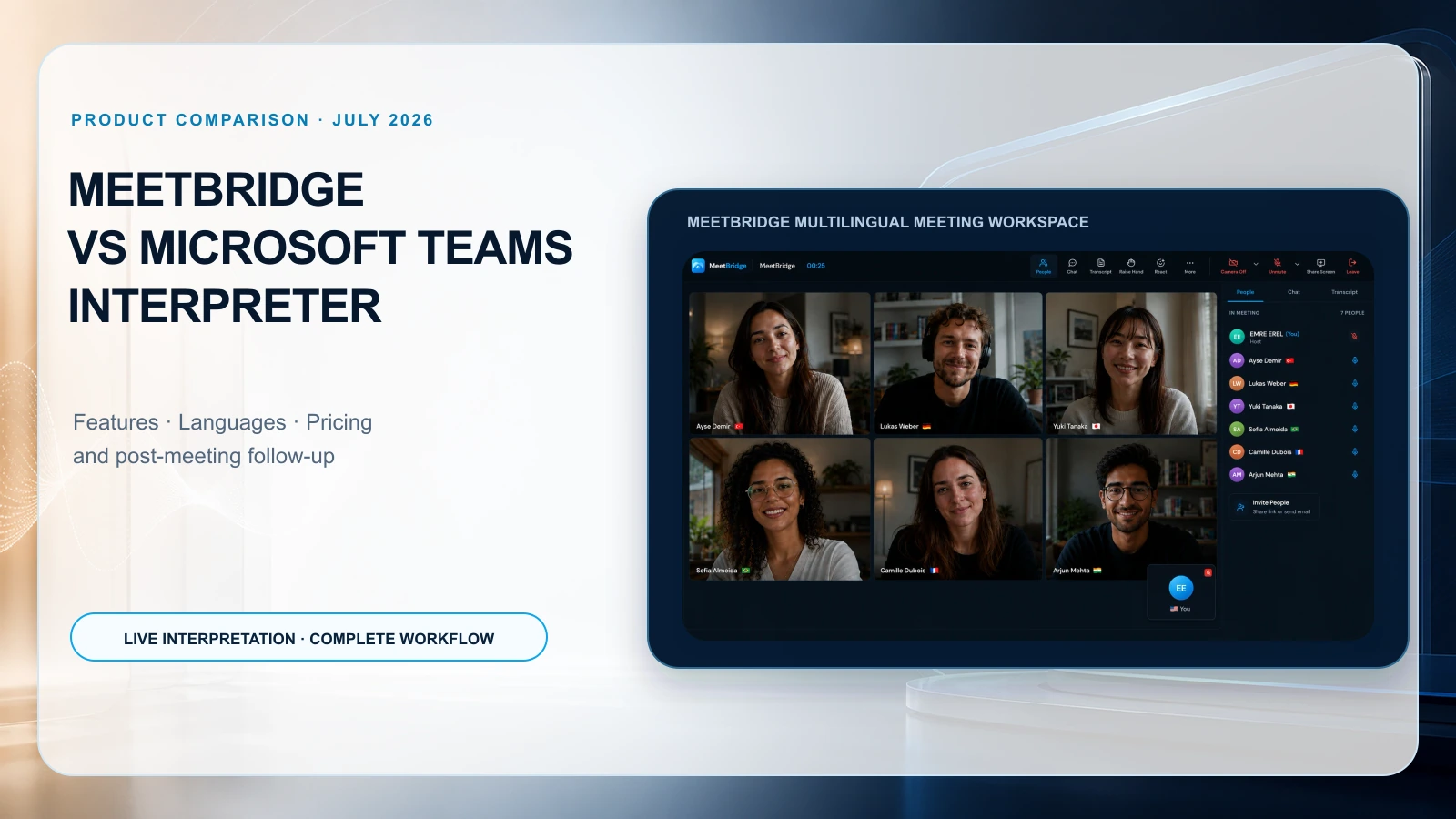
MeetBridge vs Microsoft Teams Interpreter: Languages, Access and Cost
Choose Microsoft Teams Interpreter when your meeting must stay in Teams and the people who need translated audio meet Microsoft’s requirements. Consider MeetBridge when participants can join a separate multilingual room and you want the conversation connected to transcripts, summaries, and follow-up.
MeetBridge does not translate an existing Teams call in place. A customer, candidate, or colleague joins the MeetBridge invitation for a MeetBridge session. That venue decision should come before comparing language lists or subscription prices.
This guide focuses on the questions that can block a real rollout: licenses, external access, language support, post-meeting records, and total cost. For a shorter workflow overview, see the MeetBridge and Teams comparison page.
Editorial disclosure: this is a MeetBridge-authored comparison, not an independent performance test. Microsoft documentation was reviewed on September 16, 2026. We do not claim that MeetBridge is faster, more accurate, or cheaper in every scenario. Product eligibility can differ by account, client, and rollout; verify your actual setup before purchasing.
Workflow comparison at a glance
| Decision | MeetBridge | Teams Interpreter |
|---|---|---|
| Where participants meet | A separate MeetBridge room | An existing supported Teams meeting |
| Primary live experience | Translated voice with transcript context | Teams-native interpreted speech |
| First access question | Can every participant join the selected MeetBridge workflow? | Does each person needing Interpreter satisfy Microsoft’s identity and license requirements? |
| Language decision | Check the actual speaking and listening options in the product | Check Interpreter’s output languages, not the broader Teams caption list |
| After the conversation | Connected transcript, meeting history, summaries, and actions | Evaluate transcription, Recap, and Copilot alongside Interpreter |
| Budget decision | Current MeetBridge plan and usage limits | Required Microsoft licenses and interpretation allowance |
| Strongest reason to choose | You can select a dedicated room for recurring multilingual work | Your organization is already standardized on Teams |
This table describes workflow fit. It does not imply that Microsoft lacks summaries or that every MeetBridge plan has the same limits.
Teams Interpreter licensing and usage: what to confirm
Microsoft’s administrator guide lists eligible Microsoft 365, Teams, and Copilot licenses as prerequisites. It includes 20 interpretation hours per user per month, with further access subject to capacity. A basic Teams subscription or a caption feature should not be treated as proof of Interpreter eligibility. Official licensing requirements
Before buying, ask your administrator to identify the exact users who need to listen through Interpreter. A host’s entitlement and an attendee’s entitlement are separate questions. Ask for confirmation using a real meeting invitation, not only a subscription name on a quote.
Use this procurement worksheet:
| Item | Record for your pilot |
|---|---|
| Meeting organizer | Account, organization, and relevant policies |
| Listeners needing translated audio | Each person’s account type and eligible license |
| Expected usage | Translated listening time per user each month |
| Existing subscriptions | Which required licenses you already pay for |
| Missing subscriptions | Additional licenses or services the workflow requires |
| Beyond included usage | Commercial terms and availability confirmed with the vendor |
| Required record | Transcript, recap, summary, and sharing requirements |
Can external guests use Teams Interpreter?
Microsoft’s end-user guide distinguishes verified external Microsoft 365 users with valid Copilot licenses from anonymous participants and guests, who cannot use Interpreter. This restriction concerns using Interpreter; it is not a statement that those people cannot join a Teams meeting. Microsoft’s external-participant guidance
This matters for a recruiter interviewing a candidate or a salesperson meeting a new customer. Do not assume the visitor has the same account access as an employee. Send a test invitation using the identity they will actually use on the day.
If your participants can change the meeting venue, evaluate the MeetBridge HR or sales workflow. Verify its joining instructions, device requirements, and plan limits too. Changing products does not remove the need to test access.
Supported languages: check the exact translation direction
Microsoft’s administrator page lists nine languages: Mandarin Chinese, English, French, German, Italian, Japanese, Korean, Portuguese, and Spanish. Its end-user page additionally lists Taiwanese. These official lists differ as of this review; confirm the output options visible in your tenant rather than promising a universal count. Administrator language list · End-user language list
For MeetBridge, use the languages available in the actual meeting setup and test both directions. Eleven translated website versions do not mean eleven supported speech languages. A successful source-language transcription also does not, by itself, confirm the voice-output capability you need.
Write your requirement as a concrete sentence: “Participant A speaks [language]; Participant B hears [language]; both can respond.” Repeat the test in reverse. Include names, numbers, a correction, and vocabulary from your actual business conversation.
Translated speech, captions, and recordings are different outputs
Microsoft states that Interpreter audio is not included in meeting recordings. Its documented live translated transcript does not persist in that translated form after the meeting; the original spoken-language transcript remains. Interpreter limitations
For a purchasing decision, inspect three separate artifacts: what a participant hears live, what they can read live, and what the team can access after the session. Ask someone who missed the meeting to review the retained record and identify a decision, its owner, and an unresolved question. That exercise often reveals more than a feature checklist.
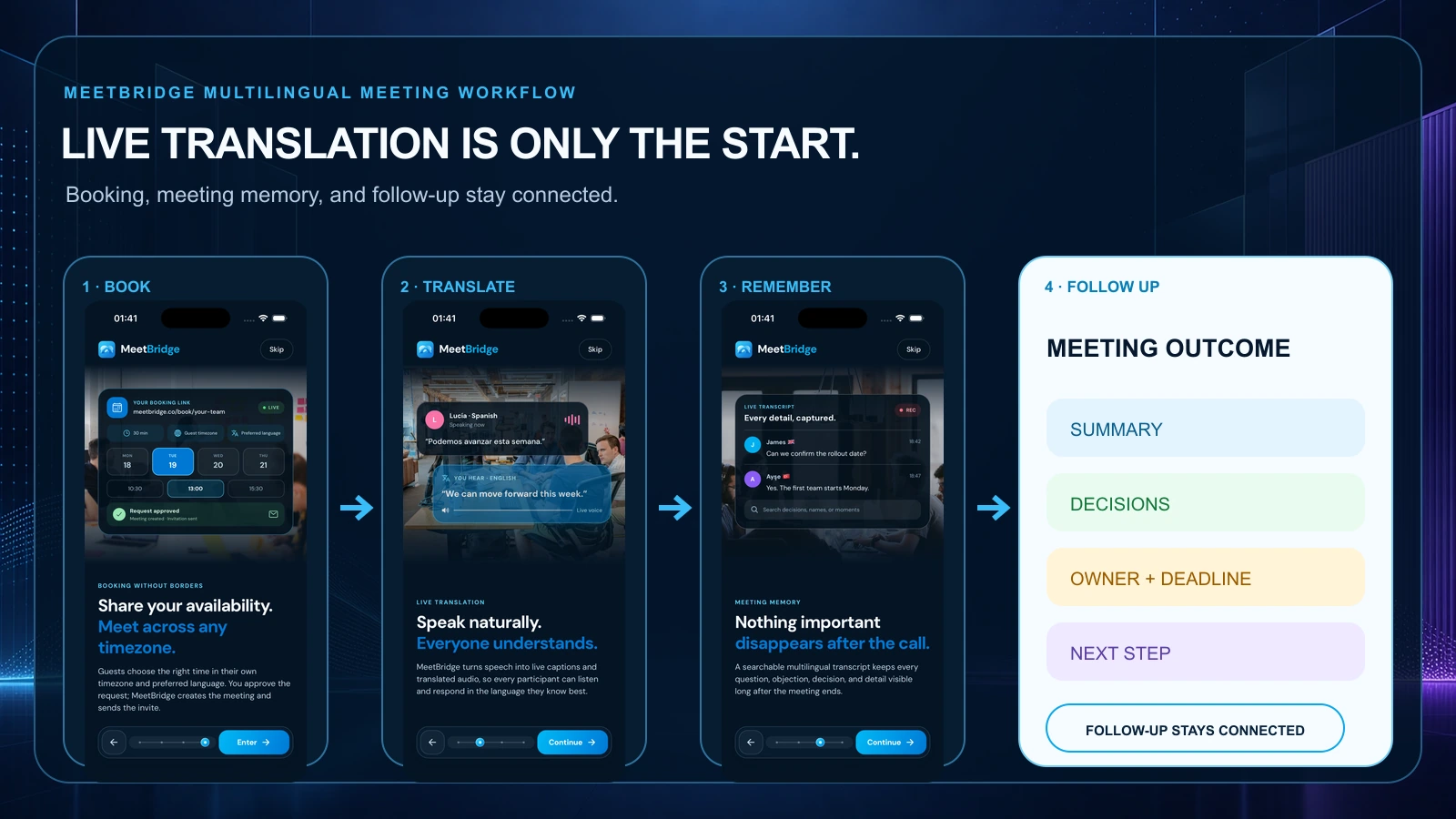
MeetBridge connects transcripts and meeting memory with meeting summaries and actions. Confirm the enabled settings, retention requirements, and permissions for your use case. Do not assume a recording capability or retention policy from the presence of a transcript.
Teams summaries and follow-up deserve a separate evaluation
Teams offers a wider post-meeting environment, including Recap and Copilot. Availability and generated content depend on the relevant features, licenses, and meeting settings. Interpreter should not be used as shorthand for everything the Microsoft suite can or cannot do. Microsoft meeting recap documentation
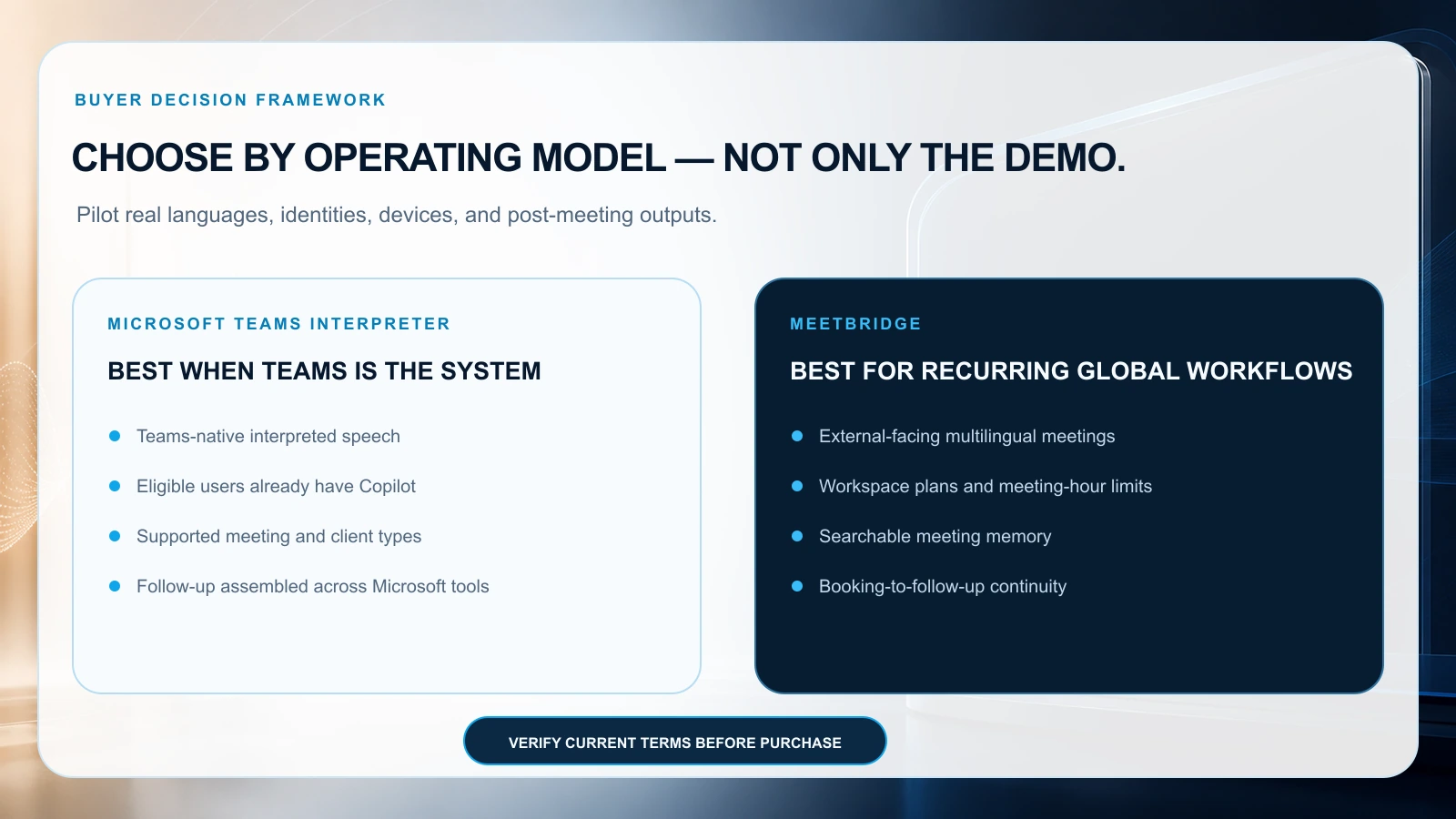
The useful comparison is the complete workflow your team will configure. For a Microsoft-based organization, existing permissions and daily habits may make Teams the more practical choice. For recurring external conversations with a flexible venue, a dedicated MeetBridge room may simplify the connection between the live call and its follow-up.
Review generated notes against the original context in either system. A tentative promise, a corrected price, or a question that remains open should not silently become a confirmed decision.
Pricing: compare the cost for your actual participants
There is no single price that answers this comparison for every organization. Microsoft subscriptions vary by customer type, geography, commitment, and existing entitlements. MeetBridge plans also have published limits that should be checked at purchase time. Use the official Microsoft pricing page and MeetBridge pricing for current terms.
For each option, calculate the additional required subscriptions, expected usage, any separate meeting-record features, and setup or review time. Count the people who need translated listening rather than multiplying the total company headcount. For an external meeting, document which costs you control and which requirements fall on the visitor.
For example, a team already equipped with eligible Microsoft licenses has a different starting cost from a team buying them solely for interpretation. Conversely, moving an established meeting process to a different room has an adoption cost. Neither comparison can be reduced to the cheapest headline amount.
Which workflow should you pilot first?
Internal meetings that must remain in Microsoft Teams
Begin with Teams Interpreter if the required languages and participant eligibility fit. Verify the actual meeting type and client. Microsoft’s support and administrator pages do not describe every call scenario identically, so avoid assuming a scheduled-meeting test proves compatibility with every call or room device.
Sales calls, candidate interviews, and supplier discussions
Begin with the external participant’s constraints. Can they install software, sign into a corporate account, and use the chosen language? If the venue is flexible, pilot MeetBridge with the same guest, device, and invitation process you will use in production.
For interviews, keep translation separate from assessment: people should evaluate job-related evidence and clarify ambiguous answers. The international interview translation guide includes a practical agenda and invitation template.
Specialist or sensitive conversations
If errors cannot be clarified reliably, involve a qualified human interpreter or specialist. Neither product comparison establishes that automated translation is appropriate for every legal, medical, employment, or contractual discussion.
A pilot checklist before committing
The following is an evaluation template, not a test result:
- Invite one internal and one external participant using their real joining method.
- Test the required language pair in both directions with names, dates, numbers, and domain terms.
- Ask a clarification question mid-conversation and check that the correction is understood.
- Note interruptions, missing speech, and the time each listener needs before responding.
- Review the transcript and summary for a decision, an owner, and an unresolved point.
- Confirm who can access the retained content and how your organization handles retention.
- Compare the actual licenses, usage limits, and staff effort required by each workflow.
Compare the complete participant journey
The first practical difference appears before anybody speaks. With Teams Interpreter, the organizer schedules a supported Teams meeting and the person who needs interpreted audio must satisfy Microsoft’s current account, license and client requirements. With MeetBridge, the organizer invites participants into a separate MeetBridge room. An internal employee, an external customer and a guest who joins anonymously may therefore have very different experiences even when they appear in the same Teams meeting.
Map every role, not just the buyer’s administrator. Ask the organizer to start the meeting, an internal colleague to listen in another language, and a real external test participant to join from the kind of device they would normally use. Record what each one can see and hear. If the external person cannot turn on Interpreter, the fact that the host can use it does not solve an external-facing use case. Conversely, if an organization requires every conversation to remain inside Teams, a separate MeetBridge room may be disallowed regardless of its meeting record.
| Participant question | Test in Teams Interpreter | Test in MeetBridge |
|---|---|---|
| Who creates the meeting? | An organizer in a supported Teams environment | A MeetBridge organizer |
| Who needs to listen to translation? | Check each listener’s Microsoft identity and eligible license | Invite each required listener into the MeetBridge room |
| How does an outsider join? | Rehearse with an account from another organization and with the intended guest type | Rehearse the actual invitation and language selection |
| What device will they use? | Check the client and meeting type against current Microsoft guidance | Check current MeetBridge app and browser support |
| What remains afterward? | Inspect Teams recording, transcript and any separately enabled recap | Inspect the MeetBridge transcript, summary and access controls |
Complete this table with your own observed result rather than a generic yes/no. The answer can change with tenant policy, account entitlement, client version and future product releases. Keep a screenshot or written configuration note with the evaluation so another administrator can reproduce it.
A closer look at the live meeting experience
Teams Interpreter has a valuable native advantage: people who already work in an eligible Teams environment can use interpreted speech in the collaboration tool they know. A buyer should test the listening-language selector, original versus translated audio balance and turn-taking cues in the actual tenant. The listener’s experience matters more than a feature toggle on the organizer’s screen. Use both short and long answers; ask listeners when they believe a speaker has finished.
MeetBridge puts multilingual conversation inside its own room and connects it to a meeting record. A team that controls its meeting venue can evaluate the full route from booking to a translated conversation, transcript and follow-up. The trade-off is a venue change for participants who expected a Teams link. Send an invitation to a person outside the product team and see whether the join instructions make sense without explanation.
Neither product should be declared faster or more accurate from its architecture. Use identical speech samples, microphones, accents and language directions. Include an interrupted answer, a corrected amount and a proper noun. Have a bilingual reviewer mark any change to meaning and a facilitator record how many times the group has to repeat or pause. An attractive voice is not a substitute for a correct date, price or commitment.
What to test when a sentence changes direction
Try: “The delivery date is the fifteenth—actually, the nineteenth, pending quality approval.” Ask the listener what date they understood at each moment and what the final record contains. Repeat with a negative statement (“we cannot approve it yet”) and with a number and currency. This reveals whether the interpretation arrives too early, remains stable enough to follow, and permits participants to correct the record. A successful test is not necessarily instant output; it is shared understanding before the meeting acts on the statement.
Do not merge four Microsoft features into one claim
Teams Interpreter handles live speech interpretation. Translated captions, transcription, Copilot or Intelligent Recap, and collaborative notes or tasks are separate parts of the Microsoft meeting environment. Their availability can depend on different licenses, settings, meeting types and retention rules. A buyer who sees a translated sentence during a meeting should not assume the same text will be saved in the post-meeting transcript.
Ask the Microsoft administrator to show the exact workflow, step by step: enable the relevant policy, join as each participant, activate Interpreter, record or transcribe if permitted, end the meeting, and open the resulting record. Check whether the recording contains original or interpreted audio and which language the stored transcript uses. If the organization needs a translated recap or task handoff, demonstrate that separately with the intended Copilot or Teams feature. Document which person can view each artifact, including someone outside the organizer’s organization.
MeetBridge’s proposition is a connected meeting workflow: booking context, live translation, transcript, summary and next steps in one environment. That still requires a buyer to inspect the actual outputs and permissions. Ask whether a person who missed the meeting can trace an action item back to the relevant passage. Confirm who can edit or export a summary and how the team corrects a mistaken name, deadline or owner before sending follow-up.
| Artifact | Buyer’s question | Why it matters |
|---|---|---|
| Original audio | Is it recorded, and who can play it? | It can clarify what was said when translation is disputed |
| Interpreted audio | Is it only live or preserved? | A listener may expect to replay what they heard |
| Captions | Are they live only, or retained afterward? | Visible text is not always a durable record |
| Transcript | Which language is stored, and can corrections be made? | Reviewers need to distinguish source speech from generated text |
| Summary | What source passages support each decision? | Fluent prose can hide a wrong quantity or commitment |
| Actions | Who approves owners and deadlines? | Automatic follow-up should not create an unreviewed obligation |
This distinction is especially important in hiring, procurement and customer escalations, where the post-meeting record can influence consequential decisions. For those contexts, set a human review rule before running the pilot.
Three scenarios with different likely starting points
An internal Teams meeting across two languages
The meeting is already scheduled in Teams. All people who need interpreted speech belong to the same organization and have eligible accounts. Teams Interpreter is a sensible first pilot because it preserves the meeting location. Verify the exact language directions, listener eligibility and how the organization will retain or summarize the discussion. If the meeting needs ongoing tasks, evaluate the relevant Microsoft note and recap tools as separate components.
A sales discovery call with a new external buyer
The seller has a Microsoft license, but the buyer’s identity and subscriptions are unknown. Test the buyer’s ability to hear interpreted speech before assuming the feature works for both sides. If the organizer may choose a new room, MeetBridge can be piloted as a dedicated multilingual meeting with transcript and follow-up in the same environment. Send the buyer a trial invitation, test their device and ask them to repeat the joining steps. If the customer mandates Teams, assess what Microsoft actually permits for that external account or select another compatible approach.
An interview with a candidate and review panel
The candidate’s access, choice and understanding matter more than the panel’s convenience. Explain translation and transcription before the interview, test the candidate’s preferred mode and provide a way to pause or correct a mistranslation. If the organization uses Teams, confirm that the candidate can receive the required output, not merely join the call. If using MeetBridge, confirm room access and how the panel will review the record. The panel should evaluate job-related evidence, not a generated score. The multilingual job interview guide includes a sample agenda and invitation.
How to calculate a useful total cost
List the people who need translation, not only meeting organizers. For Microsoft, determine which eligible licenses are already owned and which would be added; verify current included usage, overage rules and any separate recap, transcript-translation or task features. For MeetBridge, request the current plan and any usage or participant limits for the intended meeting volume. Do not rely on a price copied from an older comparison article: plan terms, eligibility and promotions can change.
Use three representative month types: a normal month, a busy month and a month with many external participants. Estimate live translation hours, number of listeners, simultaneous meetings and time spent configuring, reviewing and distributing outputs. Add any cost for a human interpreter or specialist reviewer when the conversation requires one. A platform may look cheaper per organizer but fail because the intended listeners cannot use the feature. Another may cost more per meeting yet reduce manual handoff. The correct calculation is tied to the actual workflow.
A two-week decision pilot
In the first week, define the use case and test access. Identify the meeting types, exact language pairs and all participant roles. Have an administrator confirm current Microsoft requirements in your tenant. Run the same fictional conversation in both candidate workflows where both are feasible, using the same devices, script and reviewers. Record setup time, comprehension, material translation errors and what people can access after the call.
In the second week, test the full operating process. Send a real-looking invitation to an external test participant who has agreed to help. Ask an absent colleague to use the saved record to prepare follow-up. Check permissions and retention settings with the owners of security and privacy. Price the expected monthly usage. At the end, make a decision by meeting type: internal Teams conversations may use one route, external customer meetings another. There is no requirement to declare one vendor the universal winner.
Publish the pilot result with the date, licenses, client versions, language pairs, participant roles and known limits. Without that context, “works with Teams” or “supports translation” is too broad to guide the next team. Recheck the decisive eligibility and language questions before renewal or a larger rollout, because vendor documentation and product availability can change.
Frequently asked questions
Is MeetBridge a Microsoft Teams Interpreter add-on?
No. It provides a separate meeting room. Your participants join MeetBridge for that translated session.
Does a Teams Premium or captions entitlement prove access to Interpreter?
No. Confirm Interpreter-specific eligibility against Microsoft’s current requirements. Captions, transcription, and translated speech are separate features with their own conditions.
Why might Interpreter be unavailable for a participant?
Check their account identity, assigned licenses, administrator settings, meeting type, client, and selected language. Ask your administrator to compare the actual setup with the official documentation rather than assuming the organizer’s access covers everyone.
Is MeetBridge more accurate or faster than Teams Interpreter?
We have not published a controlled comparison establishing that. Use a bilingual review of representative conversations and measure consistently if accuracy or latency is a deciding requirement.
How do I compare Teams, DeepL Voice, Zoom, and other options?
Use the broader meeting translation software buyer’s guide. It separates native features, companion translation tools, and dedicated meeting rooms.
Plan your multilingual meeting
Explore MeetBridge live translation, security information, and current plans. If you need help assessing participant access and workflow fit, contact MeetBridge with your required language pair and meeting format.