 By MeetBridge Team
Live Translation vs Translated Captions: What Is the Difference?
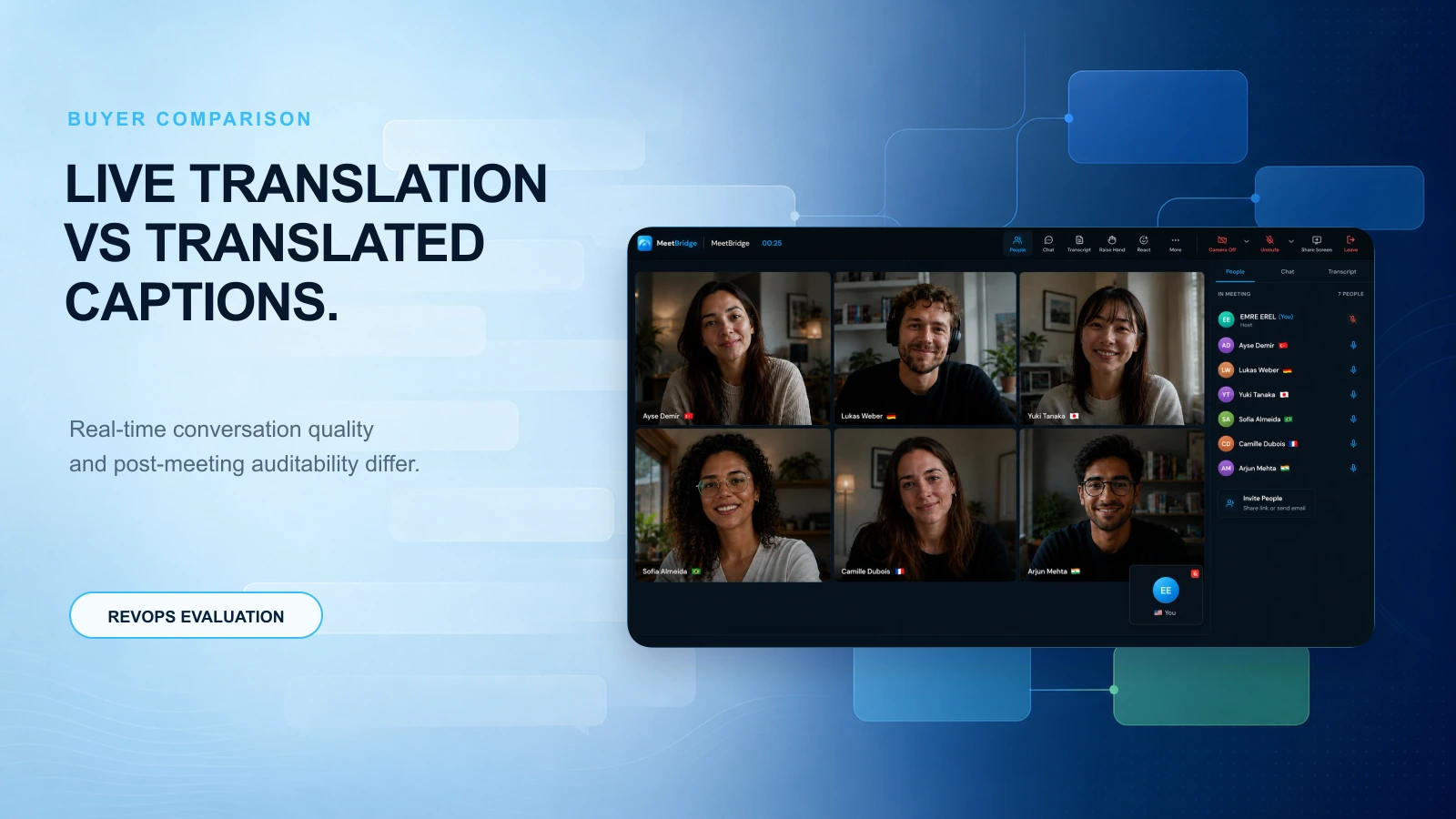
Live translation and translated captions solve different problems in multilingual meetings: one helps people collaborate in real time, the other helps people follow along and review later. Here’s a practical framework, real B2B scenarios, and a checklist to choose the right approach for customer-facing calls and intern
Live Translation vs Translated Captions: What Is the Difference?
Revenue Operations Managers often get pulled into “translation tool” decisions for a simple reason: multilingual meetings directly impact pipeline velocity, forecast reliability, and handoffs between Sales, CS, and Product. When a deal call includes English, Spanish, Japanese, and German speakers, the wrong setup creates predictable pain:
- Prospects miss key details and ask for repeats, stretching call time and lowering confidence
- Sales notes don’t match what was actually agreed, creating downstream churn risk
- Follow-ups are delayed because someone has to interpret, summarize, and translate after the fact
- Stakeholders who weren’t on the call can’t reliably review what happened
Two common options show up in evaluations: live meeting translation and translated captions. They sound similar, but they optimize for different outcomes: real-time communication quality vs post-meeting comprehension and auditability.
This guide gives you a buyer-friendly framework to compare translated captions vs live translation in practical B2B scenarios (customer-facing and internal), plus a checklist you can use immediately.
Who each fits best (quick decision lens)
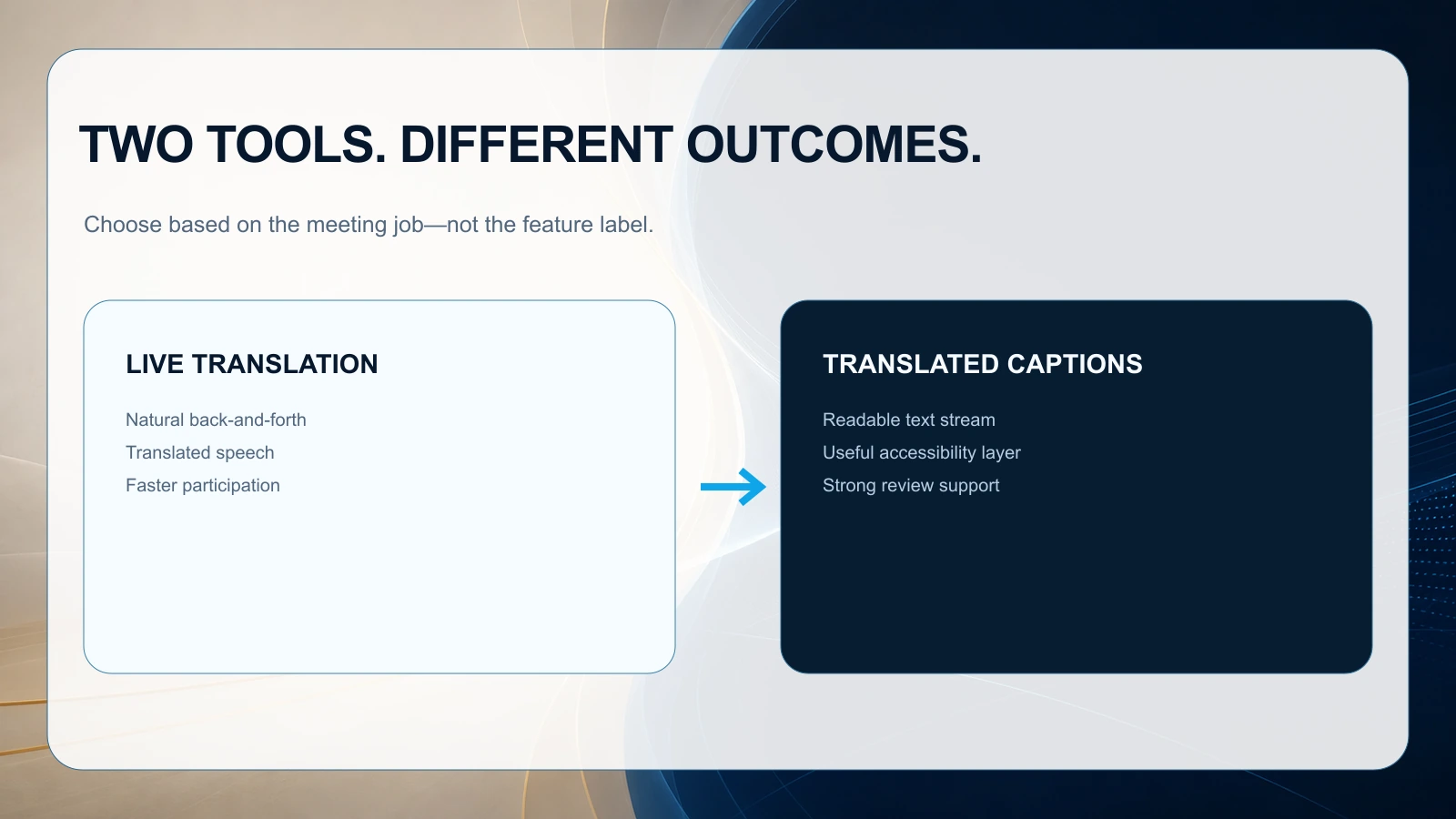
Translated captions and live translation both convert language, but they differ in timing, interaction, and how deeply they support follow-up.
Translated captions are best when…
- The meeting is mostly one-directional (webinars, demos with limited Q&A)
- Participants can tolerate some lag and occasional ambiguity
- The main goal is “help me follow along,” not “help me negotiate and decide”
- You already have a separate process for capturing decisions, owners, and next steps
Typical use cases
- Product webinars for international audiences
- Internal all-hands where comprehension matters more than dialogue
- Training sessions where the recording is the primary artifact
Live translation is best when…
- The meeting is interactive and high-stakes (discovery, negotiation, onboarding)
- You need fast back-and-forth without repeated clarifications
- You care about accurate commitments: timelines, pricing, requirements, risks
- You need multilingual parity: each participant can speak naturally, not “simplified English”
Typical use cases
- Enterprise discovery calls across regions
- Implementation kickoff with global stakeholders
- Escalations and renewal negotiations
The simplest rule of thumb
If the meeting’s success depends on dialogue and decisions, prioritize live translation. If the meeting’s success depends on viewing and comprehension, translated captions may be enough.
Live meeting differences: what changes in the conversation
When teams compare translated captions vs live translation, they often focus on “accuracy.” In practice, the bigger difference is how the conversation behaves.
1) Interaction speed and turn-taking
- Translated captions typically introduce a small delay. That delay compounds in fast conversations (interruptions, clarifications, objections).
- Live translation is designed to keep pace with dialogue so people can respond naturally.
B2B scenario: cross-border discovery call A US AE asks a nuanced question about data residency. The prospect’s security lead responds in German with caveats. With captions, the AE waits, then asks a follow-up that partially overlaps, causing confusion. With live translation, the AE can track the response in real time and probe the right constraints immediately.
2) Meaning preservation vs word-for-word conversion
- Captions often optimize for readability on screen. That can mean shortened phrases or simplified structure.
- Live translation is more focused on preserving intent so the other party can respond correctly.
Why RevOps should care: intent errors create CRM errors. If the call outcome is misinterpreted (“pilot in Q3” vs “decision in Q3”), your forecast and handoff quality suffer.
3) Speaker confidence and participation
In multilingual meetings, quieter stakeholders are often the ones with the most risk context (legal, security, finance). If they’re uncomfortable speaking a second language:
- Captions help them understand, but don’t always make them comfortable contributing.
- Live translation enables them to speak in their native language and still be understood.
B2B scenario: implementation kickoff A Japan-based IT lead has concerns about SSO configuration and internal approvals. If they stay silent, the project slips later. Live translation lowers the barrier to raise issues early.
4) Alignment in customer-facing moments
In sales and success calls, you need to hear and respond to:
- objections
- competitive comparisons
- “soft no” language
- urgency signals
Captions can be adequate for basic comprehension, but in high-stakes moments you want fewer “Wait, can you repeat that?” interruptions.
Record and follow-up differences: what you can do after the meeting
Most buying teams underestimate this part. The real cost of multilingual meetings often shows up after the call: handoffs, follow-ups, and internal alignment.
1) Transcript quality and auditability
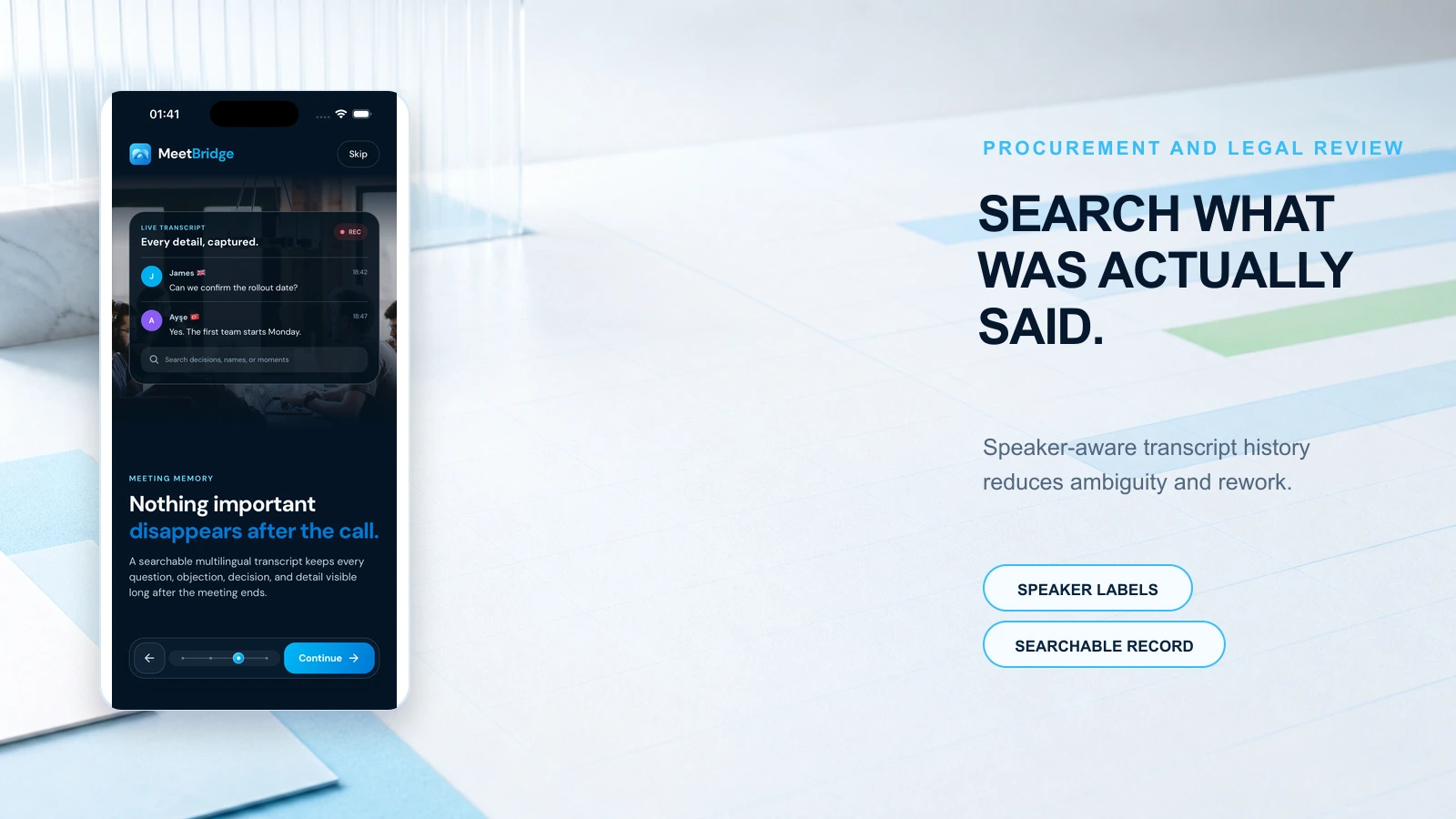
- Captions may not equal a full, structured transcript. Even when they do, you may lack speaker attribution or clean formatting.
- A meeting platform that pairs live translation with transcription gives you a durable record—critical for regulated industries, complex deals, or long implementation cycles.
B2B scenario: procurement and legal review After a multilingual negotiation, procurement asks, “Did the vendor commit to SOC 2 Type II by end of quarter?” A searchable transcript with clear speaker labels reduces back-and-forth and protects your team.
2) Summaries that reflect decisions, not just topics
A translated caption stream can help someone follow along, but it doesn’t automatically produce:
- decision logs
- risk lists
- action items by owner
- follow-up emails in the right language
For RevOps, this is where cycle time is won or lost.
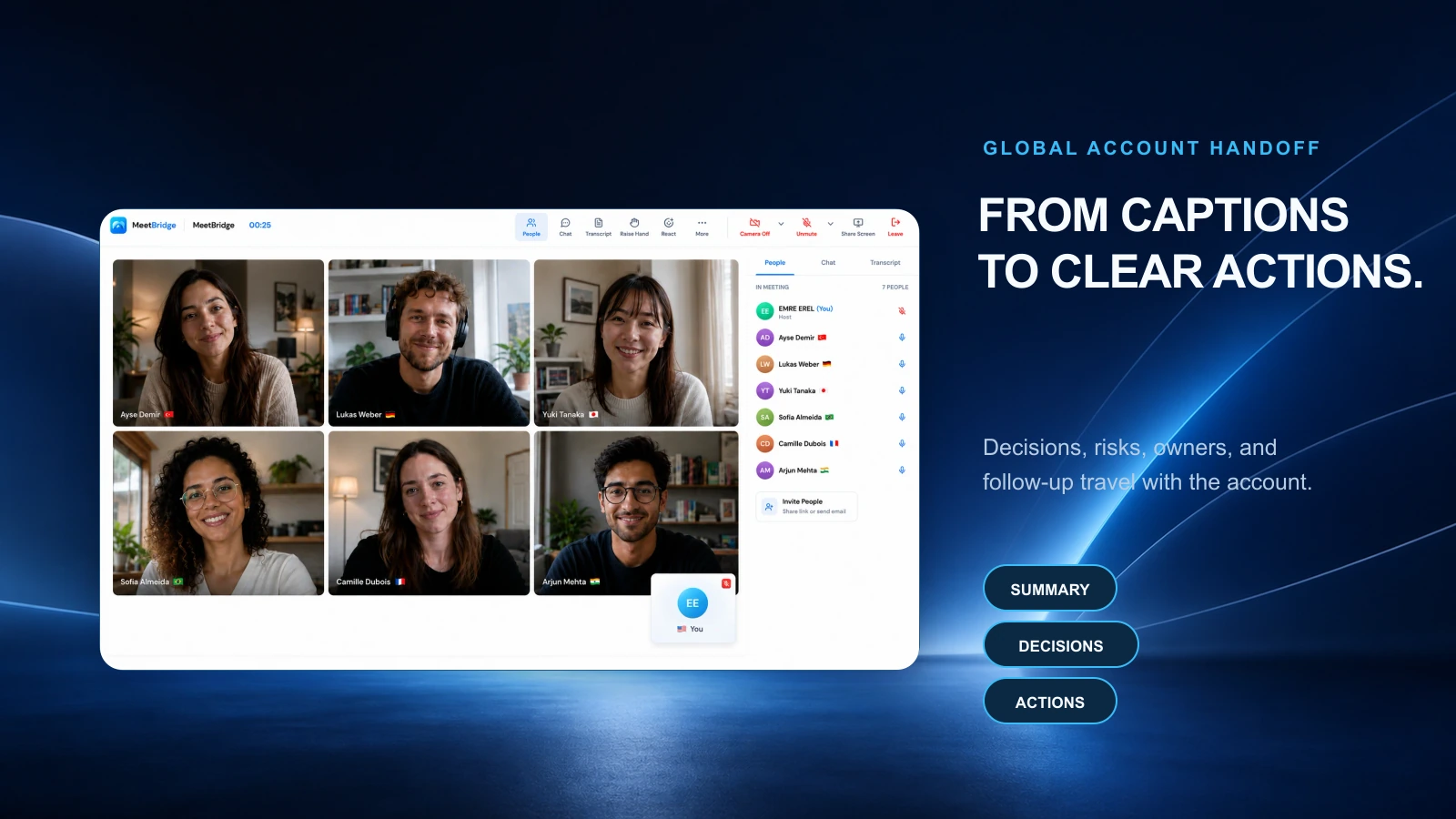
B2B scenario: global account handoff An EMEA AE closes a deal; an APAC CS team inherits onboarding. If the follow-up is a loosely translated recap, CS starts from scratch. If the system produces a structured summary (goals, scope, stakeholders, deadlines) and actions, onboarding starts immediately.
3) Multilingual follow-up depth
A strong follow-up often includes:
- recap in the customer’s language
- next steps with dates
- links to booking and resources
- confirmation of requirements
Captions don’t solve that workflow. You still need someone to translate and compose.
4) Knowledge sharing across regions
If your org sells globally, you want insights to travel:
- objections that appear in LATAM
- feature requests from DACH
- pricing sensitivities in APAC
A system that combines translation with transcripts and summaries makes this reusable without relying on bilingual “heroes.”
Trade-offs: what you gain and what you risk
Here’s a practical way to compare options without getting lost in feature lists.
Trade-off 1: Real-time collaboration vs passive comprehension
- Translated captions: great for passive comprehension; weaker for negotiation and rapid Q&A
- Live translation: better for collaboration; typically higher expectations for accuracy and latency
Trade-off 2: Meeting experience vs operational overhead
- Captions can be “good enough” in the moment, but often create manual work later (translation, summarization, action tracking).
- Live translation paired with transcripts and meeting summaries can reduce post-meeting overhead and speed follow-up.
Trade-off 3: Risk management
If you operate in environments where miscommunication is costly (security requirements, pricing, legal terms, medical or technical specs), captions may introduce unacceptable ambiguity.
Trade-off 4: Stakeholder inclusivity
Captions help non-native speakers understand, but may not empower them to speak. Live translation is often more inclusive for decision-making meetings.
What to ask vendors during evaluation
Use these questions to pressure-test real-world performance:
- Latency: How quickly does translation appear during rapid back-and-forth?
- Speaker attribution: Can we reliably see who said what in transcript and recap?
- Terminology: Can the system handle product names, acronyms, and industry terms?
- Follow-up outputs: Do we get action items, owners, and deadlines automatically?
- Multilingual artifacts: Can we generate summaries and follow-ups in multiple languages?
- Workflow integration: How does it fit into booking, CRM updates, and handoffs?
Best-fit framework (with concrete B2B scenarios)
If you’re choosing between translated captions vs live translation for business teams, evaluate based on meeting type and what “success” means.
Scenario A: Global webinar for lead generation
Goal: attendees understand the content.
- Best fit: translated captions (often sufficient)
- Nice-to-have: recording with captions for on-demand viewing
- Watch-outs: Q&A may still need live translation if you have interactive segments
Scenario B: Enterprise discovery call with multi-country stakeholders
Goal: uncover requirements, handle objections, and align on next steps.
- Best fit: live meeting translation
- Must-have follow-up: transcript + summary + action items
- Watch-outs: terminology (security, compliance, integrations) must translate accurately
Scenario C: Renewal negotiation with regional procurement
Goal: protect margin, confirm commitments, avoid misunderstandings.
- Best fit: live translation, plus a clean transcript for auditability
- Must-have follow-up: decision recap and next-step email in the customer’s language
Scenario D: Implementation kickoff across Sales, CS, and customer IT
Goal: align on scope, timeline, owners, risks.
- Best fit: live translation with strong post-meeting artifacts
- Must-have follow-up: structured plan, action items by owner, and scheduling links for working sessions
Scenario E: Internal all-hands or training
Goal: broad comprehension with minimal friction.
- Best fit: translated captions
- Optional: transcript for employees who couldn’t attend
Practical workflow: a buyer’s checklist for multilingual meeting success
Use this as a repeatable workflow to evaluate tools and standardize how your teams run multilingual meetings.
Step 1: Classify the meeting (2 minutes)
- Is it interactive (negotiation, discovery, workshop) or broadcast (webinar, training)?
- Is there financial or legal risk if something is misunderstood?
- Will there be multiple stakeholders who need to review later?
If interactive + high stakes + multiple stakeholders: default to live translation + transcript + summary.
Step 2: Define your “minimum viable artifacts” (before the call)
For customer-facing meetings, require:
- A transcript with speaker attribution
- A summary that includes decisions and open questions
- Action items with owners and due dates
- A follow-up message template (ideally generated) in the customer’s language
Step 3: Run the meeting with language parity
- Encourage each participant to speak in their strongest language
- Confirm key commitments aloud (dates, quantities, responsibilities)
- Reserve 3 minutes at the end for “decision + next steps” recap
Step 4: Produce follow-up within 30 minutes
Your operational standard should be:
- Send recap + next steps same day
- Include booking links for the next meeting(s)
- Attach or link to the transcript and summary for internal stakeholders
Step 5: Feed systems of record (RevOps hygiene)
- Update CRM fields based on the decision recap
- Log stakeholders and risks mentioned
- Attach summary to the opportunity/account for future handoffs
This workflow is where many teams feel the difference between “we had captions” and “we ran a multilingual process.”
How MeetBridge Fits (without adding complexity)
MeetBridge is designed for multilingual teams that need both live communication and follow-up depth in one flow. Instead of treating translation as a standalone overlay, MeetBridge connects the full meeting lifecycle:
- Live translation so participants can speak naturally across languages during the call
- Transcripts that create a reliable record for handoffs and audits
- meeting summaries that highlight decisions, risks, and key context (not just generic notes)
- Follow-up actions so next steps become trackable tasks, not lost bullet points
- Booking flows and links to schedule the next meeting immediately, reducing cycle time
For a Revenue Operations Manager, the value is operational: MeetBridge helps standardize multilingual meeting outcomes so pipeline isn’t dependent on bilingual individuals or manual translation work. It’s also practical for customer-facing teams: MeetBridge can support clearer discovery, faster alignment, and more consistent follow-up across regions.
If your current approach is “captions during the call, then someone writes an email and translates it later,” MeetBridge is a path to consolidate that into a repeatable process.
FAQ
What is the main difference between live translation and translated captions?
Live translation is optimized for real-time, two-way conversation so participants can respond quickly and accurately. Translated captions are optimized for on-screen readability and comprehension, often with more lag, and they typically don’t provide the same depth of post-meeting outputs (decision summaries, action items, multilingual follow-ups).
Are translated captions enough for sales calls and negotiations?
Sometimes for low-stakes calls, but for discovery, negotiation, renewals, or implementation planning, captions often fall short because the meeting depends on rapid back-and-forth and precise commitments. In those situations, live meeting translation plus a transcript and structured summary reduces misunderstandings and speeds follow-up.
How should RevOps evaluate multilingual meeting tools beyond accuracy?
Evaluate:
- latency in interactive dialogue
- terminology handling (product names, acronyms)
- transcript quality and speaker attribution
- ability to produce decision-focused summaries
- action tracking and follow-up generation
- how it fits booking flows and handoffs
MeetBridge is built around this broader workflow, not just the in-meeting translation layer.
Do we still need human translators?
For formal legal documents or high-risk communications, human review can still be necessary. But for day-to-day multilingual meetings, many teams use live translation plus transcripts and summaries to reduce reliance on manual interpretation and speed up execution.
Best next step
If your multilingual meetings are customer-facing and high-stakes, prioritize tools that improve both real-time clarity and post-meeting execution. Captions can help people follow along, but live translation paired with transcripts, meeting summaries, and actions is what turns a meeting into forward motion.
See MeetBridge in action to understand how live translation, transcription, summaries, booking links, and follow-up actions work together for multilingual teams.
FAQ
How does MeetBridge help multilingual meetings?
MeetBridge combines live translation, transcripts, and meeting summaries so teams can understand each other in real time and still keep a structured meeting record.
Can teams use MeetBridge before and after the meeting as well?
Yes. Teams can collect context with booking links and custom questions before the call, then review transcript and action outputs after the call.
Is MeetBridge only for one department?
No. Sales, HR, customer success, consulting, and global operations teams can all use the same workflow for multilingual communication and follow-up.