 By Sinan Yılmaz
How to Run Multilingual Meetings Without Slowing Them Down
Multilingual meetings often drag because teams treat translation as a separate task instead of a built-in layer of the meeting system. Learn a practical workflow to keep discussions fast, capture decisions accurately, and turn outcomes into follow-ups—without losing nuance across languages.
How to Run Multilingual Meetings Without Slowing Them Down
Running multilingual meetings is now normal for distributed teams—but many Team Leads still experience the same pattern: the meeting takes 2× longer, decisions get watered down, and action items fall through because no one is sure what was agreed in which language.
If you lead cross-functional calls across regions (Sales + Solutions, Product + Support, HR + Ops), the pain isn’t just “language.” It’s workflow friction:
- People pause to interpret, repeat, or “translate for the group.”
- Nuance gets lost, so stakeholders re-litigate decisions later.
- Notes are inconsistent, so follow-ups depend on whoever took them.
- Meetings become the bottleneck for execution.
The fix is not “hire more bilingual people” or “talk slower.” The fix is to treat translation as one layer of a stronger meeting system—where language support, documentation, decisions, and follow-up actions are handled in one flow.
Below is a practical guide to run multilingual meetings that stay fast, inclusive, and execution-ready.
Why multilingual meetings slow down (and what’s really happening)
Most multilingual meetings slow down for predictable reasons. Once you can name them, you can design around them.
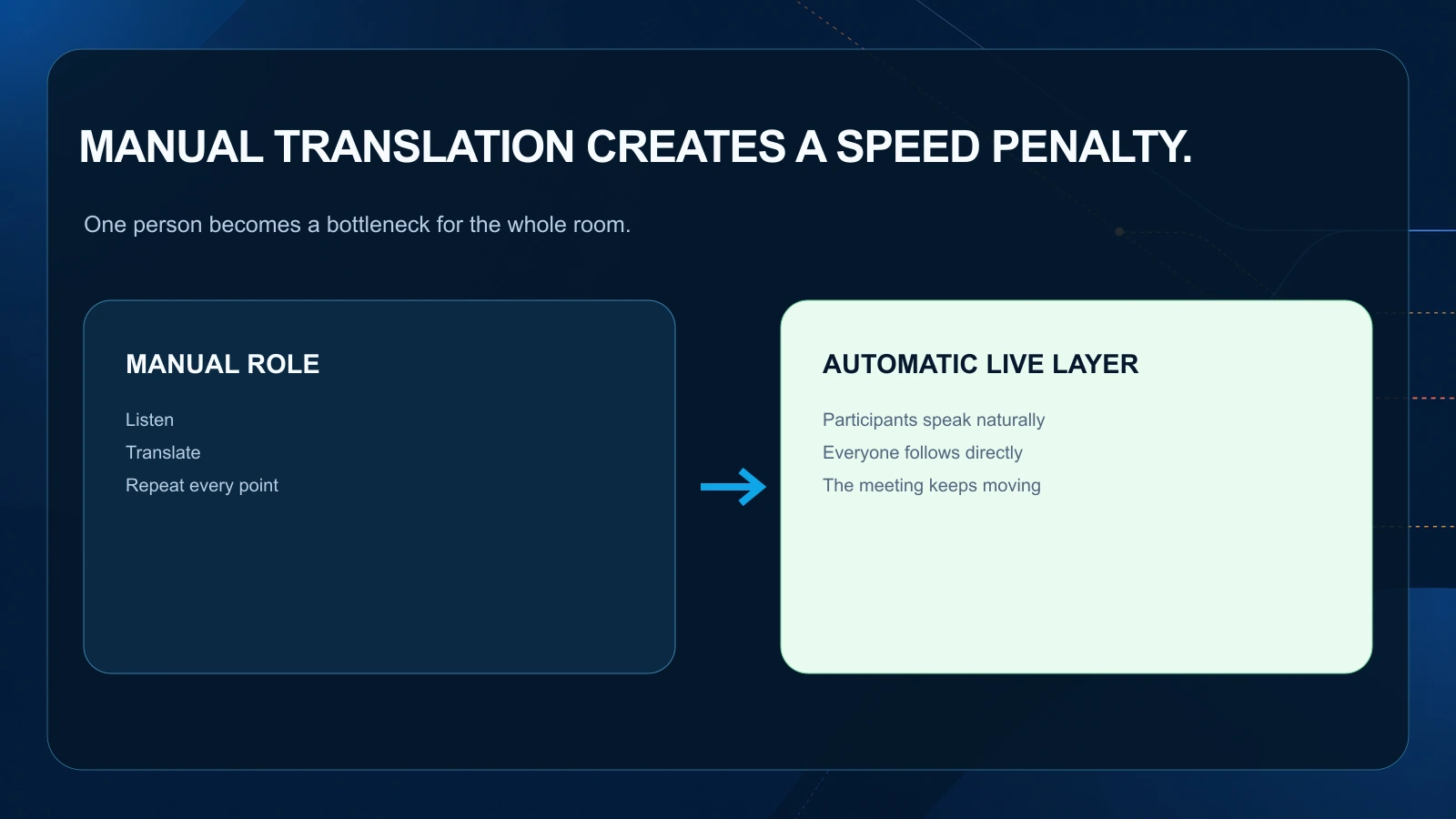
1) Translation becomes a manual meeting role
In many teams, one person informally becomes the interpreter. That creates:
- A single point of failure (if they miss something, everyone misses it)
- A power dynamic (they decide what gets translated)
- A speed penalty (every point becomes two points)
Scenario: A Team Lead in a global customer success org runs a QBR with the customer in Spanish and internal stakeholders in English. The CSM keeps switching languages, summarizing “what they said,” and the meeting runs 70 minutes instead of 45. Internal leaders leave without clear next steps, and the customer feels unheard.
2) People simplify their thinking to be understood
When participants know they’ll be translated, they often:
- Use shorter sentences
- Avoid nuance
- Skip details
This can be helpful for clarity, but it also reduces the quality of decisions.
Scenario: A product manager in Japan avoids explaining edge cases because it’s “too hard to translate,” so engineering in Germany ships an implementation that misses local requirements.
3) Decisions get re-decided because the record is weak
The biggest time sink is not the meeting itself—it’s the follow-up confusion.
- Different attendees write different notes
- Decisions aren’t captured in a shared format
- Action items aren’t assigned with owners and due dates
Scenario: A procurement call includes French, English, and Arabic speakers. Everyone leaves thinking the vendor is “approved,” but the legal team later says, “We never agreed to that.” The project slips two weeks.
4) Booking and pre-work are inconsistent across regions
Multilingual teams often have different norms around:
- Agenda depth
- Pre-reading
- Who speaks first
- How decisions are made
Without a consistent system, meetings become the place where alignment is negotiated in real time.
A better workflow: treat translation as a layer, not a detour
To run multilingual meetings without slowing down, shift from “translate the conversation” to “run a structured meeting where translation is automatic and outcomes are captured.”
A high-performing multilingual meeting workflow typically has five parts:
1) Pre-meeting alignment (agenda + decision points) 2) Live meeting clarity (real-time understanding across languages) 3) Structured decision capture (what was decided, by whom) 4) Action conversion (tasks, owners, due dates) 5) Follow-up distribution (shareable recap in each stakeholder’s language)
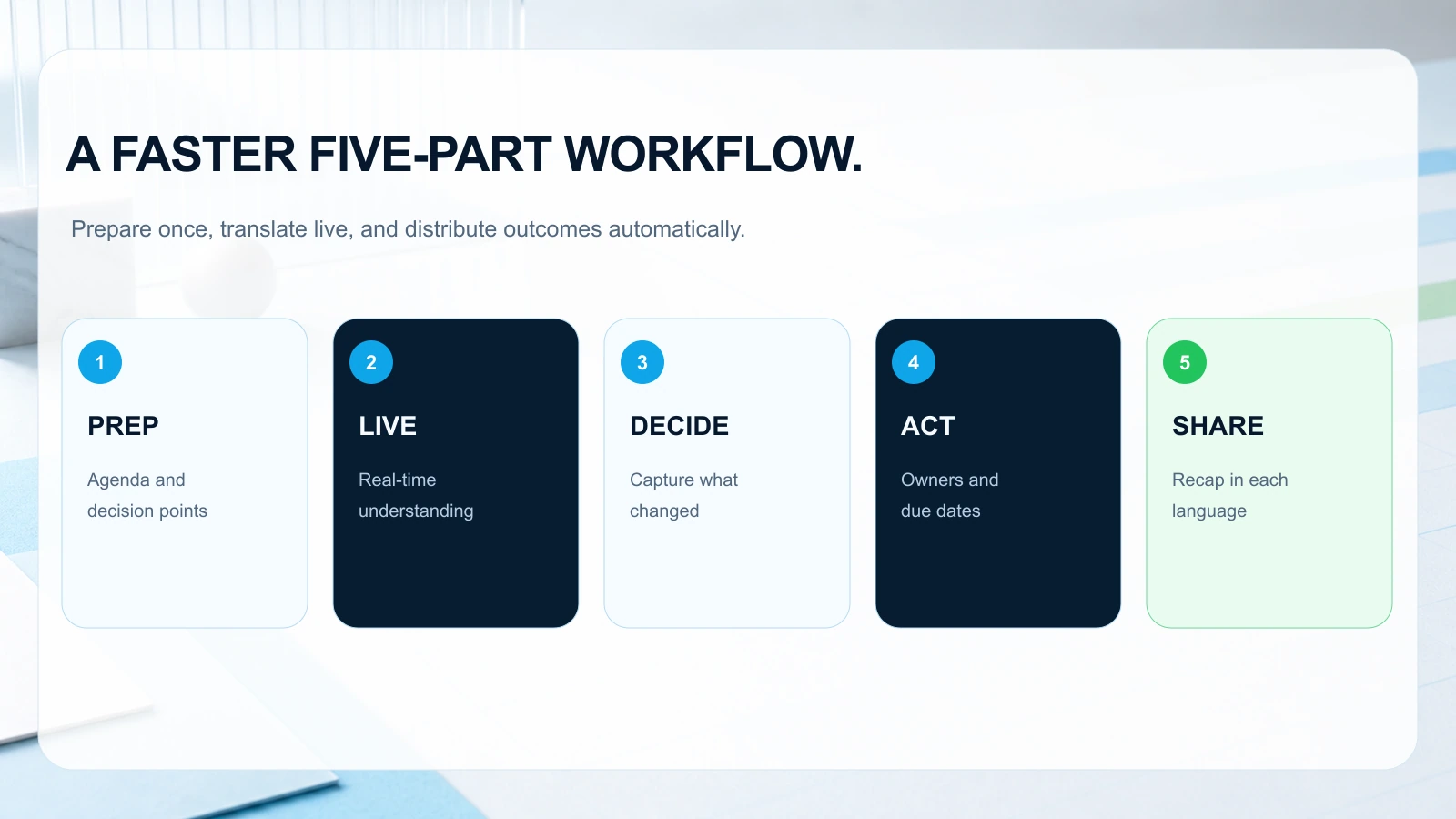
The goal is speed and accuracy: fewer repetitions, fewer clarifications, fewer “can you send notes?” messages afterward.
What changes in practice
Instead of slowing down to translate everything, you:
- Keep the conversation moving in the speaker’s natural language
- Use live translation so listeners keep up without interruptions
- Capture a transcript and summary so no one has to be the “memory”
- Turn decisions into assigned actions immediately
This is where meeting translation software becomes more than a translation tool—it becomes the operating system for multilingual meetings.
Prepare well: a multilingual meeting checklist you can reuse
Preparation is the easiest way to prevent “translation drag.” Use the checklist below as a repeatable template.
Multilingual meeting prep checklist (10–15 minutes)
1) Define the meeting’s output Choose one primary output:
- Decision (approve, reject, pick option A/B)
- Plan (timeline, responsibilities)
- Status alignment (risks, blockers)
- Customer outcome (next steps, commitments)
Write it as: “By the end of this meeting, we will…”
2) Write an agenda with decision points Avoid vague agendas like “Project update.” Instead:
- Context (2 minutes)
- Options (5 minutes)
- Decision criteria (3 minutes)
- Decision + owner (5 minutes)
- Actions + dates (5 minutes)
3) Pre-translate key terms (not the whole deck) Create a short glossary in the invite or doc:
- Product names
- Legal terms
- KPI definitions
- Acronyms
This prevents repeated clarifications mid-meeting.
4) Assign roles (lightweight, not bureaucratic) You need three roles—even if one person holds two:
- Facilitator: keeps pace, calls decisions
- Decision owner: has authority to decide or escalate
- Action owner(s): accountable for follow-up
5) Set meeting norms for multilingual participation Include 2–3 norms in the invite:
- Speak in your strongest language
- Keep points to 30–60 seconds before pausing
- Confirm decisions verbally (“So we decided X. Owner is Y. Due date is Z.”)
6) Ensure your tooling supports real-time understanding and capture If you rely on ad-hoc interpretation or fragmented notes, speed will suffer. A multilingual meeting platform should support:
- Live meeting translation
- A reliable transcript
- meeting summaries with decisions and action items
- Easy sharing for stakeholders in different languages
Capture outcomes in the meeting (without adding time)
The fastest meetings are the ones that don’t need a second meeting to clarify what happened.
Use “decision moments” to prevent rework
A decision moment is a 15–30 second pause where the facilitator states:
- The decision
- The rationale (one sentence)
- The owner
- The deadline or next checkpoint
Example (internal):
- Decision: “We will launch the new onboarding flow in Brazil on June 15.”
- Rationale: “Support capacity is confirmed and localization is complete.”
- Owner: “Ana (Regional Ops).”
- Next checkpoint: “Go/no-go review on June 10.”
Example (customer-facing):
- Decision: “We’ll run a 2-week pilot with 30 users starting next Monday.”
- Rationale: “This validates adoption before full rollout.”
- Owner: “Customer: IT lead; Us: Implementation manager.”
- Next step: “Send pilot plan by EOD Wednesday.”
Stop translating everything; translate understanding
In a well-run multilingual meeting, you don’t need someone to repeat each sentence in another language. Instead:
- Let speakers talk naturally
- Let listeners consume translated audio/text in real time
- Only slow down for decision moments and critical clarifications
This is the key difference between “multilingual meetings” that feel exhausting and multilingual meetings that feel normal.
Convert discussion into actions while the context is fresh
If action items are captured later, they become vague (“follow up,” “check with team”). Capture them live:
- Action verb + deliverable
- Single owner
- Due date
- Dependency (if any)
Good: “Send revised pricing proposal (v3) to Legal by Thursday 3pm CET.”
Weak: “Update proposal soon.”
Scale the process: make multilingual meetings repeatable across teams
Once you’ve improved one meeting, the next challenge is consistency across regions and functions.
Standardize meeting types (templates beat heroics)
Create 2–4 templates your org reuses:
- Weekly cross-region sync
- Customer QBR
- Incident postmortem
- Product launch readiness
Each template should include:
- Default agenda
- Required outputs (decisions/actions)
- Standard glossary fields
- Follow-up format
Reduce “meeting debt” with automatic artifacts
Meeting debt is the hidden cost of multilingual collaboration:
- Re-explaining decisions to people who weren’t there
- Recreating notes in another language
- Chasing owners for updates
The scalable fix is automatic artifacts:
- Transcript for auditability
- Summary for speed
- Decisions and actions for execution
Use follow-up distribution as a force multiplier
After a multilingual meeting, stakeholders often need different levels of detail:
- Executives want a 6-line summary
- Operators want action items and dates
- Regional teams want the recap in their working language
If follow-up is manual, it won’t happen consistently.
How MeetBridge fits (without changing how your team speaks)
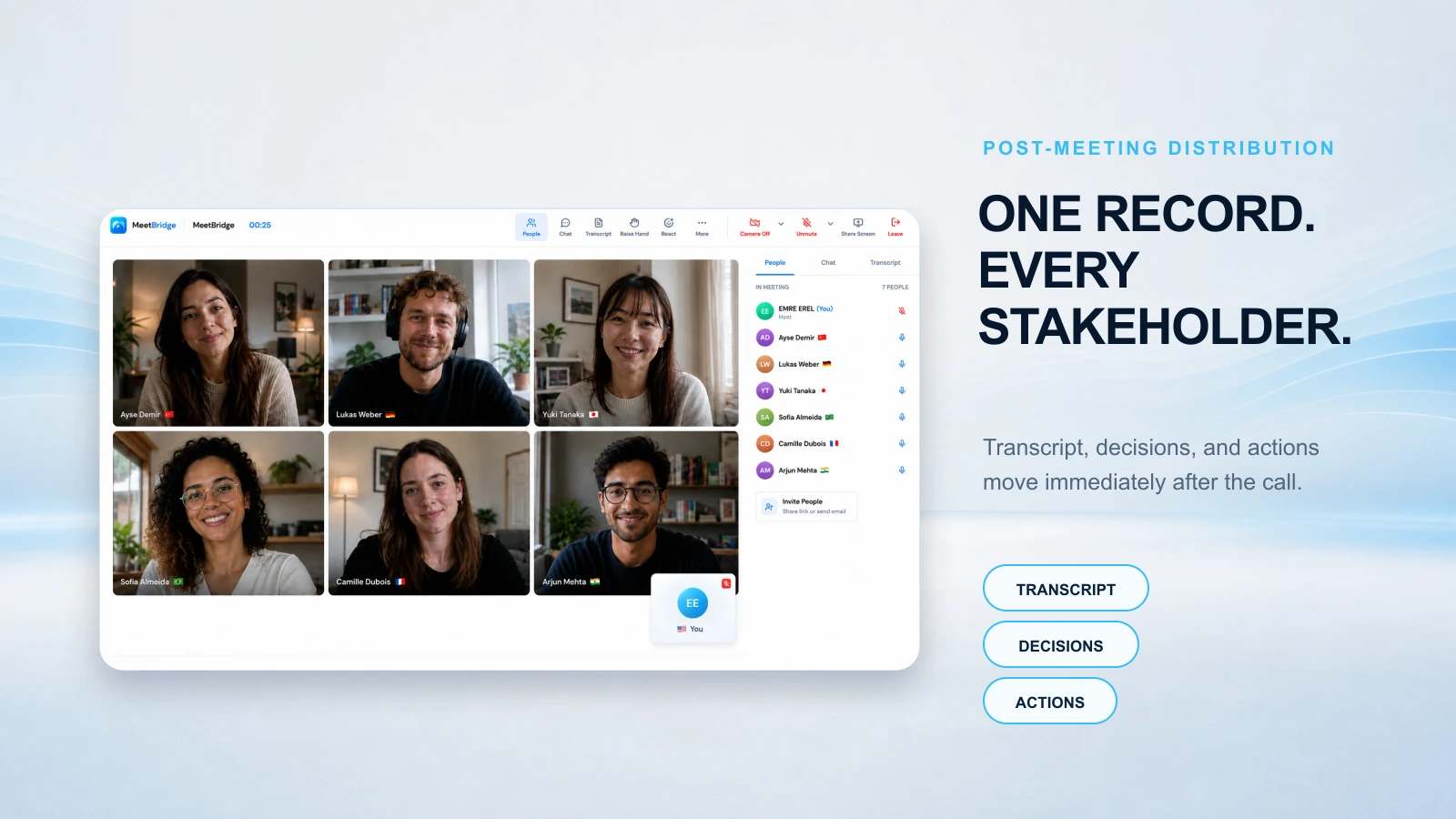
MeetBridge is designed for multilingual teams that need meetings to produce outcomes, not just conversation. The platform brings the key layers into one flow:
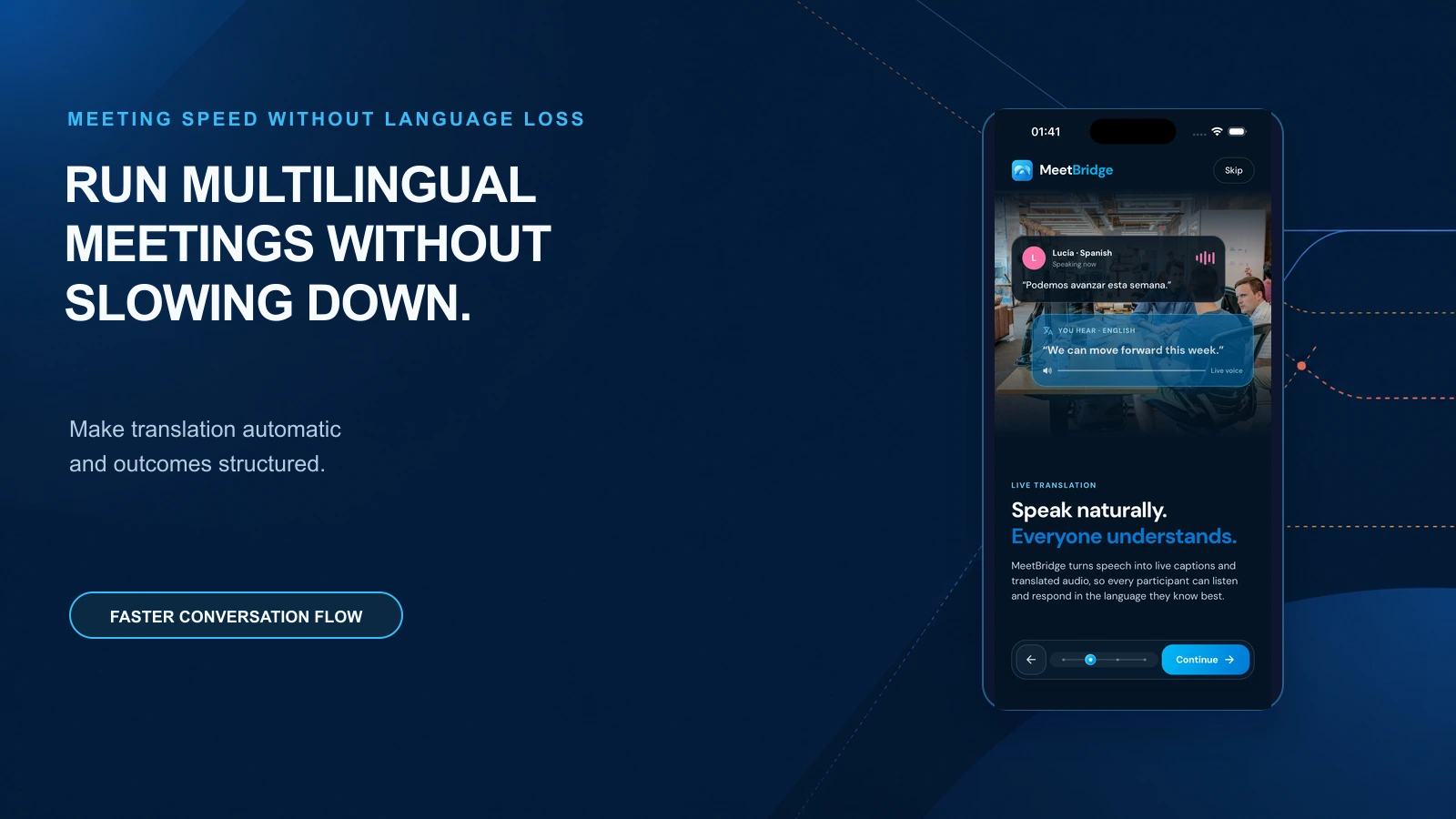
- Live translation so participants can speak naturally while others follow in their preferred language
- Transcripts that preserve the exact wording (useful for nuanced requirements, customer commitments, and compliance)
- meeting summaries that highlight the key points, decisions, and risks
- Decisions and action items extracted into a clear follow-up list with owners and due dates
- Booking flows so cross-region scheduling and handoffs are consistent
- Follow-up actions so the meeting output turns into execution instead of another round of clarification
In practice, this means your team spends less time repeating, retyping, and reconciling notes—and more time moving work forward. MeetBridge also helps reduce the reliance on a single bilingual “bridge person,” which is a common bottleneck in global orgs.
If your current setup is “video call + someone takes notes + someone translates later,” MeetBridge replaces the patchwork with a single multilingual meeting system.
Suggested next step: See MeetBridge in action.
Practical workflows for common B2B scenarios
Scenario 1: Sales-to-Delivery handoff across languages
Problem: Sales closes a deal in one language; delivery executes in another. Requirements get distorted.
Workflow: 1) Run a 30-minute handoff meeting with live translation enabled 2) Capture transcript + summary 3) Tag decisions: scope included/excluded, success criteria, timeline 4) Assign actions: implementation plan owner, customer kickoff date, risk review 5) Share recap to Sales, Delivery, and the customer sponsor in their preferred language
Result: Fewer “that’s not what we promised” escalations.
Scenario 2: Global product launch readiness
Problem: Regional teams interpret launch requirements differently.
Workflow: 1) Agenda includes explicit go/no-go criteria 2) Each region answers the same three questions: readiness, risks, asks 3) Decision moment: launch date + owner + contingency 4) Actions: localization, support staffing, enablement materials 5) Follow-up: summary + action list distributed to regional leads
Result: Fewer last-minute surprises and fewer region-specific delays.
Scenario 3: Customer escalation with multilingual stakeholders
Problem: High-stakes calls slow down because accuracy matters.
Workflow: 1) Start with a 2-minute alignment on outcomes: containment, root cause path, next update 2) Use live translation for shared understanding 3) Capture decisions and commitments precisely 4) End with “commitment review”: what we will do, what the customer will do, next meeting time
Result: Faster containment and fewer disputes about what was promised.
FAQ
FAQ
What’s the best way to keep multilingual meetings from running over time?
Use a structured agenda with explicit decision points, keep discussion flowing in each speaker’s strongest language, and reserve slow-down moments for decisions and critical clarifications. Live meeting translation plus an automatic transcript and summary reduces repetition and post-meeting rework.
Do multilingual meetings require everyone to speak English (or one common language)?
No. For many global teams, forcing one language reduces participation quality and slows decisions because people self-censor. A better approach is to let people speak naturally while using live translation to maintain shared understanding and keep the pace.
What should a multilingual meeting recap include?
At minimum: (1) decisions made, (2) action items with owners and due dates, (3) risks or open questions, and (4) the next checkpoint. For multilingual teams, it also helps to share the recap in each stakeholder’s working language so it can be forwarded internally without rework.
Is meeting translation software enough on its own?
Translation alone helps comprehension, but it won’t prevent decision drift or follow-up gaps. The biggest gains come when translation is combined with transcripts, meeting summaries, and an action workflow—so the meeting produces a reliable record and execution-ready next steps.
Key takeaways
- Multilingual meetings slow down when translation becomes a manual role and outcomes aren’t captured consistently.
- The workflow shift is to treat translation as a layer of a broader meeting system: live understanding + accurate record + action conversion.
- A repeatable checklist (agenda, glossary, roles, decision moments) prevents the most common delays.
- Tools like MeetBridge help teams run multilingual meetings faster by combining live translation, transcripts, meeting summaries, booking flows, and follow-up actions in one place.
See MeetBridge in action.
FAQ
How does MeetBridge help multilingual meetings?
MeetBridge combines live translation, transcripts, and meeting summaries so teams can understand each other in real time and still keep a structured meeting record.
Can teams use MeetBridge before and after the meeting as well?
Yes. Teams can collect context with booking links and custom questions before the call, then review transcript and action outputs after the call.
Is MeetBridge only for one department?
No. Sales, HR, customer success, consulting, and global operations teams can all use the same workflow for multilingual communication and follow-up.