
 By Sinan Yılmaz
Common Mistakes That Break Multilingual Meetings
Multilingual meetings fail for predictable reasons: unclear ownership, “translation-only” thinking, missing context, and weak follow-up. This guide shows founders and operators how to shift workflows, prevent misunderstandings, and use better meeting translation software to capture decisions and actions reliably.
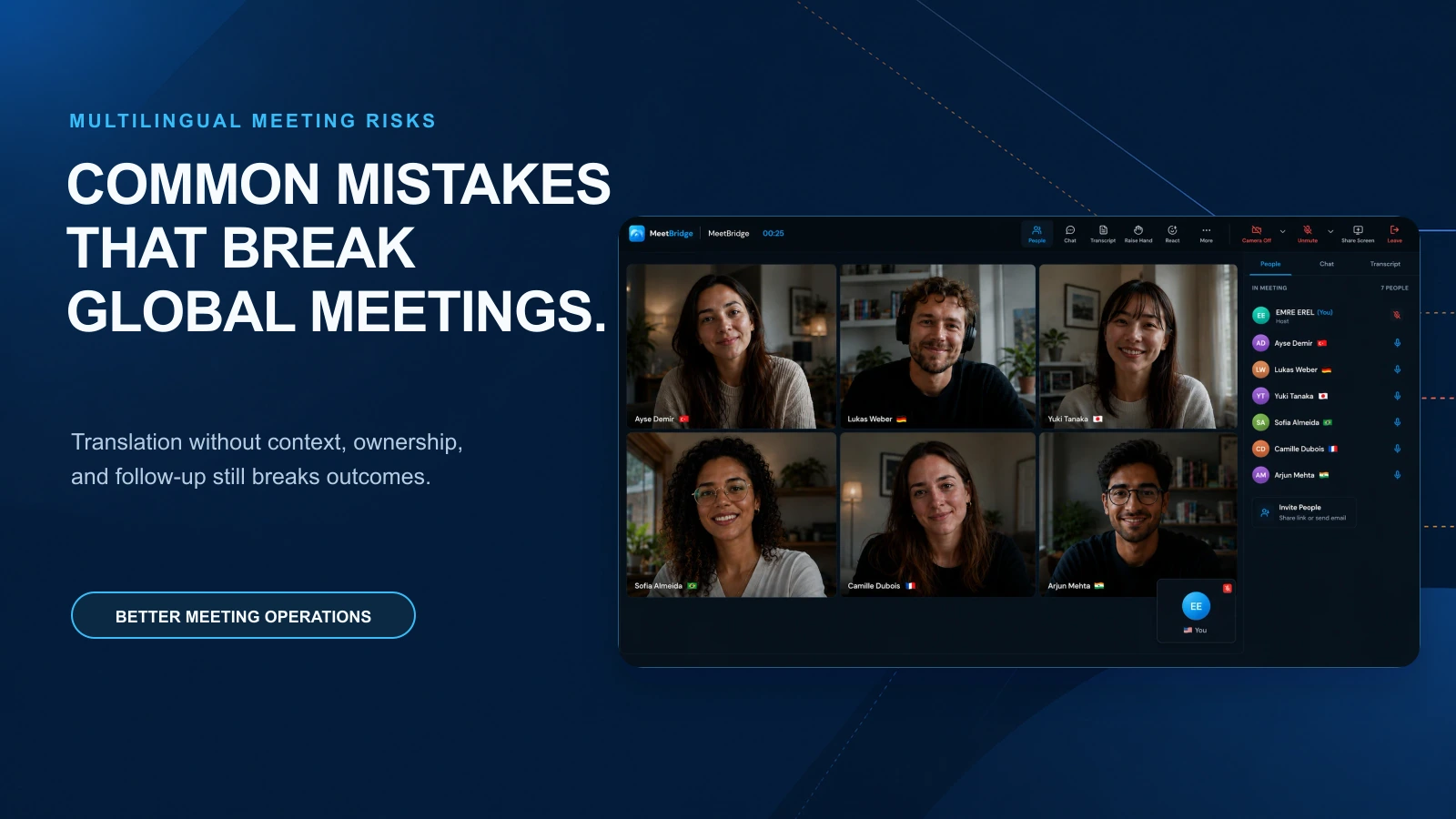
Common Mistakes That Break Multilingual Meetings
Founders and business leaders often discover the hard way that multilingual meetings don’t fail because people “don’t speak the same language.” They fail because the meeting system wasn’t designed for multilingual reality.
If you’re running sales calls across regions, coordinating a distributed product team, or negotiating with overseas suppliers, you’ve likely felt the hidden costs:
- Deals slow down because stakeholders can’t align on what was agreed.
- Engineering ships the wrong thing because requirements were “mostly understood.”
- Customer success escalations happen because nuance got lost in translation.
- Follow-ups are inconsistent because action items weren’t captured clearly.
The fix isn’t “get better interpreters” or “ask everyone to speak English.” The fix is a workflow shift: treat live meeting translation as one layer of a stronger meeting system—one that captures context, decisions, owners, and next steps.
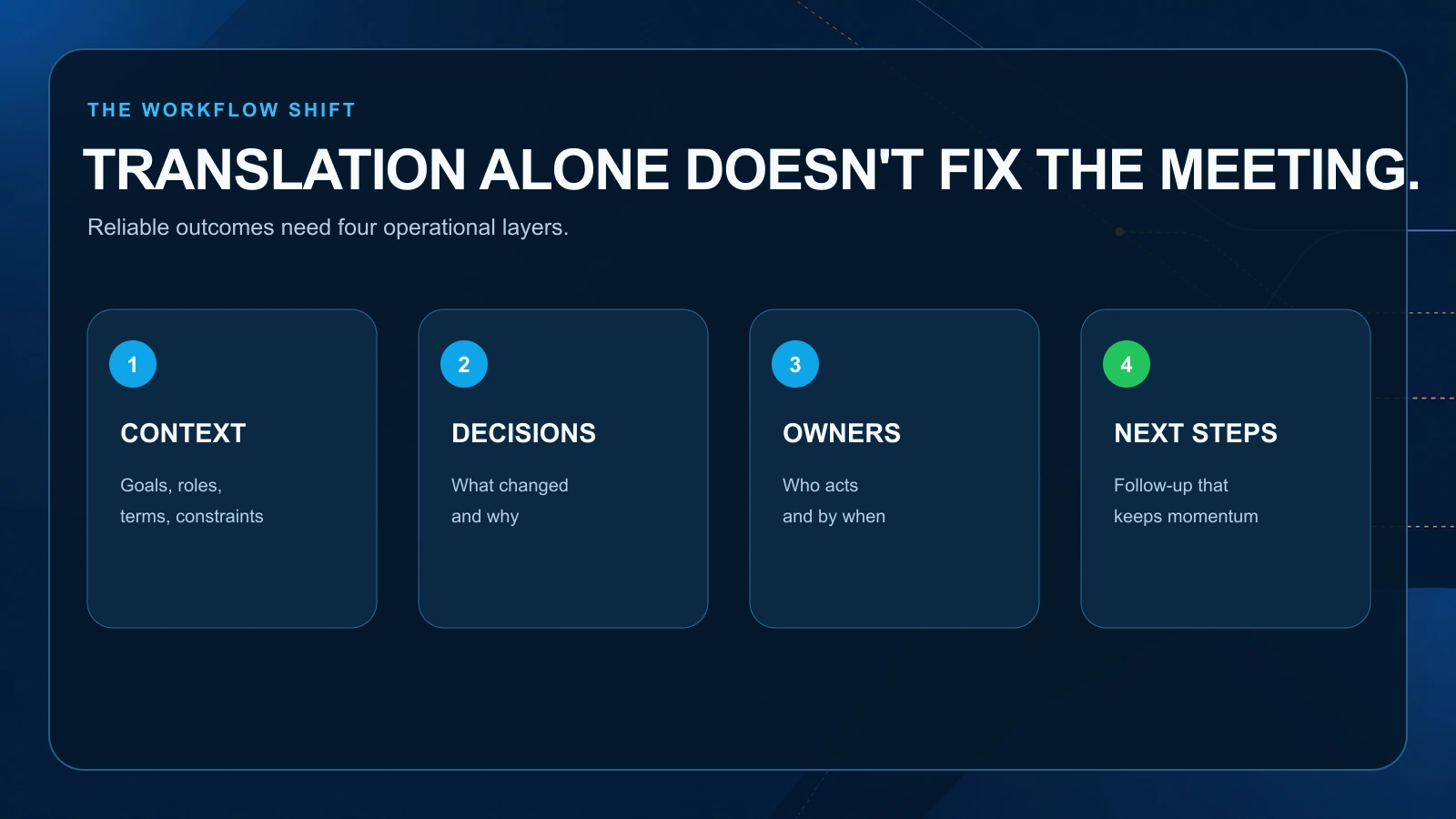
Below are the most common multilingual meetings mistakes that break outcomes, plus practical steps and tooling changes that help you run multilingual meetings at scale.
Why multilingual meetings break (and the mistakes behind it)
Mistake 1: Treating translation as the meeting, not a layer in the meeting
Many teams think the problem is simply converting words from Language A to Language B. But real business alignment requires:
- Shared context (background, constraints, definitions)
- Clear decisions (what we agreed, what we didn’t)
- Ownership (who does what by when)
- Traceability (where the decision lives and how it’s communicated)
Scenario: A US founder runs a partnership call with a Japanese distributor. The translation is “accurate,” but the distributor’s “we will consider it” is interpreted as “we’re interested.” Two weeks later, the founder is surprised there’s no progress.
What actually broke: not translation accuracy alone, but missing a decision checkpoint and a written summary that both sides confirm.
Mistake 2: Assuming everyone shares the same definitions
In multilingual meetings, terms that seem obvious often aren’t.
Common examples in B2B:
- “Pilot” (paid? free? time-boxed? success criteria?)
- “Integration” (API? SSO? data sync? one-way export?)
- “Committed” (contract signed? verbal agreement? internal approval?)
Scenario: A product manager says, “We’ll support SSO in Q3.” The translation lands, but the regional team interprets it as “available at the start of Q3,” while engineering meant “we’ll start building in Q3.”
Fix: define terms in writing during the meeting and capture them in the transcript/summary so they don’t drift.
Mistake 3: Skipping pre-reads and agenda because “we’ll clarify live”
Clarifying live is expensive in multilingual settings. Every unclear point multiplies:
- extra translation time
- more interruptions
- higher cognitive load
- more chances for nuance to be lost
Scenario: A sales leader runs a multilingual pipeline review with regional managers. Without a shared agenda, people jump between accounts, dates, and next steps. The call ends with “we’ll follow up,” but nobody is sure what to do.
Fix: pre-reads and structured agendas reduce translation burden and improve decision speed.
Mistake 4: Letting the loudest speaker set the pace
In multilingual meetings, fast talkers and dominant voices create an uneven playing field. Others may stop contributing because it’s too hard to keep up.
Scenario: A founder runs a cross-border product review. The HQ team speaks quickly, the translation lags, and the overseas team stops asking questions. Later, implementation fails due to unvoiced concerns.
Fix: explicitly manage pacing, add structured turn-taking, and use a system that keeps everyone aligned in real time.
Mistake 5: No single source of truth after the meeting
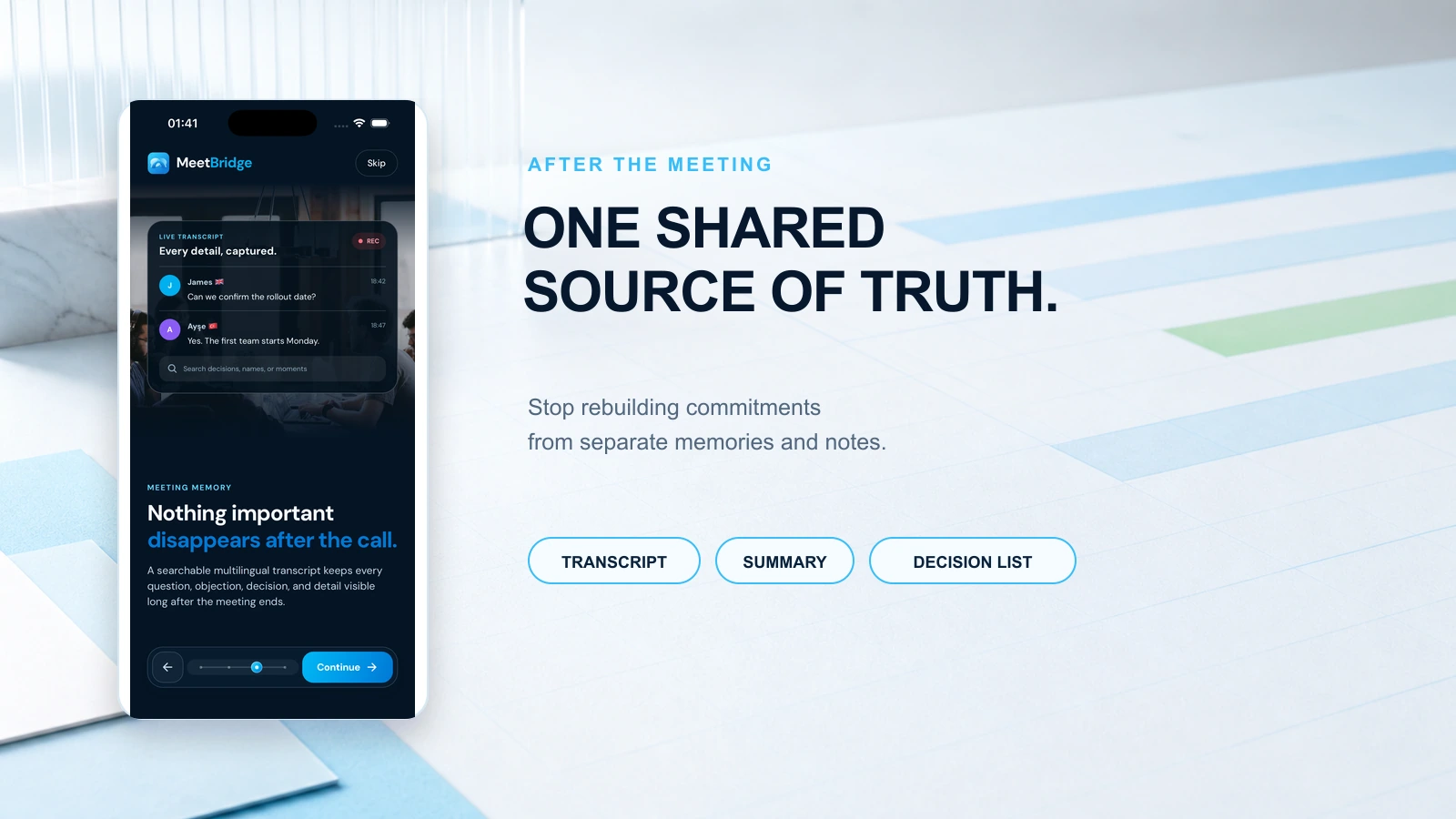
This is the biggest operational failure: decisions live in people’s memories, not in a shared artifact.
Scenario: A procurement negotiation happens in Spanish and English. After the call, each side writes their own notes. A week later, the contract draft reveals two different understandings of payment terms.
Fix: one shared transcript + summary + decision list that stakeholders can reference.
Mistake 6: “We’ll send notes” but nobody does
In multilingual meetings, follow-up notes aren’t a nice-to-have. They’re the bridge from discussion to execution.
When notes are manual, they fail under pressure:
- the wrong person is assigned
- deadlines are missing
- action items are vague
- the summary is biased toward one language group
Fix: automate capture and structure the output so it’s usable.
The workflow shift: from translation-only to an outcome-driven meeting system
If you want fewer multilingual meetings mistakes, shift from “translate what’s said” to “produce outcomes everyone can execute.”
A practical outcome-driven workflow looks like this:
- Prepare: align on goals, vocabulary, and decision points
- Run the meeting: manage pace, confirm decisions, capture context
- Capture outcomes: transcript + summary + decisions + action items
- Follow through: assign owners, track next steps, schedule next meeting
Live meeting translation is still critical—but it works best when it’s embedded in a system that reliably produces artifacts and follow-up.
Better workflow for multilingual meetings (practical and repeatable)
Step 1: Set meeting goals in one sentence
Before you invite anyone, write:
- “At the end of this meeting, we will have decided ______.”
Examples:
- “At the end of this meeting, we will have agreed on pilot scope, success metrics, and start date.”
- “At the end of this meeting, we will have confirmed the top 3 requirements and the owner for each.”
This reduces rambling and helps translation stay focused.
Step 2: Use a decision-first agenda
A multilingual agenda shouldn’t be a list of topics. It should be a list of decisions.
Template:
- Context (2–3 minutes): what changed since last time
- Decision 1: ______ (10 minutes)
- Decision 2: ______ (10 minutes)
- Action items + owners (5 minutes)
- Confirm next meeting / booking link (2 minutes)
Step 3: Add a shared glossary for high-risk terms
You don’t need a long glossary. You need a short list of terms that frequently cause misunderstanding.
Examples for SaaS teams:
- “Go-live”
- “Security review”
- “Data residency”
- “SLA”
- “Proof of concept”
Define each in one line and share it ahead of time.
Step 4: Designate a “decision checker” role
In multilingual meetings, someone should be responsible for confirming decisions in simple language.
Decision checker script:
- “Let me restate the decision in one sentence.”
- “Is that correct in both languages?”
- “What is the deadline and who owns it?”
This role can rotate, but it must exist.
Prepare well: a checklist you can apply today
Use this checklist before any high-stakes multilingual meeting (sales, negotiation, product requirements, incident review).
Multilingual meeting prep checklist (10 minutes)
- Define outcome: what must be decided by the end?
- Identify participants: who is a decision-maker vs. observer?
- Share a decision-first agenda 24 hours ahead
- List 5–10 high-risk terms and define them
- Share key artifacts (PRD, proposal, contract draft) with section references
- Decide how questions will be handled (raise hand, round-robin, chat)
- Plan pacing: schedule micro-pauses every 2–3 minutes
- Set follow-up expectations: “You’ll receive a summary + action items within X hours”
This alone prevents a large portion of multilingual meetings mistakes—especially the ones that show up later as rework.
Capture outcomes: transcripts, summaries, and action clarity
Multilingual meetings don’t end when the call ends. They end when the work is unblocked.
Mistake 7: Capturing notes in one language only
If the “official notes” are only in the HQ language, you create an information hierarchy. Regional teams become dependent on someone else’s interpretation.
Better approach: capture a transcript and provide summaries that are accessible across languages.
Mistake 8: Writing summaries that describe discussion instead of decisions
A useful summary answers:
- What did we decide?
- What are the open questions?
- Who owns each action item?
- What is the deadline?
- What is the next meeting or checkpoint?
Scenario: A customer escalation meeting happens across English and German. The notes say “discussed root cause and next steps.” Two days later, the customer is still waiting because no owner was assigned to the workaround.
Fix: action items must be explicit, assigned, and time-bound.
Mistake 9: Losing “why” (context) in translation
Even when decisions are captured, teams often lose the rationale. Without the “why,” future stakeholders re-open settled topics.
Fix: capture short rationale bullets:
- “Why we chose option A”
- “Constraints we must respect”
- “What would change this decision”
Scale the process: how better tooling changes multilingual meetings
If you run multilingual meetings occasionally, manual processes can work. If you run them weekly across sales, product, support, and partnerships, manual breaks.
Here’s what better meeting translation software changes operationally:
1) Consistency: every meeting produces the same outputs
Instead of hoping someone sends notes, the system produces:
- transcript
- meeting summary
- decisions
- action items
- follow-up prompts
Consistency is what allows a founder to scale communication without being in every call.
2) Speed: fewer clarification loops
When stakeholders can review a transcript and summary in their preferred language, you cut:
- “What did we agree?” messages
- repeated meetings
- rework caused by misinterpretation
3) Accountability: actions don’t disappear
Tooling that connects meeting outcomes to follow-up actions reduces the most expensive failure mode: silent non-execution.
4) Better cross-functional alignment
Sales, product, legal, and CS often join multilingual calls with different goals. A unified meeting artifact keeps everyone aligned on the same reality.
How MeetBridge fits (without changing how your team works overnight)
MeetBridge is designed for multilingual teams that need meetings to produce outcomes, not just conversations.
In practice, that means MeetBridge can support an end-to-end flow:
- Live translation during the meeting so participants can follow and contribute in real time
- Transcripts that preserve exact wording (useful for requirements, negotiations, and compliance-heavy conversations)
- meeting summaries that turn long discussions into decision-focused outputs
- Decisions and action items captured clearly so execution doesn’t rely on memory
- Booking flows and links to schedule the next step while momentum is high (especially useful in sales and partnerships)
- Follow-up actions so tasks don’t vanish into chat threads
A practical example: a founder running multilingual sales calls can use MeetBridge to translate live, then send a decision-oriented summary to both the prospect and internal stakeholders. The next meeting can be booked immediately via a link, and the follow-up actions (security questionnaire, pricing approval, pilot plan) are assigned while the context is fresh.
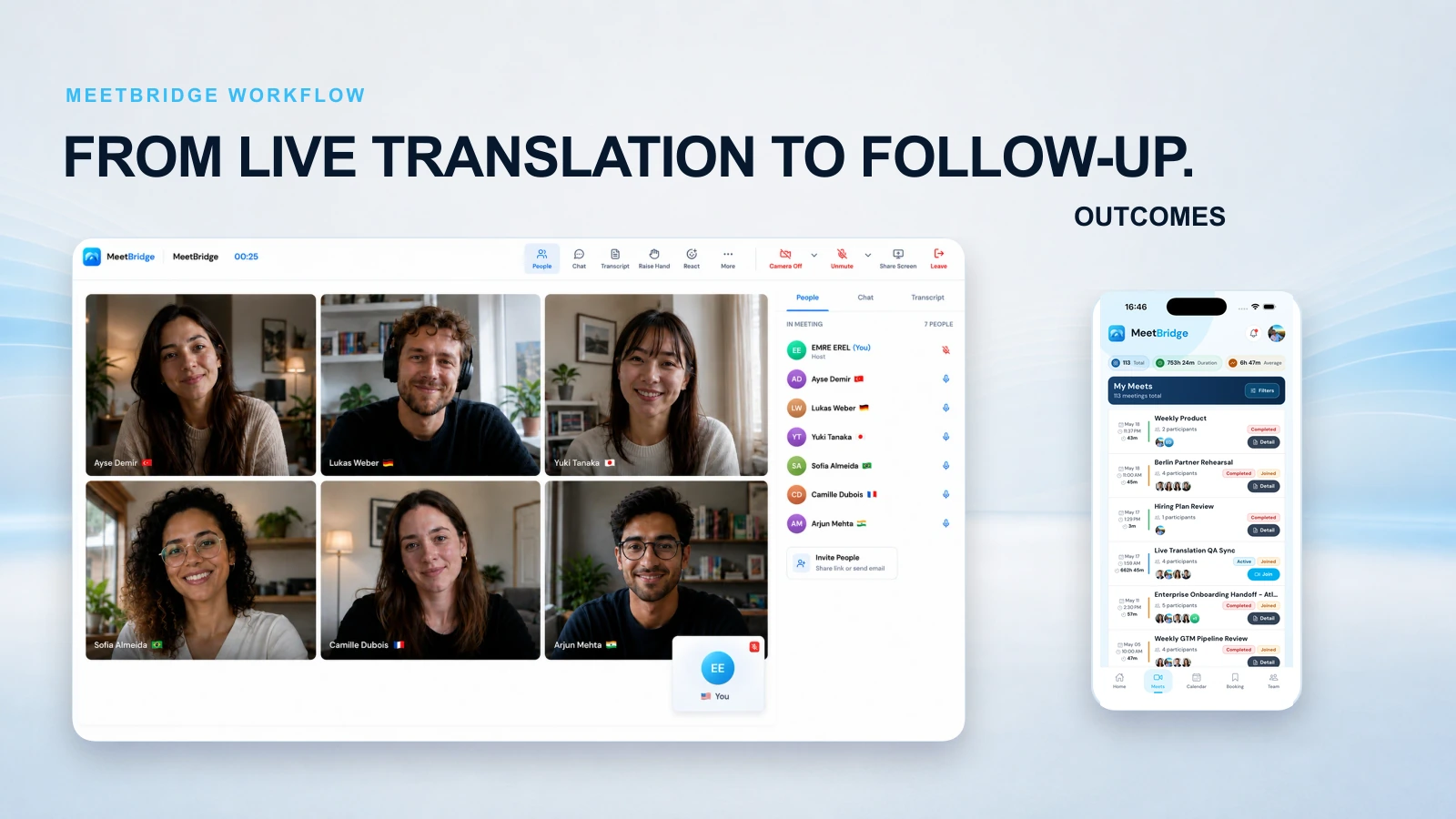
Another example: a product team spanning Korea, France, and the US can use MeetBridge to reduce misunderstandings around requirements. The transcript and summary become the shared source of truth, and action items are distributed without one region acting as the “translator of record.”
The goal isn’t to add more process. It’s to make the process you already need (clarity, decisions, follow-through) happen reliably in multilingual settings.
Practical scenarios: what “good” looks like in real B2B meetings
Scenario 1: Cross-border sales discovery
What breaks: The buyer’s pain points are translated, but the nuance of urgency and decision process is lost.
Better workflow:
- Confirm decision process explicitly: “Who signs, who influences, what’s the timeline?”
- Capture and share a bilingual summary with next steps
- Book the technical deep dive before ending the call
Outcome: fewer stalled deals due to misaligned expectations.
Scenario 2: Multilingual product requirements review
What breaks: Teams agree verbally, but interpretations differ across regions.
Better workflow:
- Use a glossary for key terms (“must-have,” “P0,” “launch,” “beta”)
- Insert decision checkpoints: “We are deciding X now”
- Publish transcript + decision list + owners
Outcome: less rework and fewer “that’s not what we meant” cycles.
Scenario 3: Supplier negotiation and contract alignment
What breaks: Payment terms, delivery dates, and penalties are understood differently.
Better workflow:
- Read back key terms in plain language
- Capture exact phrasing in the transcript
- Summarize terms as a checklist to validate after the call
Outcome: fewer contract redlines and fewer disputes later.
A lightweight operating system for multilingual meetings
If you want a simple standard your team can adopt, use this “3 artifacts” rule:
The 3 artifacts rule
After every multilingual meeting, produce:
- Decision list (bullets, unambiguous)
- Action list (owner + deadline + definition of done)
- Open questions (who will answer + by when)
If you can’t produce these, the meeting isn’t finished—regardless of how good the live meeting translation was.
FAQ
What are the most common multilingual meetings mistakes in business teams?
The most common issues are treating translation as the entire solution, skipping structured agendas, failing to confirm decisions, capturing notes in only one language, and not producing clear action items with owners and deadlines. These problems usually show up later as rework, stalled deals, or misaligned delivery.
Is live meeting translation enough to run effective multilingual meetings?
Live meeting translation helps people participate in real time, but it’s rarely enough on its own. Effective multilingual meetings also require a repeatable workflow for decision checkpoints, a shared source of truth (transcripts and summaries), and a follow-up system that turns outcomes into assigned actions.
How do I choose meeting translation software for multilingual teams?
Look for tools that go beyond translation: reliable transcripts, decision-focused summaries, and a way to capture and distribute action items. If your meetings drive revenue or delivery, also consider booking links and follow-up workflows so the next step happens immediately. MeetBridge is built around this end-to-end flow for multilingual teams.
How can founders reduce misunderstandings without slowing meetings down?
Use a decision-first agenda, define 5–10 high-risk terms ahead of time, and assign a “decision checker” to restate agreements in simple language. Then ensure every meeting outputs a transcript and a short decision/action summary so alignment doesn’t depend on memory.
See MeetBridge in action
If multilingual meetings are creating rework, stalled follow-ups, or inconsistent execution, the fastest fix is to standardize how outcomes are captured and shared. MeetBridge combines live translation, transcripts, meeting summaries, booking flows, and follow-up actions so your team can move from “we talked about it” to “we shipped it” across languages.
FAQ
How does MeetBridge help multilingual meetings?
MeetBridge combines live translation, transcripts, and meeting summaries so teams can understand each other in real time and still keep a structured meeting record.
Can teams use MeetBridge before and after the meeting as well?
Yes. Teams can collect context with booking links and custom questions before the call, then review transcript and action outputs after the call.
Is MeetBridge only for one department?
No. Sales, HR, customer success, consulting, and global operations teams can all use the same workflow for multilingual communication and follow-up.