 By Emre Erel
How Multinational Companies Eliminate Language Barriers in Meetings
Multinational companies eliminate language barriers in meetings by connecting live translation with preparation, transcripts, decisions, action items, and follow-up workflows.
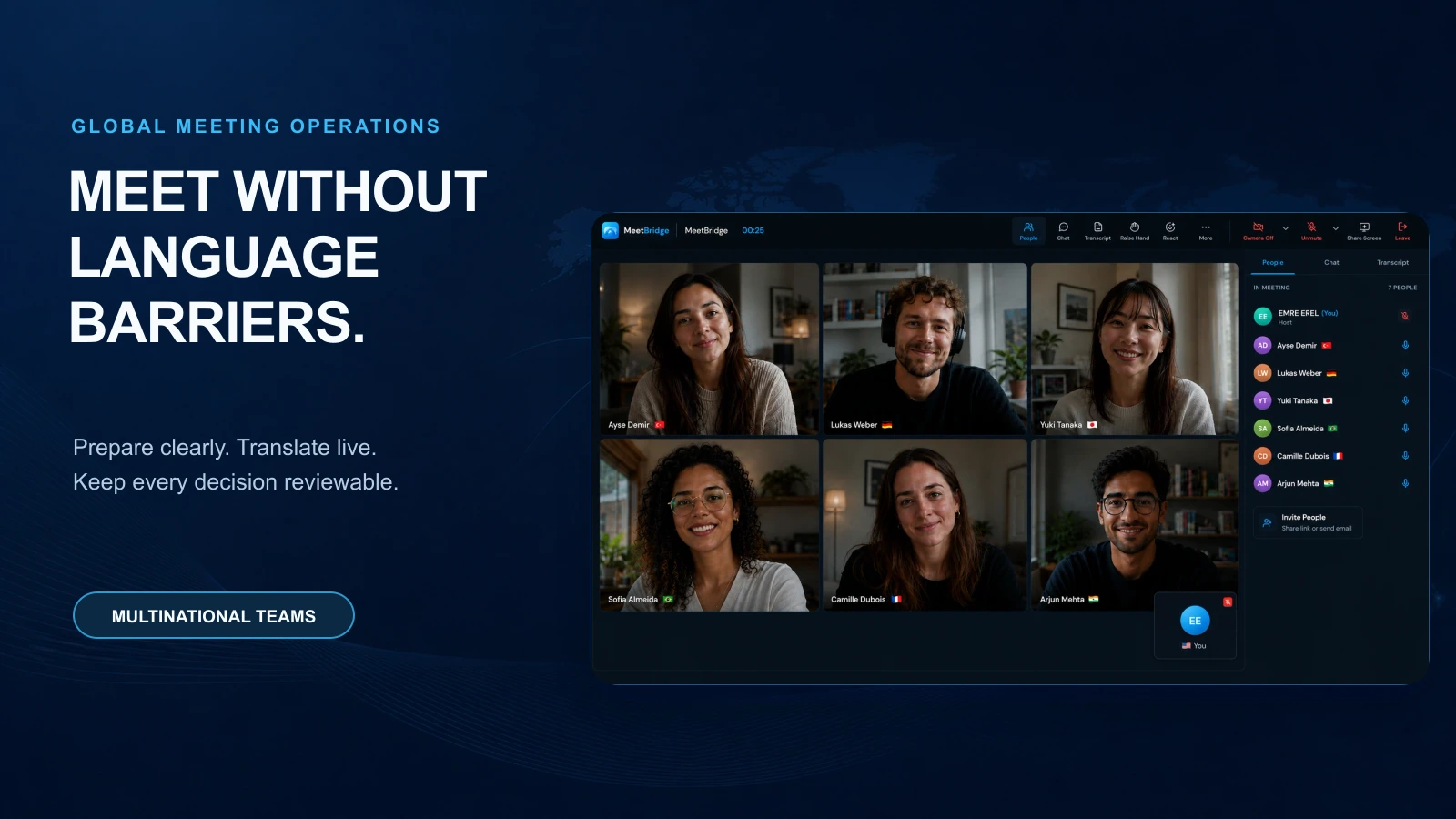
How Multinational Companies Eliminate Language Barriers in Meetings
Multinational companies do not eliminate language barriers in meetings by asking everyone to speak slower English, adding translated captions to every call, or relying on one bilingual teammate to rescue the conversation.
Those tactics can help for a moment. They do not solve the deeper business problem.
Language barriers in meetings become expensive when they affect participation, decisions, ownership, and follow-up. A buyer understands only part of the answer. A candidate cannot explain their strongest experience naturally. A supplier agrees to a delivery term, but the final notes say something different. A regional team hears the discussion, but the action item is written from headquarters’ point of view.
The strongest multinational teams treat language as a meeting workflow problem, not only a translation problem.
That means they connect live translation, transcripts and meeting memory, meeting summaries and actions, booking context, and follow-up into one operating system for multilingual meetings.
The answer: build a multilingual meeting system
The goal is not simply “everyone heard a translated version of the call.”
The goal is:
- Everyone can participate in the meeting while speaking naturally.
- Everyone can review what was said after the meeting.
- Everyone agrees on the decisions.
- Everyone knows who owns the next step.
- Everyone can move forward without another clarification meeting.
That is the difference between translation as a feature and multilingual meetings as a business system.
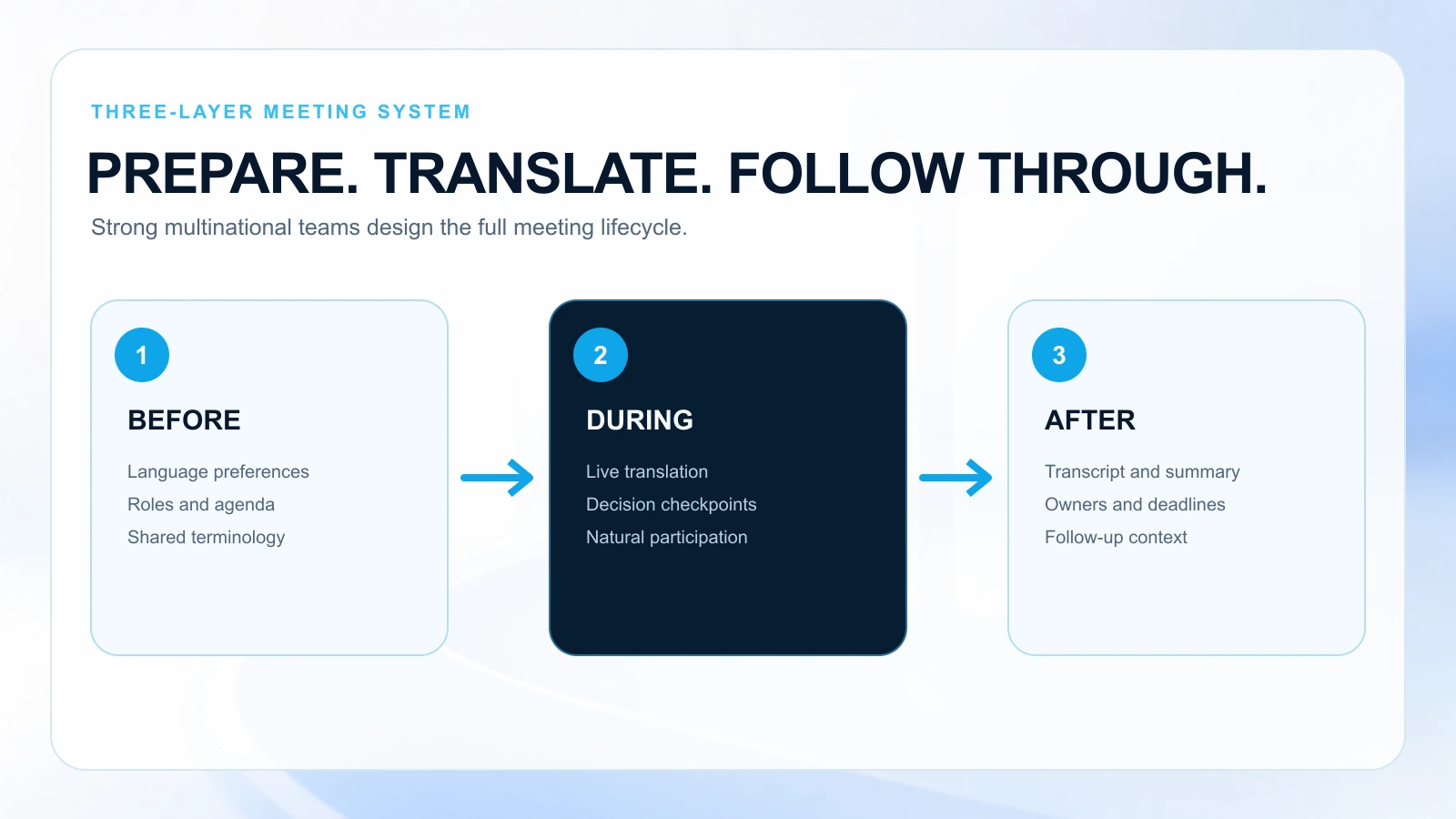
A multinational company eliminates language barriers when the meeting has clear inputs, a reliable live layer, and structured outputs.
| Meeting layer | What usually breaks | What strong multinational teams do |
|---|---|---|
| Before the meeting | Language needs, agenda, and context are unclear | Collect language preferences, participant roles, goals, and key terms before the call |
| During the meeting | People understand fragments but hesitate to contribute | Use live translation, simple facilitation, decision checkpoints, and shared terminology |
| After the meeting | Notes are late, biased, or incomplete | Create a transcript, summary, decision list, action items, owners, and follow-up context |
This is why a dedicated multilingual meeting platform matters for business teams. It keeps translation connected to the meeting record, the decisions, and the work that happens next.
How language barriers show up in multinational meetings
Language friction rarely looks like a dramatic failure during the call. Most of the time, the meeting feels “good enough” until execution starts to drift.
1) Participation becomes uneven
When the meeting defaults to one dominant language, fluent speakers move faster. Non-native speakers may understand the main idea but avoid asking detailed questions, challenging assumptions, or explaining nuance.
That matters because the quietest participant may be the person who knows the local customer, the regulatory constraint, the supplier limitation, or the real implementation risk.
2) Decisions become implied instead of explicit
Multinational meetings often include cultural differences in how people express agreement, hesitation, or disagreement. A polite response can sound like approval to one team and uncertainty to another.
If the meeting does not include decision checkpoints, people leave with different interpretations.
3) Follow-up becomes one-language biased
Many teams run the call in several languages but write the official recap in one language. That recap becomes the source of truth, even if it misses nuance from the original conversation.
This creates a hidden hierarchy: the language of the recap becomes more powerful than the conversation itself.
4) Bilingual “heroes” become bottlenecks
A bilingual teammate can translate, facilitate, take notes, and explain cultural nuance once or twice. But when the company scales across regions, that person becomes a bottleneck.
They are no longer only participating in the meeting. They are also acting as interpreter, scribe, project manager, and risk manager.
That is not a scalable language strategy.
The workflow multinational companies use to reduce language barriers
The best approach is not complicated. It is repeatable.
Step 1: collect language context before the meeting
Better multilingual meetings begin before anyone joins the room.
Before the call, the host should know:
- Which languages participants prefer to speak and hear
- Who is a decision-maker, influencer, observer, or technical expert
- What outcome the meeting must produce
- Which terms, acronyms, product names, or legal phrases may create confusion
- Which documents, proposals, requirements, or contract sections need shared context
This is where booking links are useful. Instead of scheduling a generic call and discovering language needs live, teams can collect context through custom questions before the meeting starts.
For example:
- “Which language would you prefer to use during the meeting?”
- “What should we prepare before the call?”
- “Which decision do you want to make by the end of this meeting?”
- “Are there technical, legal, or pricing terms we should define in advance?”
The result is a meeting that starts with context instead of confusion.
For customer-facing calls, this preparation layer is especially important. The guide on how to prepare for a multilingual customer meeting covers the same principle: preparation reduces translation load and protects decision quality.
Step 2: use live translation for participation, not passive viewing
Translated captions can help participants follow a meeting. But high-stakes multinational meetings usually need more than passive comprehension.
Sales discovery, supplier negotiation, candidate interviews, customer escalations, and executive alignment calls depend on back-and-forth conversation. People need to ask, answer, clarify, object, and decide while the context is still fresh.
That is why live translation is most valuable when it supports interaction.
With MeetBridge live translation, participants can follow multilingual conversations as they happen and keep the meeting moving without waiting for manual interpretation. This helps teams avoid the common pattern where one language group controls the pace while everyone else waits for a recap.
The practical rule is simple:
If the meeting’s success depends on dialogue and decisions, prioritize live translation. If the meeting is mostly one-way viewing, translated captions may be enough.
For a deeper comparison, read Live Translation vs Translated Captions: What Is the Difference?.
Step 3: make the meeting easier to translate
Technology helps, but facilitation still matters.
Multinational teams reduce language barriers by making the conversation “translation-friendly” without making it slow or unnatural.
Use these habits:
- Speak in complete, short ideas.
- Avoid idioms, slang, and region-specific shorthand.
- Define acronyms the first time they appear.
- Pause after important decisions.
- Restate commitments in plain language.
- Ask yes/no confirmation for critical points.
- Use names when assigning owners.
Instead of saying:
“Let’s circle back on the rollout motion once Legal weighs in and we’ve sanity-checked the commercial side.”
Say:
“We will wait for Legal’s review. Then Sarah will confirm whether the rollout plan is commercially approved.”
The second version is easier to translate, easier to summarize, and easier to act on.
This does not mean multilingual meetings should become slow. It means the team should remove avoidable ambiguity. For more operating tactics, see How to Run Multilingual Meetings Without Slowing Them Down.
Step 4: create a transcript that becomes the shared record
In multinational companies, the meeting record matters because not every stakeholder attends the live call.
Sales engineers need buyer requirements. Customer success needs onboarding context. Legal needs commitment history. HR needs interview details. Operations needs supplier terms. Executives need the decision without replaying the entire conversation.
A transcript turns the meeting from a temporary conversation into a reviewable record.
But the transcript must be useful. It should help teams answer:
- Who said what?
- What language was used?
- What was the actual commitment?
- Which requirement, objection, or risk was mentioned?
- What needs to be reviewed before follow-up?
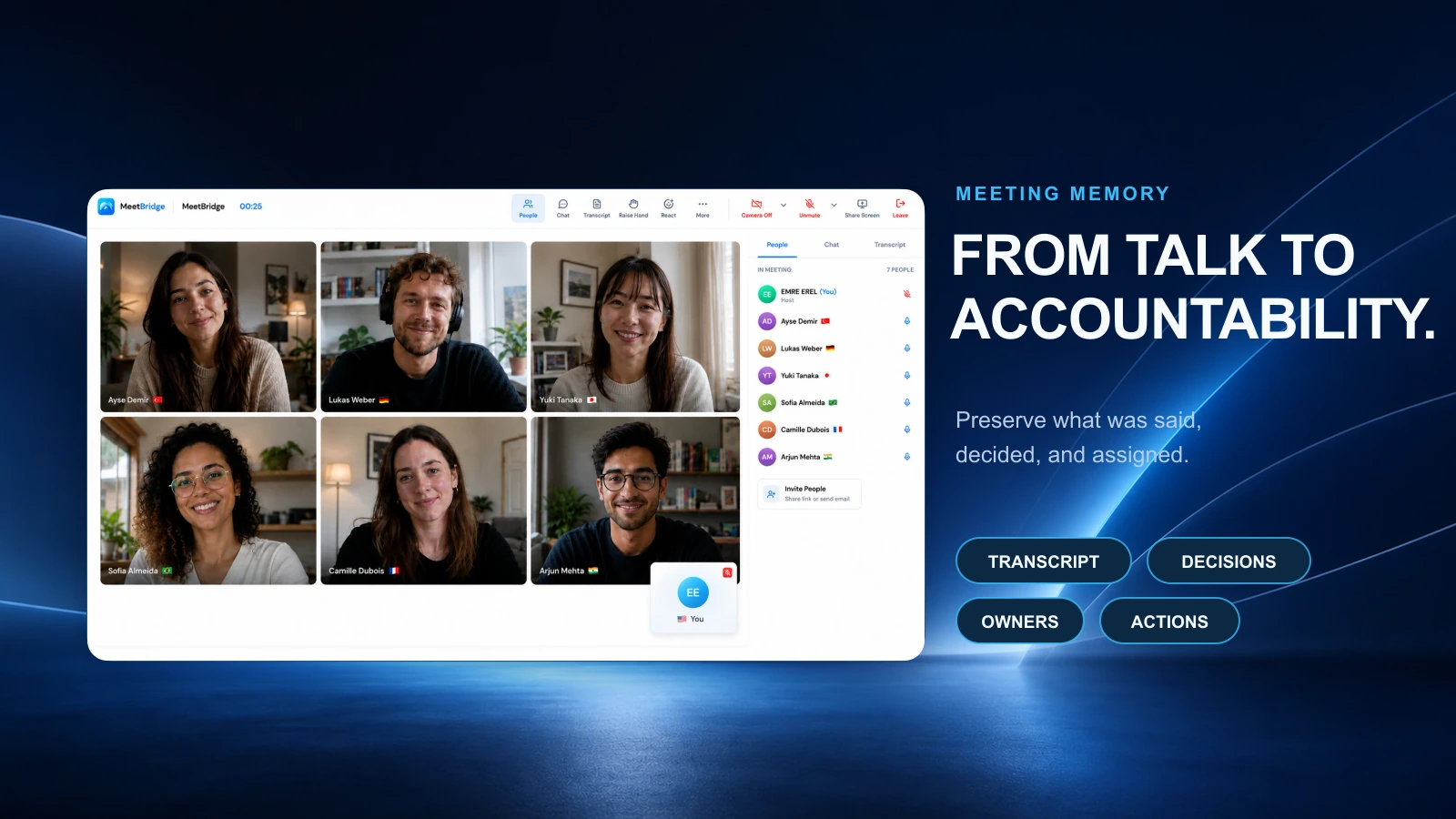
Transcripts and meeting memory make this easier by keeping the meeting record connected to the conversation, chat, timeline, decisions, and follow-up context.
This is also where multinational companies reduce one of the biggest risks of language barriers: the difference between what was said and what was remembered.
Step 5: convert the conversation into decisions and actions
A multilingual meeting is not successful because people understood the call. It is successful when the company can act on the outcome.
After every important multilingual meeting, the output should include:
- Decisions made
- Open questions
- Risks and blockers
- Action items
- Owners
- Deadlines
- Next meeting or follow-up step
Generic notes are not enough.
A weak summary says:
“The team discussed implementation timeline and next steps.”
A strong summary says:
“Decision: implementation starts July 8 after security review. Action: Maria sends API documentation by June 25. Owner: Kenji confirms sandbox access by June 27. Open question: whether SSO is required for phase one.”
This is where meeting summaries and actions create operational leverage. The meeting output becomes easier to review, edit, share, and execute.
The same idea appears across MeetBridge’s workflow guides: common mistakes that break multilingual meetings are rarely only about translation accuracy. They are usually about unclear ownership, missing context, and weak follow-up.
Step 6: follow up in a way every region can act on
Follow-up is where many multinational meetings fail.
The call is multilingual, but the recap is written for headquarters. The customer conversation happens in Spanish, but the internal escalation is written in English from memory. The supplier negotiation happens across Turkish and German, but the final action list uses vague language.
A stronger follow-up includes:
- A concise summary of the outcome
- Decisions in plain language
- Action items with owners and due dates
- Links to relevant documents or booking pages
- Clarification of any unresolved terms
- A next meeting path when needed
For external meetings, follow-up should also respect the stakeholder’s working language. A buyer, candidate, supplier, or patient should not need to decode internal shorthand to understand what happens next.
Step 7: build meeting memory across regions
Multinational companies do not only need better individual meetings. They need continuity across many meetings.
A cross-border sales process may include discovery, demo, procurement, security review, proposal, onboarding, renewal, and escalation. If each meeting loses context, the team pays the language tax again and again.
Meeting memory helps teams preserve:
- Customer objections
- Candidate expectations
- Supplier commitments
- Product requirements
- Regional risks
- Legal or compliance questions
- Decisions and rationale
- Next-step history
That memory becomes valuable when a new stakeholder joins, a different region takes over, or the team needs to understand why a decision was made.
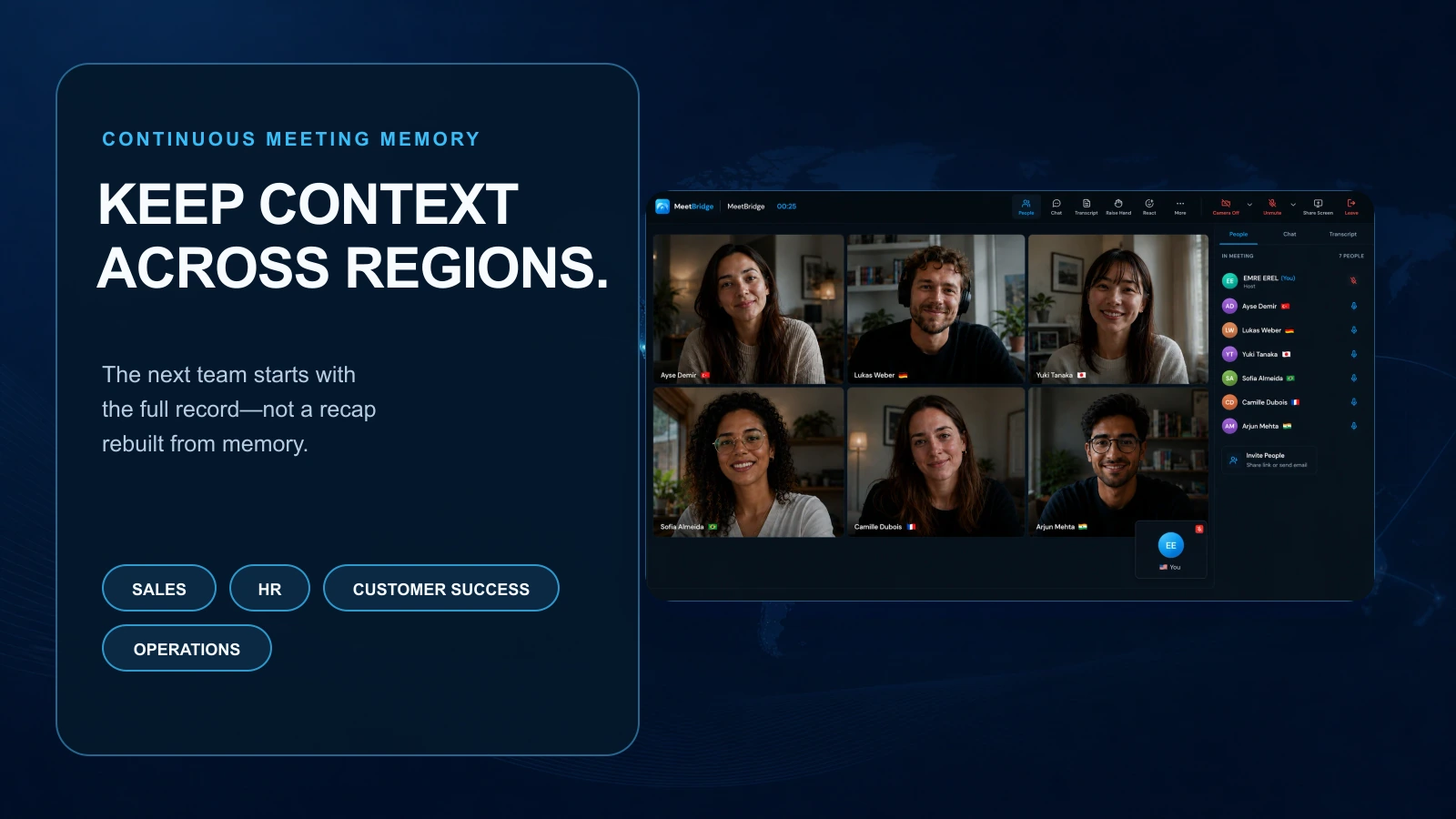
This is why global teams need more than translated captions. Captions help the call. Meeting memory helps the company.
Where language barriers cost multinational companies the most
Language barriers in meetings are not equal everywhere. They become most expensive where misunderstanding affects revenue, trust, compliance, or execution.
Cross-border sales and SaaS
In global sales, language barriers can hide buyer urgency, decision criteria, pricing concerns, security requirements, and competitive objections.
A multinational sales team needs more than a translated call. It needs a clean handoff from discovery to proposal, from proposal to procurement, and from sales to onboarding.
MeetBridge supports B2B sales and SaaS teams by helping them translate live, capture buyer context, and preserve follow-up details after the call.
HR and international hiring
International candidates often express their strongest experience more naturally in their preferred language. If the interview forces them into a second language, hiring teams may evaluate language comfort instead of role fit.
A better workflow allows candidates to communicate more naturally while the hiring team keeps a structured record for review.
MeetBridge helps HR and international hiring teams reduce language friction in interviews, onboarding, and employee conversations.
Customer success and support
Customer success meetings often contain product feedback, blockers, renewal concerns, training needs, and commitments. If those details are misunderstood, the customer feels unheard and the internal team receives incomplete context.
For customer success teams, live translation is only the first layer. The real value comes when the meeting produces a clear action plan that support, product, and account teams can trust.
Consulting and professional services
Consulting meetings depend on precise requirements, assumptions, risks, and decisions. A small misunderstanding during discovery can become a large delivery problem later.
For consulting services, multilingual meeting records help preserve client context, workshop outcomes, and project decisions.
Export, manufacturing, and operations
Supplier and distributor conversations include pricing, quality, shipment timing, specifications, penalties, documentation, and order changes. One ambiguous phrase can create expensive downstream work.
MeetBridge helps export and operations teams translate conversations live while keeping pricing, shipment, quality, and follow-up details easier to trace.
What multinational companies should stop doing
To eliminate language barriers, teams need to stop relying on habits that feel convenient but create hidden risk.
Stop assuming English is enough
A common corporate language can help standardize communication. It does not guarantee equal participation, precise understanding, or accurate follow-up.
If people are translating in their heads, they may contribute less, decide slower, or avoid nuance.
Stop treating translation as the whole meeting
Translation helps people understand words. It does not automatically create decisions, owners, deadlines, or trust.
That is why meeting translation software should be evaluated as part of the full meeting lifecycle: before, during, and after the call.
Stop relying on one bilingual teammate
Bilingual teammates are valuable. But if the entire meeting process depends on them, the company has not solved the language barrier. It has moved the barrier onto one person.
Stop writing vague action items
Vague action items become worse across languages.
Replace:
- “Follow up with the customer”
- “Check pricing”
- “Review the issue”
- “Align internally”
With:
- “Aylin sends the revised pricing table to Carlos by Thursday”
- “Mika confirms whether the API limit affects phase one by June 26”
- “Sarah books a technical follow-up with the customer’s security lead”
Language clarity and execution clarity are the same problem.
A practical checklist for multilingual meetings
Use this checklist before any high-stakes multinational meeting.
Before the meeting
- [ ] Define the meeting outcome in one sentence.
- [ ] Confirm participant languages and roles.
- [ ] Identify the decision-maker.
- [ ] Share a decision-first agenda.
- [ ] Add a short glossary for high-risk terms.
- [ ] Collect context with a booking form or pre-meeting questions.
- [ ] Confirm audio quality and meeting access.
During the meeting
- [ ] Let participants speak in the language they know best.
- [ ] Use live translation for real-time understanding.
- [ ] Restate important decisions in plain language.
- [ ] Confirm owners and deadlines while everyone is present.
- [ ] Pause after complex or high-risk terms.
- [ ] Capture open questions before the meeting ends.
After the meeting
- [ ] Review the transcript.
- [ ] Create a decision-focused summary.
- [ ] Assign action items with owners and due dates.
- [ ] Send follow-up in language that stakeholders can act on.
- [ ] Attach the meeting record to the customer, candidate, project, supplier, or account context.
- [ ] Book the next step while momentum is high.
If your team cannot produce these outputs, the language barrier has not been eliminated. It has only been postponed.
How MeetBridge fits the multinational meeting workflow
MeetBridge is built for teams that meet with customers, candidates, partners, suppliers, patients, and global teams across languages.
It connects the workflow:
- Booking links collect context before the meeting.
- Live translation helps participants understand the conversation while people speak.
- Transcripts and meeting memory preserve what happened after the call.
- meeting summaries and actions turn discussion into decisions, tasks, and follow-up context.
- The product overview shows how the full flow works from booking to live meeting to record and action.
The core idea is simple: do not make translation a disconnected layer on top of a meeting. Make it part of the meeting system.
That is how multinational companies reduce misunderstanding without adding more manual coordination.
The takeaway
Multinational companies eliminate language barriers in meetings by designing for the full meeting outcome.
They prepare better before the call. They use live translation so people can participate naturally. They facilitate with clearer language. They preserve transcripts. They summarize decisions. They assign action items. They follow up in a way every region can act on.
The best multilingual meeting is not only the one people understood.
It is the one people can execute.
See MeetBridge in action
If your team runs multilingual meetings with customers, candidates, suppliers, partners, or global teams, explore how MeetBridge connects the full workflow:
- Live translation: keep the meeting understandable while people speak.
- Transcripts and meeting memory: preserve the record after the call.
- meeting summaries and actions: turn discussion into decisions and next steps.
- Booking links: collect context before the meeting starts.
- Product overview: see the full multilingual meeting workflow.
To evaluate MeetBridge for your team, contact sales or review pricing.
FAQ
What causes language barriers in multinational meetings?
Language barriers in multinational meetings usually come from more than vocabulary. The biggest issues are unequal participation, unclear decisions, missing context, vague action items, and follow-up written from only one language group’s perspective.
How do multinational companies reduce language barriers in meetings?
They reduce language barriers by combining preparation, live translation, structured facilitation, transcripts, meeting summaries, decision capture, action items, and multilingual follow-up. The goal is to create a meeting system where people can participate during the call and execute after it.
Is live translation enough for business meetings?
Live translation helps people understand and respond in real time, but it is rarely enough by itself. Business meetings also need transcripts, summaries, decisions, owners, deadlines, and follow-up context. That is why MeetBridge treats live translation as one layer of a complete multilingual meeting workflow.
What is the best tool for multilingual business meetings?
The best tool depends on the meeting type. For high-stakes business meetings, look for multilingual meeting software that supports live translation, transcripts, meeting memory, meeting summaries, decisions, action items, booking context, and follow-up workflows.
Should multinational companies use translated captions or live translation?
Translated captions can work for one-way meetings, webinars, or low-interaction updates. Live translation is a better fit when the meeting depends on dialogue, negotiation, Q&A, objections, or decisions. For business teams, the best setup often pairs live translation with transcripts and post-meeting summaries.
Does MeetBridge replace human interpreters?
Not always. For legal, medical, employment, safety, or highly sensitive conversations, teams may still need qualified human review or certified professionals. MeetBridge is strongest for recurring business meetings where teams need scalable live understanding, reliable records, summaries, actions, and follow-up.
How can teams measure whether language barriers are decreasing?
Track practical outcomes: fewer clarification messages after meetings, faster follow-up, fewer repeated meetings, clearer action ownership, better participation from non-native speakers, and fewer disagreements about what was decided.
Related posts
Continue reading:
- Why Global Teams Need More Than Translated Captions
- What to Look for in Multilingual Meeting Software
- Common Mistakes That Break Multilingual Meetings
- How to Prepare for a Multilingual Customer Meeting
- How to Run Multilingual Meetings Without Slowing Them Down
- Live Translation vs Translated Captions: What Is the Difference?
- What Is an Live Meeting Translator and How Does It Work?