
 By MeetBridge Team
Real-Time Translation for Job Interviews: A Recruiter’s Guide
Plan multilingual job interviews with live translation, a 30-minute agenda, a candidate invitation template, and a checklist for human review.
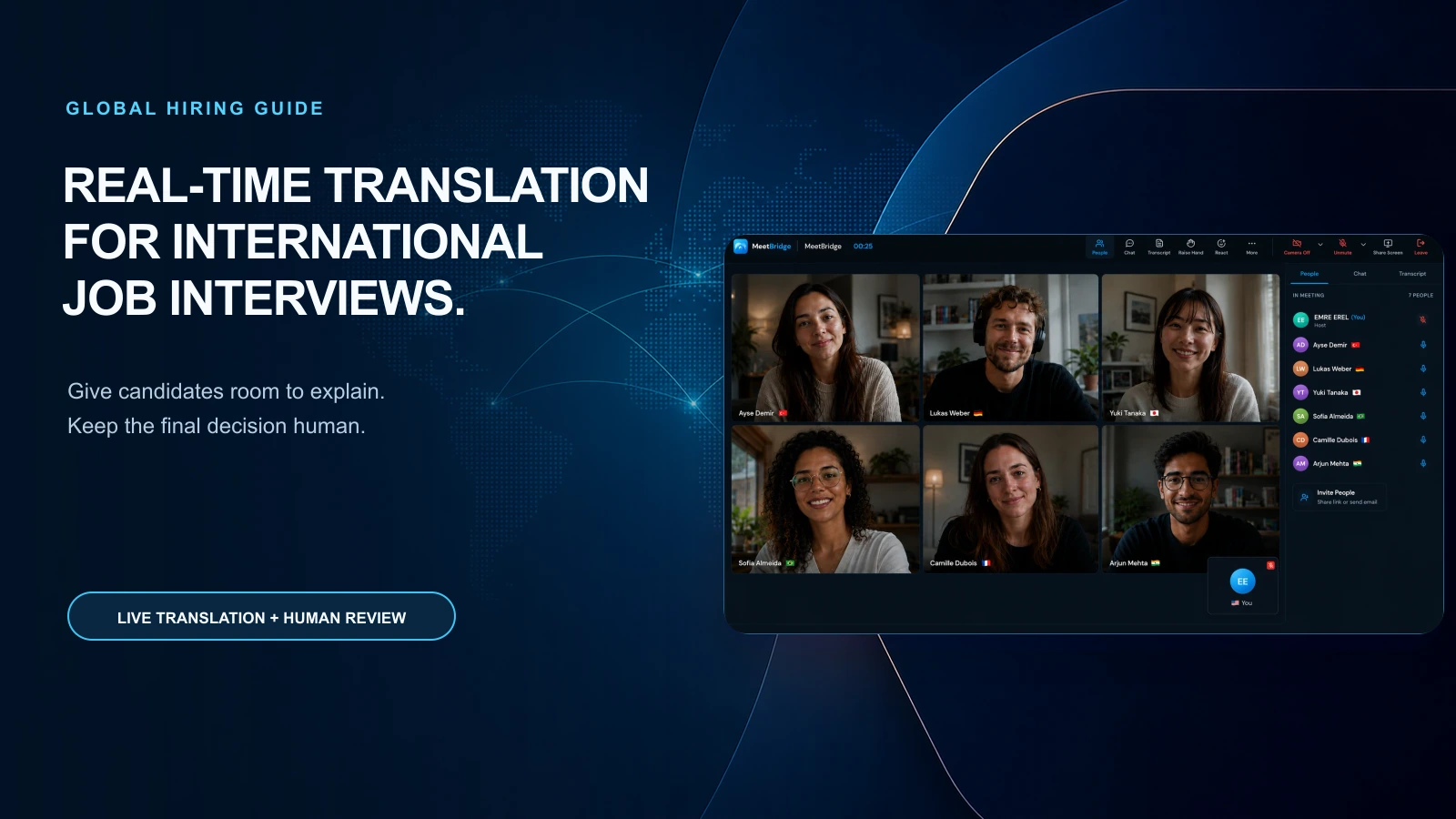
Real-Time Translation for Job Interviews: A Recruiter’s Guide
Real-time translation for international job interviews lets candidates and interviewers speak different languages during the same live conversation. A useful setup combines the right language pair, clear turn-taking, a shared question set, and a way to correct misunderstood answers before the hiring team evaluates them.
For recruiters: choose whether the interview needs translated audio, captions, or a human interpreter before sending the invitation. Confirm that both sides can join and use their required language. MeetBridge provides translated voice and transcript context in a separate MeetBridge meeting room; it does not add translation to an existing Teams, Zoom, or Google Meet call.
This guide covers a single interview from preparation to human review. For scheduling, interviewer capacity, and consistency across many interviews, use the separate multilingual candidate interviews at scale playbook.
A practical 30-minute multilingual interview agenda
The timings below are a planning example, not measured customer results. Adjust the interview length when translation or an accommodation requires more time.
| Time | Recruiter action | What to confirm |
|---|---|---|
| Before the call | Ask for preferred speaking and listening languages; test access and audio | The exact language pair works for both participants |
| Minutes 0–3 | Explain translation, transcription, and the correction process | The candidate understands the setup and can raise concerns |
| Minutes 3–7 | Ask one introductory question and let the translation finish | Names, role titles, and responsibilities are understood |
| Minutes 7–22 | Ask the prepared competency questions, one at a time | Evaluate job evidence; pause to clarify uncertain wording |
| Minutes 22–27 | Invite the candidate’s questions | Both sides can ask follow-up questions in their chosen language |
| Minutes 27–30 | Restate next steps and correct important details | Dates, responsibilities, and any unresolved points are explicit |
| After the call | Review uncertain transcript passages and complete the human scorecard | A fluent summary has not replaced the candidate’s actual meaning |
Candidate invitation template
Adapt this message to your real process before sending it:
We would like to invite you to a live interview for [role] on [date, time, and time zone]. Which language would you prefer to speak and hear? We plan to use [translation tool] for [translated audio/captions], with [an accurate explanation of any transcription or recording]. Please tell us if you need a different arrangement. During the interview, you can ask us to pause, repeat, or correct a translation. Your interviewer remains responsible for evaluating your answers.
Do not promise that recordings are disabled, data is deleted automatically, or transcripts are private unless those statements match the configured service and your hiring process. Share the correct room link and joining instructions, especially when candidates normally expect a Teams or Zoom invitation.
Which interview translation method should you choose?
| Situation | A practical starting point | What to test |
|---|---|---|
| Candidate prefers listening to translated speech | Live voice translation | Both translation directions, terminology, and time to finish listening |
| Candidate prefers reading while hearing original speech | Translated captions | Readability, screen sharing, and whether captions meet their needs |
| A job explicitly requires a particular language skill | A clearly identified language-assessment section | Keep that assessment separate from translated competency questions |
| Technical or consequential answers remain ambiguous | A qualified interpreter or bilingual clarification | Subject expertise and an agreed process for correcting the record |
Automated live translation is different from an automated video interview or automatic candidate scoring. This guide concerns conversations led and assessed by people. If you need asynchronous interviews or ATS integration, verify those capabilities separately.
Research note: Legal and regulatory references in this guide were reviewed on July 14, 2026. Employment, recording, privacy, accessibility, and AI rules differ by country and may change. This article is operational guidance, not legal advice. Review your process with qualified local counsel and HR or data-protection specialists where appropriate.
What real-time translation should do in an international interview
In a well-designed interview, real-time translation should help both sides participate in the same conversation.
It can support:
- A candidate answering behavioral or technical questions in their strongest language.
- A recruiter explaining the role, process, compensation structure, and next steps clearly.
- A hiring manager asking follow-up questions without waiting for a separate written translation.
- A panel reviewing a transcript after the interview instead of relying on one person's memory.
- A global HR team keeping a more consistent record across countries and interview stages.
Depending on the system, the live experience may use translated captions, translated audio, a bilingual transcript, or a combination of these. The right mode depends on the language pair, interview format, candidate preference, accessibility needs, and importance of voice conversation to the role.
If your team is still deciding between these formats, read Live Translation vs Translated Captions: What Is the Difference?. For the underlying workflow, see What Is a Live Meeting Translator and How Does It Work?.
What real-time translation should not do is equally important.
It should not:
- Infer a candidate's personality, trustworthiness, emotional state, or cultural fit from their voice.
- Turn pauses caused by translation latency into evidence of weak communication.
- Treat an accent as a competency score.
- Automatically rank candidates from translated transcripts or AI summaries.
- Hide the fact that speech, text, or generated audio is being processed.
- Replace a qualified human interpreter where the risk, law, accommodation, or interview design requires one.
- Become the sole source for a hiring decision.
That boundary keeps the tool focused on access to meaning rather than automated judgment.
Why multilingual job interviews are easy to get wrong
The visible problem is language. The deeper problem is process consistency.
Candidates may simplify answers in a second language
A candidate can understand a question and still struggle to explain the details of a project, conflict, technical decision, or leadership example in a non-native language. They may use shorter sentences, avoid nuance, or choose a safer example.
The panel can then mistake language economy for shallow experience.
Real-time translation gives the candidate more room to describe the situation, their action, and the result. It does not guarantee a perfect translation, but it can reduce the pressure to compress a complex answer into unfamiliar vocabulary.
A bilingual interviewer can become both interpreter and evaluator
Asking a bilingual recruiter or teammate to translate may look efficient. It also gives that person two jobs at once.
They must listen, interpret, choose equivalent wording, manage timing, observe the candidate, take notes, and form an evaluation. Important details can be shortened unintentionally. Other panel members may receive the interpreter's reconstruction rather than the candidate's full answer.
For informal screening, that may be manageable. For high-volume, senior, regulated, or technically complex hiring, it creates avoidable inconsistency.
Different candidates can receive different interview conditions
One candidate may interview directly in the panel's language. Another may use a bilingual teammate. A third may receive translated captions. A fourth may be asked to complete the interview entirely in a second language.
Those interviews are not automatically comparable.
The hiring team needs to decide in advance:
- Which competencies are being assessed?
- Is proficiency in a specific language actually required for the role?
- Which interview sections may use translation?
- Which questions, timing rules, follow-up prompts, and scoring anchors will remain consistent?
- How will translation errors or technical failures be documented?
The goal is not to make every interview technically identical. It is to give candidates a comparable opportunity to provide job-related evidence.
Notes can become more confident than the conversation
An AI-generated summary often sounds polished. That polish can hide uncertainty.
A translated answer may contain a terminology error. A transcript may assign a sentence to the wrong speaker. A summary may turn a tentative statement into a firm claim. If the panel reads only the summary, the most compressed output becomes the most influential one.
Use the hierarchy below:
- The candidate's intended meaning and any clarification they provided.
- The original and translated conversation context.
- The transcript as a review aid.
- The summary as a navigation aid.
- The scorecard completed by trained human interviewers.
The summary should never outrank the conversation.
Start with a structured interview, not a translation feature
Translation works best when the underlying interview is already disciplined.
The U.S. Office of Personnel Management describes structured interviews as using predetermined questions and common evaluation standards so candidates receive a more consistent opportunity to provide information. Its guidance emphasizes asking candidates the same questions in the same order and evaluating responses against the same rating scale. See the OPM structured interview guidance.
For a translated interview, structure should include:
- Job-related competencies defined before interviews begin.
- Core questions written in clear, direct language.
- Approved follow-up prompts for clarification.
- Behavioral anchors or evidence standards for each rating.
- Approved translations of core questions, permitted probes, competency definitions, and scoring anchors, reviewed by a qualified bilingual or native-language reviewer where the risk justifies it.
- The same interview duration or a documented translation-time adjustment.
- A process for marking translation or connectivity issues.
- A rule that interviewers score evidence, not accent, fluency, speed, or demeanor unless a clearly defined job requirement makes a communication skill relevant.
Translation does not repair an unstructured process. It may make an inconsistent conversation easier to understand, but the evaluation will still be inconsistent.
Separate job language requirements from interview language access
Global hiring teams should answer one question before offering translation:
Is proficiency in a particular language an essential part of this job, or is it merely the language the interview panel happens to use?
Those are different situations.
If a customer-support role requires daily communication with customers in German, the employer may need to evaluate job-related German communication. If a software engineer will work in a multilingual team where technical performance does not depend on polished spoken English, forcing the entire interview into English can measure the wrong thing.
In the United States, the EEOC explains that national-origin discrimination includes unfavorable treatment connected to ethnicity or accent and applies to hiring. The agency's guidance says language or accent requirements should be connected to effective job performance rather than assumptions about where a person comes from. Review the EEOC national-origin discrimination guidance.
A practical interview design can separate the two goals:
- Use the candidate's preferred language, with translation, for experience, leadership, problem-solving, and role-context questions.
- Use a clearly identified section to test the language actually required for the job.
- Explain why that section is different.
- Apply the same job-related standard to every candidate for the same role.
- Do not score translation latency, system errors, or accent as candidate performance.
This lets the team evaluate required language ability without turning the entire interview into an unnecessary language test.
Before the interview: design the multilingual process
Most failures can be prevented before anyone joins the call.
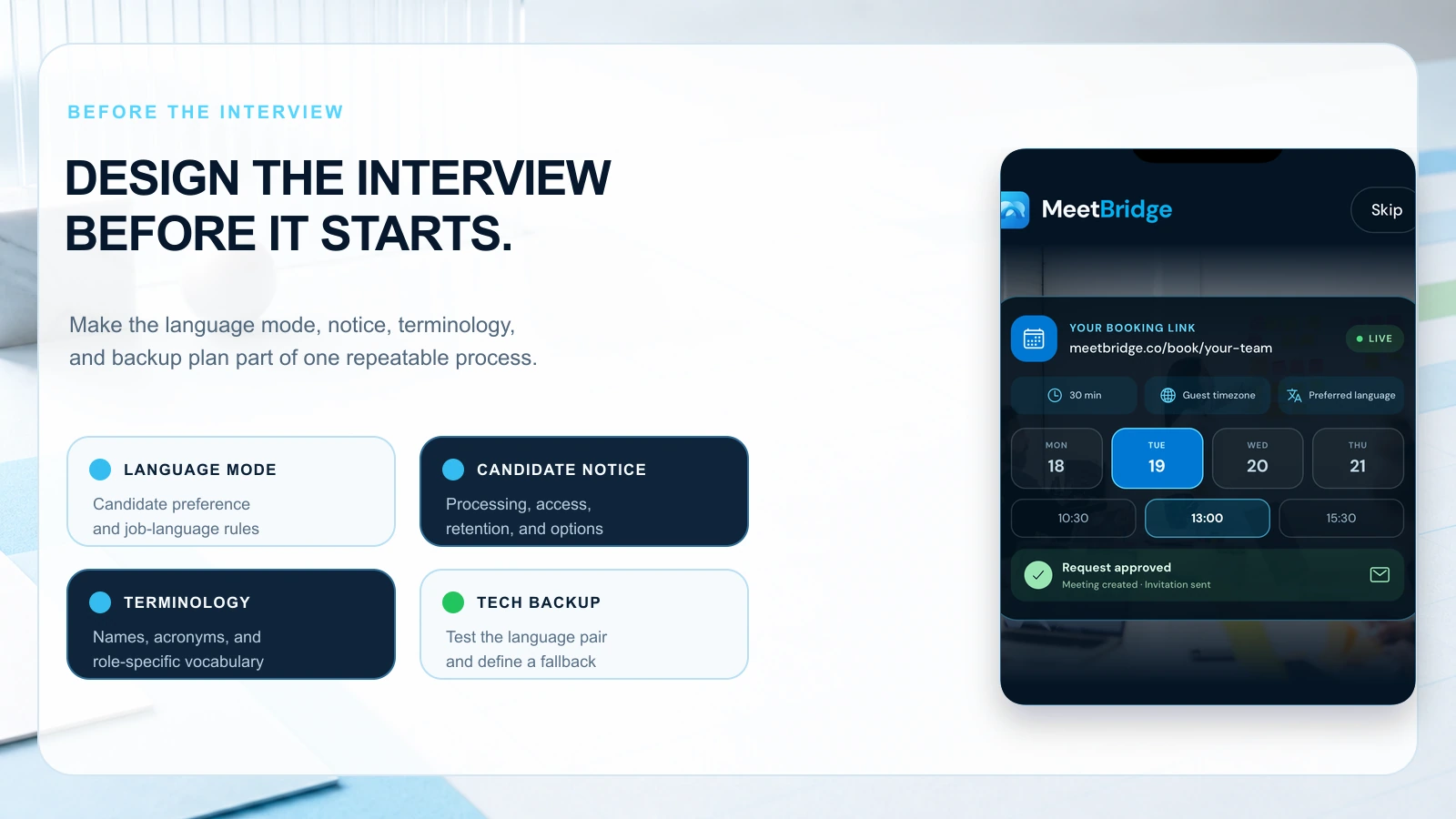
1. Define the interview's purpose
Write down what this interview stage must establish.
For example:
- Recruiter screen: motivation, eligibility, availability, salary alignment, and high-level experience.
- Hiring manager interview: role competencies, scope, decisions, collaboration, and impact.
- Technical interview: technical reasoning, implementation choices, tradeoffs, and debugging.
- Panel interview: evidence across several competencies and stakeholder perspectives.
- Executive interview: strategic judgment, leadership systems, risk, and organizational impact.
Do not add translation to a vague interview. Clarify the evidence you need first.
2. Decide which language mode applies
Give the candidate a clear choice where the process allows it:
- Speak in their preferred language throughout.
- Use translation only when needed.
- Read translated captions while hearing the original audio.
- Use translated audio if available and appropriate.
- Conduct a defined job-language assessment without translation.
Test the exact language pair. A platform's total language count does not prove that your required pair handles job titles, acronyms, names, technical vocabulary, and regional pronunciation well.
3. Send a candidate notice in advance
The invitation should explain:
- That real-time translation or transcription will be used.
- Whether translated text, generated audio, a transcript, notes, or a recording may be created.
- Why the system is being used.
- Who may access the interview record.
- How long the organization expects to retain it.
- Whether the candidate can request another interview arrangement.
- Where the candidate can ask privacy, accessibility, or process questions.
Do not wait until the candidate joins a panel call to reveal that AI-supported processing is active.
For UK recruitment, Acas advises employers to prepare consistent questions, plan for online-interview technology and backups, obtain permission if an interview needs to be recorded, and store recordings or notes securely. See the current Acas guidance on interviewing job applicants.
Local requirements differ, especially for recording, voice processing, employment monitoring, and consent. Make the notice part of a reviewed hiring policy rather than an improvised sentence from each recruiter.
4. Ask about access needs without making assumptions
Language preference and disability accommodation are not the same thing.
A candidate may need translated speech, captions, a sign-language interpreter, extra time, a different input method, or another adjustment. Ask what would help them participate, and route accommodation requests through the appropriate HR process.
Do not assume real-time translation replaces an accommodation. Do not infer a disability, health condition, nationality, or immigration status from a language request.
5. Collect only useful pre-interview context
MeetBridge booking links can help teams collect participant context and custom answers before a meeting. For hiring, useful questions may include:
- Preferred spoken language.
- Preferred translation mode.
- Time zone and availability.
- The correct pronunciation of the candidate's name.
- Whether they need an accessibility or interview adjustment contact.
- Role-specific preparation information already approved by HR.
Avoid collecting sensitive information simply because a custom field exists. Keep pre-interview questions tied to scheduling, access, and the assessment process.
6. Prepare terminology and proper nouns
Build a short reference list for:
- Company and product names.
- Team names and internal acronyms.
- Role-specific technical terms.
- Certifications and professional qualifications.
- Locations, customer segments, and industry vocabulary.
The interviewer should still define unfamiliar jargon. A glossary reduces avoidable errors; it does not justify speaking in unexplained internal language.
7. Run a technical check and define a backup
Confirm:
- The candidate can open the meeting link on their device.
- Microphone and audio routing work.
- The candidate can select or confirm the correct language.
- The panel knows how to identify active translation or transcription.
- The team has a backup link, phone option, reschedule rule, or human interpreter path.
- A technical failure will not be treated as poor candidate performance.
If the system fails during a high-stakes answer, stop, explain the issue, and restore comparable interview time.
During the interview: protect meaning and candidate agency
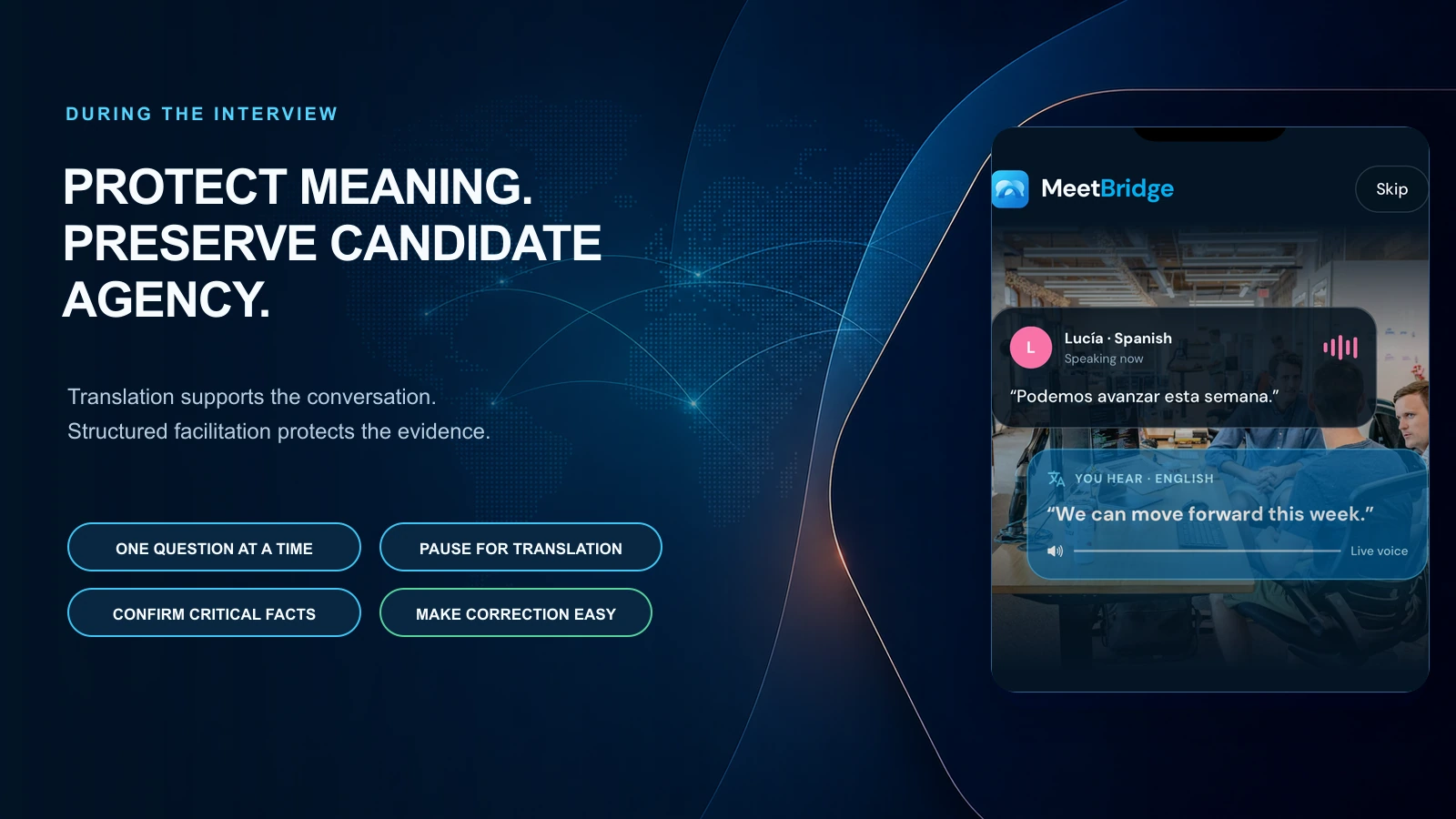
Set expectations in the first two minutes
The facilitator should explain:
- Which language each participant will use.
- Whether translation appears as text, audio, or both.
- That small delays or errors may occur.
- How the candidate can request repetition or correction.
- Whether a transcript, summary, or recording is being created.
- Which parts of the interview, if any, assess a required job language.
Ask the candidate to confirm that the setup is understandable before scoring begins.
Use translation-friendly turn-taking
Good interview technique also improves translation quality.
- Ask one question at a time.
- Use short, complete thoughts rather than fragments.
- Avoid several panelists speaking over one another.
- Pause after complex questions.
- Expand acronyms the first time they appear.
- State numbers, dates, currencies, and technical identifiers clearly.
- Let the candidate finish before adding a follow-up.
- Repeat a question in simpler wording when the meaning is unclear.
Do not reduce every question to unnatural, robotic language. The goal is clear conversation, not speaking to the translation system.
Distinguish a pause from a performance signal
A candidate may pause because they are:
- Waiting for translated audio.
- Reading a caption.
- Checking whether a technical term was translated correctly.
- Switching between languages.
- Deciding how to correct the output respectfully.
Interviewers should not treat those pauses as evidence of weak confidence, poor executive presence, or slow thinking.
If response speed is truly job-relevant, test it in a separate, defined exercise with comparable conditions.
Make correction easy
Give the candidate simple phrases or controls for:
- “That translation is not what I meant.”
- “Please repeat the original question.”
- “I would like to answer that term in English.”
- “The number/date/name in the transcript is incorrect.”
- “Can we pause the translation for this section?”
When a correction matters to the evaluation, the interviewer should restate the corrected meaning and mark it in the notes.
Confirm critical claims
Use confirmation for details such as:
- Employment dates.
- Team size and scope.
- Revenue, budget, volume, or performance numbers.
- Certifications and licenses.
- Technical architecture.
- Legal work authorization questions approved by HR.
- Availability and compensation expectations.
For example: “I understood that you led a team of 12 across three countries. Is that correct?”
Confirmation is not an interrogation. It is a way to prevent one translation error from becoming a scorecard fact.
Give the panel explicit roles
For panel interviews, assign:
- Facilitator: manages timing, language mode, and candidate questions.
- Question owner: asks the planned competency question.
- Evidence note-taker: records job-related evidence and flags translation uncertainty.
- Technical observer: monitors connection and translation issues without evaluating the candidate.
- Decision owner: ensures the debrief follows the approved scorecard.
One person can hold more than one role in a small team, but everyone should know who owns the process.
After the interview: review evidence without automating the decision
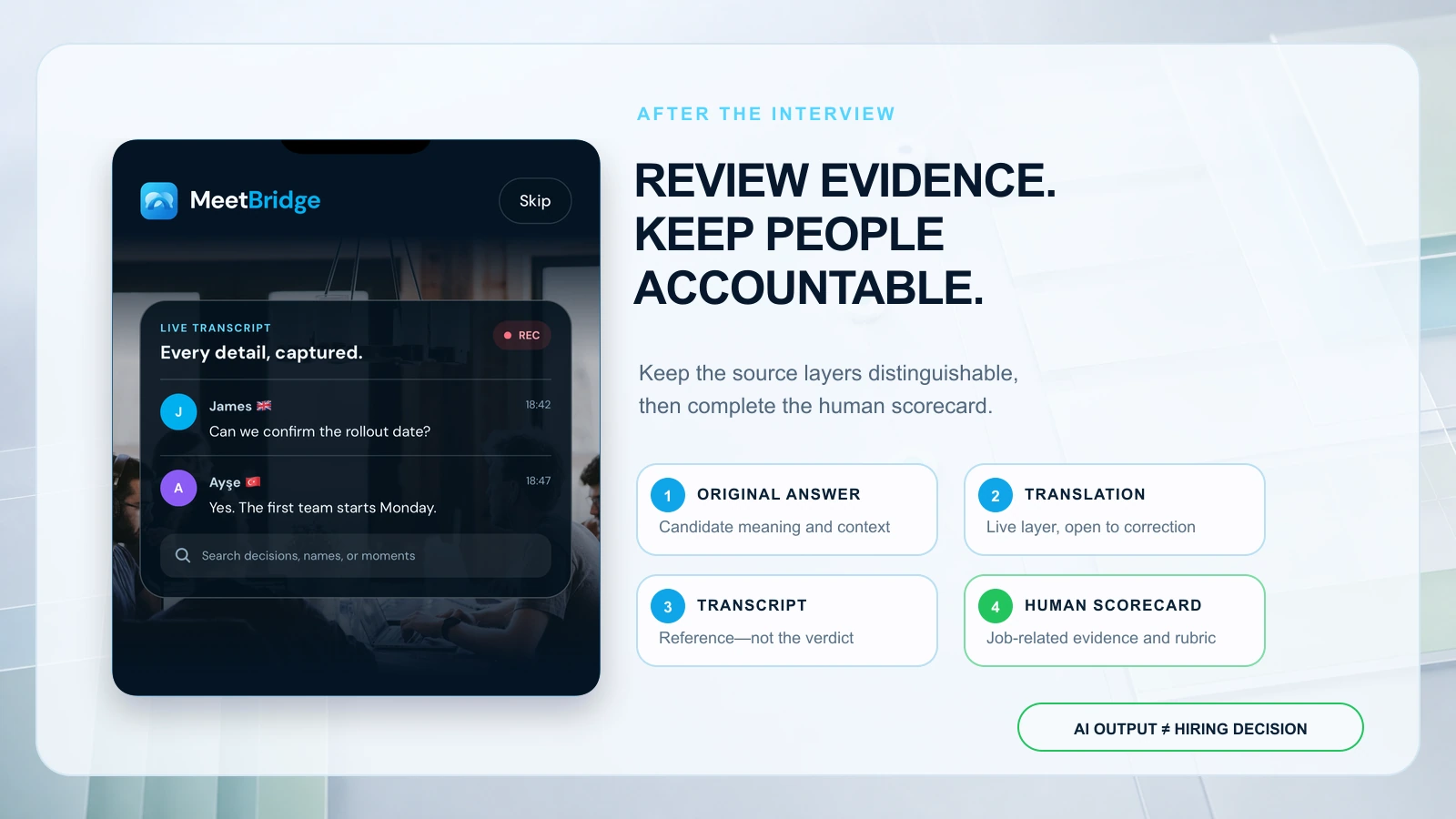
Review the transcript as a reference, not a verdict
MeetBridge transcripts and meeting memory can keep interview details available for later review. That is useful when several stakeholders need to compare what they heard or revisit a candidate's explanation.
The transcript may still contain errors caused by noise, accents, overlapping speech, terminology, or connectivity. Review uncertain passages against the surrounding context and any correction made during the interview.
Do not copy a translated sentence into a rejection rationale without checking that it accurately represents the candidate's answer.
Complete scorecards before group influence takes over
Each interviewer should complete their evidence-based assessment before a broad panel discussion where possible.
The scorecard should contain:
- The competency assessed.
- Evidence from the candidate's answer.
- The relevant situation, action, and result.
- Any translation or technology limitation affecting that evidence.
- A rating tied to the approved behavioral anchor.
- Follow-up questions that remain unresolved.
Avoid labels such as “not polished,” “not confident,” “hard to understand,” or “not a culture fit” unless the interviewer can connect the observation to a defined, job-related criterion and separate it from language or accent.
Use summaries for navigation
Meeting summaries and actions can help recruiters identify follow-up tasks, open questions, and process next steps. For hiring, appropriate outputs may include:
- Send the technical exercise.
- Confirm availability with the candidate.
- Ask the hiring manager to review a specific project example.
- Schedule the next interview stage.
- Resolve an unclear certification or employment date.
An AI summary should not declare that a candidate is “strong,” “weak,” “honest,” or “a good fit.” Those are selection judgments, not administrative follow-up.
Keep original, translated, and generated layers distinguishable
Where your system and policy allow, reviewers should be able to tell the difference between:
- What the candidate originally said.
- The live translation.
- A corrected translation.
- Interviewer notes.
- An AI-generated summary.
- The final human scorecard.
Collapsing these into one document makes errors harder to trace.
Give the candidate a follow-up path
Tell candidates how to:
- Ask a process question.
- Correct an important factual misunderstanding.
- Request an accessibility or privacy contact.
- Learn when the hiring team expects to decide.
- Understand the next interview stage.
This does not mean candidates rewrite their interview after the fact. It gives them a channel to address a material translation or process error.
How the workflow changes by interview type
| Interview type | Translation priority | Main risk | Recommended control |
|---|---|---|---|
| Recruiter screen | Fast two-way understanding | Administrative details become inaccurate | Confirm dates, location, availability, and compensation details explicitly |
| Hiring manager interview | Nuanced examples and follow-up | Language fluency is mistaken for depth of experience | Use structured questions and score job-related evidence |
| Technical interview | Exact terminology, logic, and numbers | Code, architecture, units, or acronyms are mistranslated | Let candidates keep technical terms in the original language and verify critical details |
| Panel interview | Consistent experience across several interviewers | Cross-talk, duplicated questions, and uneven interpretation | Use one facilitator, planned turns, and shared correction rules |
| Executive interview | Strategic context and ambiguity | Polished summaries overstate certainty | Review original context and separate synthesis from evidence |
| Job-language assessment | Direct observation of required language skill | Translation masks the competency being tested | Define a separate no-translation section with consistent standards |
For more general tool selection criteria, read Live Translation App for Meetings: What Business Teams Should Look For in 2026.
Real-time translation software checklist for global hiring
Evaluate the full interview workflow, not only the language list.
Live experience
- Does the exact language pair work in realistic interview conditions?
- Are translated captions, audio, or both available in the mode you need?
- Is latency manageable for behavioral and technical questions?
- Can participants correct the selected language?
- Can the candidate follow the original speaker as well as the translation?
- What happens when two people speak at once?
Candidate access
- Can an external candidate join without a difficult account setup?
- Does the invitation explain device and software requirements?
- Is there a backup path for unsupported devices or weak connections?
- Can the organization support relevant accessibility adjustments?
- Can the candidate understand when processing features are active?
Interview record
- Is the transcript connected to the correct meeting and speakers?
- Can reviewers distinguish transcript context from AI-generated summaries?
- Are corrections visible or documentable?
- Can access be limited to the appropriate hiring team?
- Can retention and deletion follow the employer's policy?
Hiring governance
- Does the vendor describe how speech, translation, transcripts, and generated outputs are processed?
- Has the employer documented its purpose and legal basis where required?
- Are candidates told how the tool is used?
- Is the system prohibited from becoming the sole decision-maker?
- Are interviewers trained not to score latency, accent, or translation artifacts?
- Is there a process to audit errors across language pairs and candidate groups?
Procurement and security
- Who is the controller, processor, or service provider for each data flow?
- Which subprocessors support speech, translation, hosting, or generated audio?
- Where can processing and storage occur?
- What contractual, transfer, deletion, and incident terms apply?
- Will candidate content be used for model training, product improvement, or unrelated analytics, and can that use be disabled or contractually restricted?
- Is a data-protection impact assessment or similar review required?
- Can the vendor support the organization's security questionnaire?
MeetBridge publishes a security overview, a Meeting Voice & AI Processing notice, and a Data Processing Agreement to help teams review these questions against their own obligations.
Privacy, recording, and AI governance
An interview can include identity data, employment history, compensation expectations, disability or accommodation information, immigration-related details, and other sensitive context. Adding translation, transcription, generated speech, or summaries changes the data flow even when the meeting is not permanently recorded as audio.
Map the actual processing
Document:
- Audio processed during the live interview.
- Captions and translated text.
- Generated translated audio.
- Final transcripts.
- Interviewer notes.
- AI-generated summaries and action items.
- Meeting metadata and participant identity.
- Exports or information copied into an applicant tracking system.
- Retention, backups, and deletion.
Do not describe the system to candidates only as “translation” if it also creates a stored transcript and summary.
Minimize candidate data
The UK Information Commissioner's Office advises organizations using AI in recruitment to identify a lawful basis, define controller and processor responsibilities, explain AI use to candidates, monitor fairness and accuracy, and limit collection to the personal information required for the purpose. See the ICO's data-protection considerations for AI-assisted recruitment.
Operationally, that means:
- Do not retain every transcript indefinitely “just in case.”
- Do not reuse interview content for unrelated purposes without review and an appropriate basis.
- Do not expose candidate records to broad internal audiences.
- Do not infer protected or highly sensitive traits from speech or text.
- Do not collect sensitive information through pre-interview questions unless it is necessary and properly governed.
Keep people accountable for the decision
The EU AI Act treats certain employment-related AI uses as high-risk, and its rules and implementation timeline continue to evolve. The European Commission's current AI Act implementation overview emphasizes risk management, data quality, logging, documentation, transparency, human oversight, robustness, cybersecurity, and accuracy for high-risk systems.
A translation feature used only to help people understand one another is different from a system that scores, ranks, recommends, or rejects candidates. The boundary can change when an employer feeds translated content into automated selection logic.
Labels do not decide the classification. A product described as “translation” may create a materially different risk if it also tags candidate traits, generates evaluative summaries, filters applicants, recommends who should advance, or becomes the practical basis for a human decision.
Ask:
- Does the system merely translate, or does it evaluate?
- Does a generated output materially influence who advances?
- Can a human understand, challenge, and override the output?
- Can the organization explain the decision using job-related evidence?
- Are candidates told about automated processing that may affect them?
Obtain legal advice for the countries and hiring use cases in scope.
When to use a human interpreter instead
Real-time AI translation is useful for many screening, hiring manager, and routine cross-border interviews. It is not automatically the right choice for every interview.
Consider a qualified human interpreter when:
- Law, regulation, a collective agreement, or accommodation process requires one.
- The interview concerns a safety-critical or licensed role where exact language has high consequences.
- The candidate uses a language or dialect the system has not performed well on.
- The interview includes sensitive legal, medical, immigration, or employee-relations issues.
- The hiring team needs consecutive or simultaneous interpretation managed by a trained professional.
- A previous translation failure materially affected the process.
- The candidate requests an arrangement the organization determines should be supported by a professional interpreter.
A human interpreter also needs a clear role, confidentiality expectations, preparation, and consistent interview rules. Human interpretation reduces some risks and introduces others; it is not a substitute for process design.
For a broader comparison of the two approaches, read Live Meeting Translation vs Human Interpreters for Business Calls.
A MeetBridge workflow for international job interviews
MeetBridge for HR and international hiring is designed to help recruiters, hiring managers, people teams, and global HR operations run multilingual candidate and employee conversations with clearer records and follow-up.
A practical workflow looks like this:
1. Prepare through the booking flow
Use a booking link or invitation to collect the candidate's language preference, time zone, and approved preparation details. Include the candidate notice and a contact for access or privacy questions.
2. Run the live translated interview
Let participants speak naturally while live translation helps the other side follow the conversation. Keep questions structured, manage turn-taking, and confirm critical details.
3. Preserve the review context
Use the transcript and meeting history to revisit exact examples, terminology, corrections, and commitments. Limit access to the relevant hiring team.
4. Turn the meeting into process actions
Use summaries and action items for administrative follow-up: schedule the next stage, send an exercise, resolve an open question, or update the candidate. Do not use a generated summary as an automated hiring recommendation.
5. Complete the human scorecard
Interviewers record job-related evidence against the same rubric used for other candidates. Translation or connectivity limitations remain visible in the review.
6. Retain and delete according to policy
Apply the organization's recruitment retention schedule, access controls, candidate-rights process, and deletion requirements to the meeting record and any downstream copies.
A 30-day pilot plan for global hiring teams
Week 1: define scope and controls
- Select one or two roles with recurring international interviews.
- Choose two or three priority language pairs.
- Document which competencies are assessed and whether job-language testing is required.
- Approve candidate notice, privacy, accommodation, retention, and escalation language.
- Define a human interpreter fallback.
Week 2: test the complete interview
- Run internal mock interviews with native or fluent speakers.
- Test behavioral, technical, numerical, and company-specific vocabulary.
- Measure translation delay and recovery from cross-talk.
- Test candidate joining, language selection, transcript review, and access permissions.
- Create a short interviewer training guide.
Week 3: run a controlled pilot
- Invite a small number of candidates with clear notice and choice.
- Use the same structured questions and scoring anchors as the standard process.
- Mark every material translation, transcript, or connectivity issue.
- Ask candidates and interviewers about clarity without asking them to rate protected traits or accent.
Week 4: review and decide
- Compare completion rates, interview length, issue frequency, and follow-up time.
- Audit whether scorecards contain job-related evidence.
- Check whether interviewers relied on summaries instead of the conversation.
- Review access, retention, and candidate communications.
- Decide which roles, languages, and interview stages are ready to scale.
Metrics that are useful—and metrics to avoid
Useful operational metrics
- Candidate-reported ability to understand the interview process.
- Interviewer-reported ability to understand job-related answers.
- Number of material translation corrections.
- Number of technical interruptions or reschedules.
- Time spent on post-interview note reconstruction.
- Percentage of scorecards completed with specific evidence.
- Time from interview to candidate follow-up.
- Language pairs that need glossary work or a human interpreter.
- Candidate withdrawal or completion rate, reviewed carefully and in context.
Metrics to avoid
- Accent quality score.
- Emotion, enthusiasm, honesty, or confidence inferred from voice.
- Culture-fit score generated from translated text.
- Personality prediction from speech patterns.
- Automatic ranking from transcript keywords.
- Penalizing candidates for translation delay or correction requests.
- Comparing raw speaking speed across languages.
Measure whether the process works. Do not turn linguistic variation into a proxy for employability.
International interview checklist
Before the interview:
- [ ] The role's competencies and language requirements are documented.
- [ ] Questions and scoring anchors are structured and job-related.
- [ ] The candidate received clear notice about translation and data processing.
- [ ] Language preference and access needs were confirmed.
- [ ] The exact language pair and device flow were tested.
- [ ] Interviewers know the backup and correction process.
- [ ] Access and retention rules are approved.
During the interview:
- [ ] The facilitator explains the language and processing setup.
- [ ] Panelists use one-speaker-at-a-time turn-taking.
- [ ] Translation pauses are not scored as candidate behavior.
- [ ] Technical terms, names, dates, and numbers are confirmed.
- [ ] The candidate can request repetition or correction.
- [ ] Any material technology issue is documented and time is restored.
After the interview:
- [ ] Interviewers complete evidence-based scorecards.
- [ ] Uncertain transcript passages are reviewed in context.
- [ ] AI summaries are used for navigation and follow-up, not selection.
- [ ] The panel separates original, translated, corrected, and generated content.
- [ ] Candidate follow-up is sent promptly.
- [ ] Records remain limited to authorized people and the approved retention period.
Frequently asked questions
Does real-time translation make an international job interview fair?
Not by itself. It can reduce language friction, but fairness also depends on structured questions, comparable conditions, job-related scoring, candidate notice, accommodation processes, human review, and appropriate data handling.
Should candidates be allowed to interview entirely in their native language?
That depends on the role and assessment purpose. If a particular language is not an essential job competency, translation may help the team evaluate the candidate's actual experience. If the role requires a specific language, test that skill in a clearly defined and consistent interview section.
Can a company record a translated interview?
Recording rules differ by country and context. Give clear advance notice and obtain any permission required by applicable law, employment policy, or contract. Also explain whether translation or transcription creates stored text even if permanent audio recording is not enabled.
Can recruiters use the translated transcript to score candidates?
The transcript can support evidence review, but it may contain errors. Interviewers should check important passages, account for corrections, and score the candidate against a job-related rubric. The transcript should not be the sole source for the decision.
Is AI translation better than a human interpreter for interviews?
It depends on the interview. AI translation can provide faster access, consistent availability, and connected transcripts for many routine interviews. Qualified human interpreters may be more appropriate for legally sensitive, accommodation-related, safety-critical, low-resource-language, or unusually complex interviews.
What if the translation is wrong during a critical answer?
Pause the interview, let the candidate restate or correct the answer, confirm the intended meaning, document the correction, and restore any lost time. If the issue cannot be resolved, reschedule or use a qualified interpreter rather than scoring incomplete evidence.
Should AI generate a recommendation after the interview?
For this workflow, no. AI can organize a summary or follow-up tasks, but trained people should evaluate candidates using approved, job-related criteria. Automated employment recommendations introduce additional fairness, transparency, privacy, and regulatory risk.
How should global teams compare candidates interviewed in different languages?
Keep the competencies, core questions, follow-up rules, time policy, and rating anchors consistent. Document the language mode and any material translation issue. Compare evidence against the role requirements, not fluency in the interviewer's language unless that fluency is itself a documented job requirement.
How can MeetBridge support international interviews?
MeetBridge connects booking context, live translation, transcripts and meeting memory, summaries, and actions in one workflow. HR teams can use it to reduce language friction during the conversation and preserve a clearer record for human review and follow-up.
Final guidance for global hiring teams
The best real-time translation workflow does not make the technology the center of the interview.
It gives the candidate more room to explain what they have done. It gives interviewers more reliable access to the answer. It gives the hiring team a reviewable record. And it keeps the final decision with trained people using job-related evidence.
Use real-time translation when it helps the interview measure the right competencies. Keep required language testing explicit. Tell candidates what is being processed. Make correction easy. Review transcripts and summaries with appropriate skepticism. Retain only what the organization needs.
When those controls are in place, international interviews can become more consistent, more understandable, and easier to move from conversation to responsible hiring action.
To explore the complete workflow, visit MeetBridge for HR and international hiring or review the broader guide to best real-time meeting translation software in 2026.
Related MeetBridge resources
- HR and international hiring
- Live translation
- Transcripts and meeting memory
- Meeting summaries and actions
- Booking links
- How Multinational Companies Eliminate Language Barriers in Meetings
- Live Translation App for Meetings: What Business Teams Should Look For in 2026
- Best Real-Time Meeting Translation Software in 2026
- What Is a Live Meeting Translator and How Does It Work?
- Live Translation vs Translated Captions: What Is the Difference?
- Live Meeting Translation vs Human Interpreters for Business Calls
- What to Look for in Multilingual Meeting Software
Official references
- U.S. Office of Personnel Management: Structured Interviews
- U.S. Equal Employment Opportunity Commission: National Origin Discrimination
- Acas: Interviewing Job Applicants
- UK Information Commissioner's Office: AI-Assisted Recruitment Data Protection Considerations
- European Commission: AI Act Implementation Overview