 By MeetBridge Team
Live Translation for Health Tourism Consultations: Improve Patient Intake and Treatment Follow-Up
Learn how live translation helps health tourism teams improve multilingual patient intake, doctor coordination, treatment planning handoffs, meeting records, and follow-up after consultations.
Live Translation for Health Tourism Consultations: Improve Patient Intake and Treatment Follow-Up
Health tourism consultations depend on trust before they depend on travel.
A patient may be speaking with a clinic in another country for the first time. They may be comparing treatment options, trying to understand the process, asking about recovery, sharing personal health concerns, or deciding whether they feel safe enough to travel. The clinic or health tourism agency may need to collect intake details, coordinate with doctors, explain next steps, and keep the patient engaged after the call.
When the patient and the care team do not share the same language, every part of that journey becomes harder.
A slow translation handoff can make the patient feel distant. A missing intake detail can delay treatment planning. A weak follow-up summary can create confusion about documents, appointments, preparation, payment, travel timing, or post-treatment instructions. A coordinator may understand the patient during the call but fail to transfer the full context to the clinical team afterward.
That is why health tourism teams should think about live translation as more than a convenience feature.
The right live translation workflow can help teams improve:
- Patient intake quality.
- First consultation clarity.
- Treatment planning coordination.
- Doctor and coordinator handoffs.
- Follow-up after the meeting.
- Patient confidence before travel.
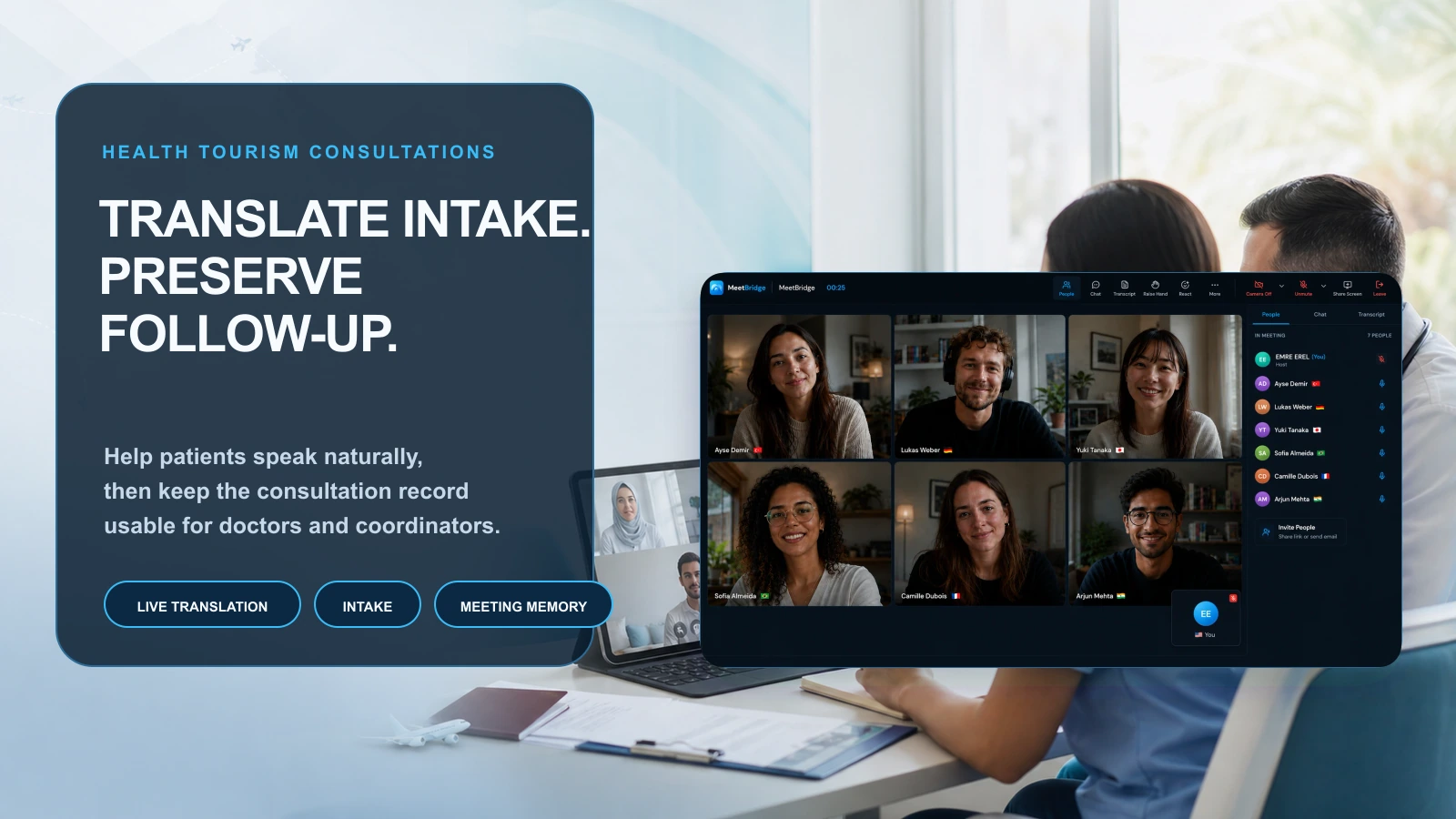
MeetBridge is built for multilingual meetings where language affects trust, urgency, and follow-through. For health tourism teams, it connects live translation, booking links, transcripts and meeting memory, and meeting summaries and actions into one consultation workflow.
For the industry-specific use case, start with MeetBridge for health tourism.
Why live translation matters in health tourism consultations
Health tourism is built around cross-border trust. Patients often choose a clinic, agency, or treatment destination before they ever arrive in person. The first consultation may shape whether they feel understood, whether they share sensitive details honestly, and whether they believe the team can guide them safely through the next step.
Language friction can affect that trust in several ways:
- The patient avoids asking questions because speaking feels difficult.
- The coordinator simplifies the explanation too much.
- The doctor receives an incomplete version of the patient’s concern.
- A family member translates informally and filters details unintentionally.
- The patient says “yes” even when they have not fully understood.
- Follow-up instructions are written without the context from the live call.
- The next coordinator starts from zero because the previous conversation was not preserved.
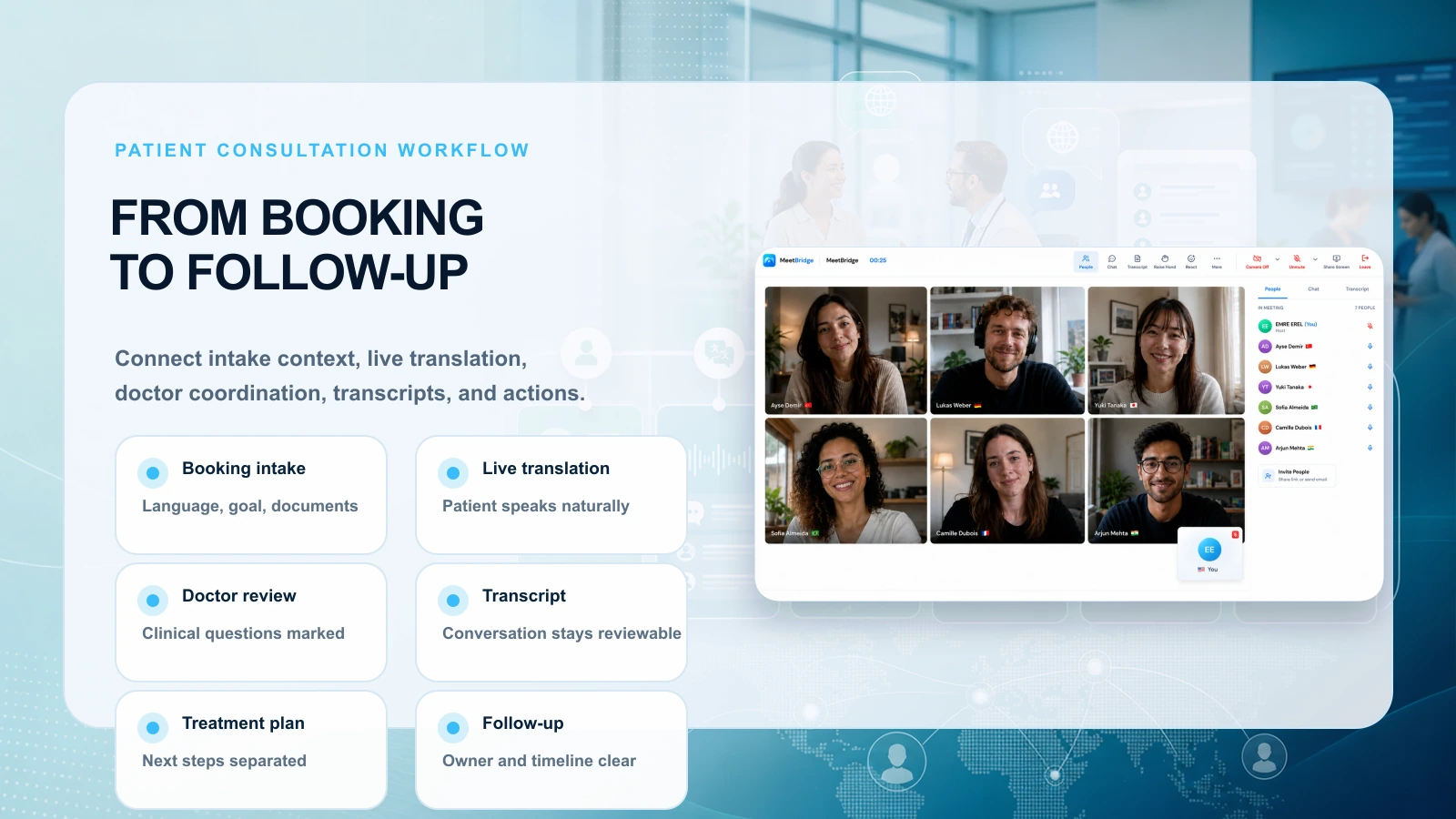
A live translation tool can help the patient speak in the language they know best. But health tourism teams need more than live understanding. They need a record of the conversation, a clean handoff, and a follow-up plan that can be reviewed before the next interaction.
That is where a meeting platform matters.
A basic translation app helps people understand a sentence. A multilingual consultation workflow helps the team understand the patient, preserve the context, and move the case forward.
Health tourism consultations are not ordinary sales calls
Health tourism teams do need to convert interest into action. But the meeting is not only a sales conversation.
A patient consultation can include:
- Symptoms, concerns, expectations, and treatment goals.
- Medical history, medications, allergies, previous procedures, and current limitations.
- Photos, test results, scans, or documents that must be reviewed by a qualified professional.
- Questions about treatment options, preparation, recovery, travel, accommodation, and timing.
- Emotional concerns about safety, pain, privacy, cost, and family support.
- Coordination between patient-facing staff, doctors, nurses, translators, and operations teams.
- Follow-up instructions that must be clear, accurate, and confirmed.
That makes communication quality especially important.
A patient may not know which detail matters clinically. A coordinator may not know which statement should be escalated. A doctor may need more context before making a recommendation. A follow-up team may need to explain the next step without changing the meaning of what was discussed.
This is why live translation for health tourism should be designed around the full patient consultation lifecycle.
| Stage | What the patient needs | What the team needs | Where live translation helps |
|---|---|---|---|
| Before the call | A clear way to share context and choose a language | Intake questions, documents, expectations, and meeting purpose | Booking context prepares the consultation before translation starts |
| During intake | A safe way to explain concerns in their own language | Accurate patient story, timeline, and required details | Live translation keeps the conversation direct and natural |
| During treatment discussion | Clear explanation of process, risks, requirements, and next steps | Doctor/coordinator alignment and clarification checkpoints | Translation supports two-way explanation, not only one-way captions |
| After the call | A clear summary and next-step plan | Transcript, decisions, tasks, owners, and follow-up context | Meeting memory and meeting summaries reduce lost details |
| Before the next interaction | Continuity and confidence | Reviewable case context and open questions | The team can continue from the previous conversation instead of starting over |
For a broader explanation of how real-time translation should connect to meeting outcomes, read Best Real-Time Meeting Translation Software in 2026.
What patient intake should capture before the consultation
A better multilingual consultation starts before the patient joins the call.
If the health tourism team begins with no context, the first 10 minutes often become basic clarification. The coordinator asks what the patient is looking for. The patient repeats information already sent through WhatsApp, email, or a website form. The doctor joins later without the full background. The follow-up team has to rebuild everything again after the meeting.
A stronger workflow collects essential context before the call and connects it to the meeting record.
With MeetBridge booking links, teams can collect meeting requests, ask custom pre-meeting questions, and prepare the consultation with more context.
For health tourism, pre-consultation intake may include:
- Patient’s preferred spoken language.
- Patient’s preferred written follow-up language.
- Country and time zone.
- Treatment area or procedure interest.
- Main concern or goal.
- Current stage: exploring, ready to book, second opinion, post-treatment follow-up, or urgent clarification.
- Existing documents or files that need review through the clinic’s approved process.
- Travel window or target treatment date.
- Whether a family member, companion, or caregiver will join.
- Questions the patient wants answered during the consultation.
- Consent and privacy acknowledgments required by the organization.
The key is not to collect every possible detail. The key is to collect the right information through approved, secure processes so the consultation can begin with context.
A well-prepared multilingual consultation feels more professional because the patient does not have to repeat everything. It also helps the team decide who should attend the meeting: patient coordinator, doctor, nurse, treatment planner, travel coordinator, or financial counselor.
Live translation helps patients explain the problem in their own words
Patient intake is not only a checklist. It is a story.
A patient may describe when something started, what they have already tried, what worries them most, and what outcome they hope for. They may use everyday language, regional expressions, or emotional wording that does not fit neatly into medical categories. They may switch between symptoms, travel concerns, financial questions, and family expectations.
When a patient is forced to speak in a second language, they may simplify the story. They may omit uncertainty. They may avoid sensitive details. They may agree too quickly because they do not want to slow down the call.
Live translation changes the dynamic.
With MeetBridge live translation, participants can follow the conversation while people speak. For health tourism consultations, that means the patient can explain concerns in a language they know well, while the coordinator or care team can respond without turning the whole meeting into a manual interpretation session.
This helps in moments like:
- “I had this procedure before, but I was not happy with the result.”
- “I am worried about traveling alone after treatment.”
- “My doctor in my country told me something different.”
- “I do not understand whether I need to stay one week or two weeks.”
- “What happens if I have a complication after I return home?”
- “Can I send my scans before deciding?”
These are not just sentences to translate. They are signals of patient intent, concern, readiness, and risk. A better live translation workflow helps the team hear the full context and then capture it for review.
For a general comparison of live translation and caption-only approaches, read Live Translation vs Translated Captions: What Is the Difference?.
The biggest risk: understanding during the call but losing context after it
Many health tourism teams solve the live language problem informally.
A bilingual coordinator joins the call. A family member translates. A doctor speaks in a second language. A staff member writes notes in one language and later summarizes them for the rest of the team.
This can work for simple conversations. It becomes risky when the consultation includes sensitive details, treatment expectations, clinical questions, travel timing, preparation requirements, or post-treatment responsibilities.
The live conversation may feel successful, but the record after the call may be weak.
Common problems include:
- Intake details are stored in chat, email, CRM notes, and personal memory.
- The doctor only receives a short summary instead of the patient’s full concern.
- The patient receives a follow-up message that misses an important caveat.
- The treatment planner does not see which questions were already answered.
- A second coordinator repeats the same questions in the next call.
- The team cannot confirm who promised to send which document.
- The patient loses confidence because follow-up feels disconnected from the consultation.
This is why transcripts and meeting memory matter. A transcript gives the team a reviewable record. Meeting memory helps the next interaction start from the previous context instead of forcing the patient to begin again.
In health tourism, continuity is part of trust.
If a patient explained a concern on Monday, they expect the team to remember it on Thursday. If the patient shared travel limitations in the first consultation, the treatment planning call should not ignore them. If the doctor requested a document, the follow-up should show exactly what is needed and who should send it.
How live translation improves treatment planning coordination
Treatment planning in health tourism often requires several roles:
- Patient coordinator.
- Doctor or clinical reviewer.
- Nurse or medical assistant.
- Treatment planner.
- Travel or accommodation coordinator.
- Finance or payment advisor.
- Post-treatment follow-up team.
Each role needs a different part of the consultation record.
The doctor needs clinically relevant context. The coordinator needs patient expectations and open questions. The operations team needs timing and travel constraints. The follow-up team needs the exact next steps. The patient needs a clear written explanation in language they can understand.
Live translation supports the live discussion, but the real operational value comes when the meeting output is structured.
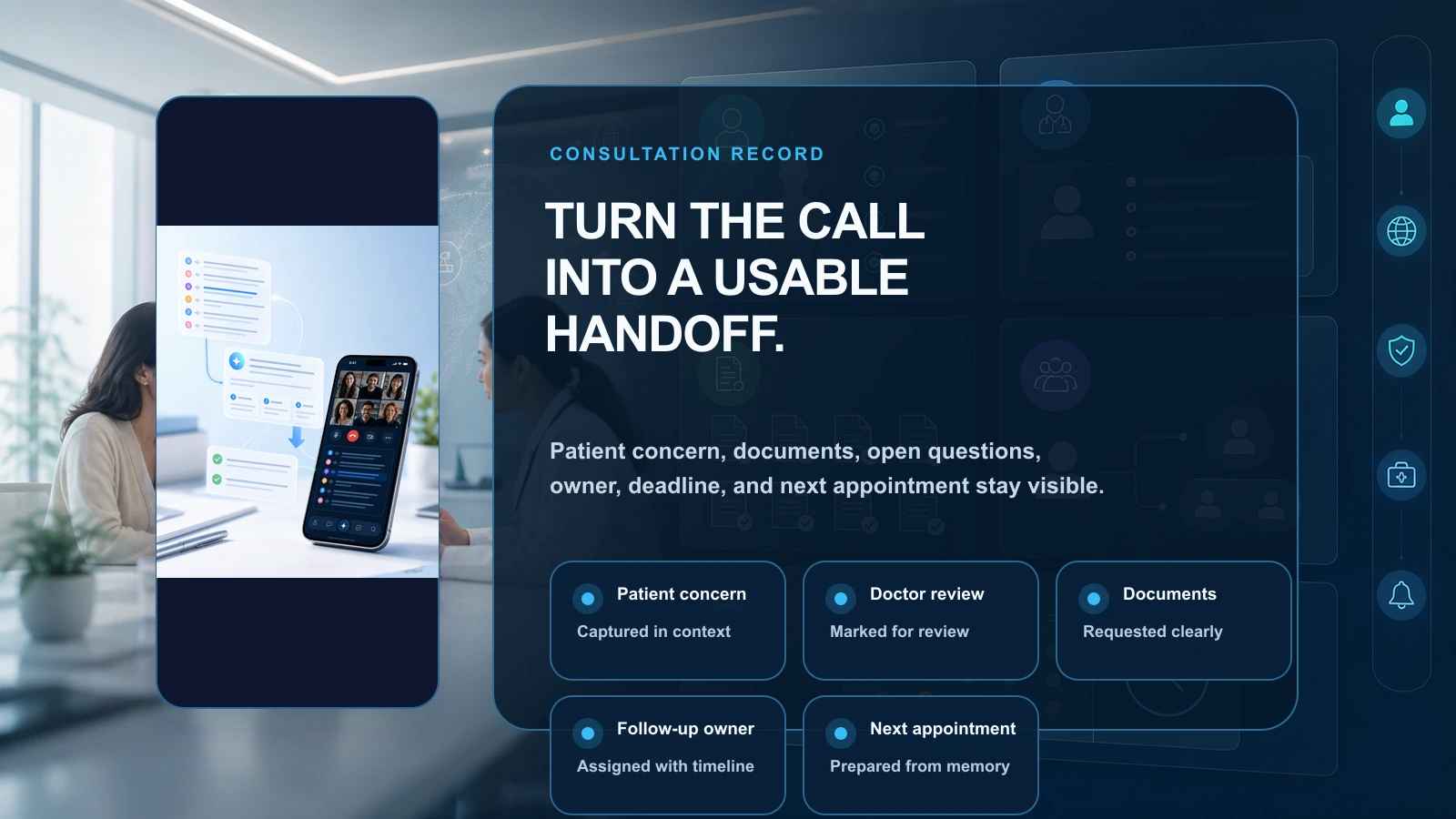
After a multilingual consultation, the team should be able to identify:
- Main patient concern.
- Treatment interest.
- Relevant history shared during the call.
- Documents requested.
- Questions answered.
- Questions that require doctor review.
- Decisions made.
- Preparation requirements.
- Travel constraints.
- Risks or uncertainties to clarify.
- Follow-up owner.
- Next appointment or message.
MeetBridge meeting summaries and actions help teams turn consultation records into summaries, decisions, action items, and follow-up context. For health tourism teams, that can reduce manual cleanup and make handoffs clearer.
Important: generated summaries should not replace clinical judgment. Medical details, consent language, diagnosis, treatment recommendations, and safety-critical instructions should be reviewed and approved by qualified professionals before they are sent or used as final patient guidance.
What a strong multilingual health tourism workflow looks like
A strong workflow has three parts: preparation, live consultation, and follow-up.
1) Before the consultation
The team collects enough information to make the meeting useful.
Useful preparation includes:
- Preferred language for the live call.
- Preferred language for written follow-up.
- Patient’s main concern or treatment goal.
- Questions the patient wants answered.
- Existing documents that should be reviewed through the correct process.
- Whether the consultation is first intake, treatment planning, second opinion, or follow-up.
- Who will join the call.
- Consent and privacy requirements.
This is where booking links help because the consultation can begin with context instead of confusion.
2) During the consultation
The meeting should allow the patient to speak naturally and the team to clarify actively.
Useful live practices include:
- Start by confirming the patient’s preferred language.
- Explain who is in the meeting and each person’s role.
- Clarify that AI translation supports communication but does not replace professional clinical review.
- Ask one question at a time.
- Avoid long monologues with multiple instructions.
- Confirm numbers, dates, medications, allergies, procedures, and travel timing carefully.
- Use plain language where possible.
- Pause for questions often.
- Ask the patient to repeat important next steps in their own words.
- Mark unclear items for review instead of guessing.
Live translation should support confidence, not rush the patient.
3) After the consultation
The team turns the meeting into a usable record.
Strong follow-up should include:
- Consultation summary.
- Patient’s main goal or concern.
- Documents requested.
- Questions that need medical review.
- Decisions or provisional next steps.
- Action items for the patient.
- Action items for the clinic or agency.
- Owner for each next step.
- Expected timeline.
- Next appointment or contact plan.
- Safety or escalation instructions reviewed by qualified staff when applicable.
This is where meeting summaries and actions and meeting memory become important. The team should not have to reconstruct the entire consultation from scattered notes.
For more on preventing multilingual meeting breakdowns, read Common Mistakes That Break Multilingual Meetings.
Patient intake: what improves when translation is live
Live translation can improve patient intake because it reduces the pressure to communicate in a less comfortable language.
Patients ask more complete questions
A patient may hesitate to ask about pain, recovery, risk, cost, scars, travel restrictions, medication, or family support when they are speaking in a second language. When they can speak naturally, the conversation often becomes more complete.
Coordinators can clarify earlier
Without live translation, coordinators may wait until after the call to ask someone else for help. That creates delay. With live translation, they can clarify the patient’s meaning during the meeting.
Doctors receive better context
The quality of a treatment planning conversation depends on the quality of intake. If the patient’s concern is captured clearly, clinical reviewers can make better use of the consultation record.
Follow-up becomes easier to personalize
A generic follow-up says:
“Thank you for your consultation. Please send your documents.”
A stronger follow-up says:
“Thank you for explaining your main concern, previous procedure history, and preferred travel window. Next step: please send the requested test results through the clinic’s approved channel. Our team will review them and confirm whether a doctor consultation is needed before travel planning.”
That level of follow-up is easier when the meeting produced a structured record.
Treatment follow-up: where many health tourism teams lose trust
Patient confidence can drop after the first consultation if the follow-up is unclear.
Common follow-up problems include:
- The patient receives a message in a language they do not fully understand.
- The summary ignores a concern they raised live.
- The next step is vague.
- The patient does not know who is responsible.
- The required documents are not listed clearly.
- The timeline changes without explanation.
- Medical review and operational follow-up are mixed together.
- The patient asks the same question again because the answer was not captured.
A better follow-up system should make the next step obvious.
For example:
| Follow-up item | Weak version | Stronger version |
|---|---|---|
| Documents | “Send your reports.” | “Please send blood test results, previous procedure notes, and current medication list through the approved upload channel.” |
| Timeline | “We will contact you soon.” | “The coordinator will confirm document review status within two business days.” |
| Ownership | “Our team will check.” | “Mina owns document collection. Dr. review starts after all required files are received.” |
| Patient action | “Prepare for the procedure.” | “Do not change medication or preparation steps unless the clinical team confirms them in writing.” |
| Open question | “Doctor will decide.” | “Open question: whether additional imaging is required before final treatment planning.” |
The goal is not to make AI write medical instructions. The goal is to help the team preserve the conversation so qualified staff can produce a clearer, safer follow-up.
Where human interpreters are still important
Live translation can help health tourism teams scale communication and reduce delays. But it should not be treated as a replacement for qualified medical interpreters in every situation.
Human interpreters, certified professionals, or direct clinical review may be required or strongly recommended when the consultation includes:
- Formal informed consent.
- Diagnosis or treatment decisions.
- Safety-critical instructions.
- Medication changes.
- High-risk procedures.
- Emergency or urgent medical situations.
- Legal, regulatory, or insurance requirements.
- Sensitive conversations where emotion, culture, or nuance is central.
- Patients with limited ability to use digital tools or follow translated output.
Health tourism teams should define their own escalation rules.
A practical approach is to use live translation for scalable communication, intake, coordination, and routine follow-up, while using qualified human review for high-risk, clinical, legal, or consent-heavy moments.
For a deeper comparison, read Live Meeting Translation vs Human Interpreters for Business Calls.
How to use teach-back in translated consultations
One of the simplest ways to reduce misunderstanding is to ask the patient to explain the next step back in their own words.
This is often called the teach-back method.
In a multilingual consultation, the team can use it in a non-shaming way:
- “I want to make sure we explained this clearly. Can you tell me what you will do after this call?”
- “Just to confirm the plan, what documents will you send first?”
- “Before we end, can you explain what you understand about the next appointment?”
- “What will you tell your family member about the travel timeline?”
- “Which part is still unclear?”
This is not a test of the patient. It is a test of the team’s explanation.
Live translation makes teach-back more practical because the patient can repeat the plan in their own language while the team follows the answer. The transcript can also help the team check whether the final understanding matches the intended next step.
For health tourism, teach-back is especially useful for:
- Document requirements.
- Appointment timing.
- Travel preparation.
- Post-treatment follow-up.
- Recovery expectations.
- Open questions that require doctor review.
- Who the patient should contact if something changes.
A practical consultation checklist for health tourism teams
Use this checklist to evaluate and improve your multilingual health tourism consultations.
Before the call
- [ ] Confirm the patient’s preferred spoken language.
- [ ] Confirm the patient’s preferred written follow-up language.
- [ ] Collect the main treatment interest or concern.
- [ ] Ask what the patient wants to understand during the call.
- [ ] Request only necessary documents through approved channels.
- [ ] Confirm who will join the meeting.
- [ ] Prepare the coordinator, doctor, or treatment planner with relevant context.
- [ ] Define whether the call is intake, consultation, treatment planning, or follow-up.
- [ ] Confirm privacy, consent, and recording policies.
During the call
- [ ] Introduce everyone and explain each role.
- [ ] Confirm the language setup.
- [ ] Let the patient explain concerns in their own words.
- [ ] Ask short, clear questions.
- [ ] Avoid speaking for too long without pauses.
- [ ] Confirm dates, numbers, documents, and responsibilities.
- [ ] Mark clinically important questions for qualified review.
- [ ] Use teach-back for important next steps.
- [ ] Avoid finalizing sensitive medical guidance without proper review.
After the call
- [ ] Review the transcript.
- [ ] Create a consultation summary.
- [ ] Separate patient concerns, clinical review items, operational tasks, and travel questions.
- [ ] List documents requested.
- [ ] Assign owners and deadlines.
- [ ] Confirm what should be sent to the patient.
- [ ] Have qualified staff review clinical or safety-critical content.
- [ ] Send follow-up in the patient’s preferred written language when appropriate.
- [ ] Keep the record available for the next patient interaction.
This is the difference between “we translated the call” and “we managed the consultation.”
How MeetBridge supports health tourism teams
MeetBridge for health tourism is designed for clinics, health tourism agencies, coordinators, and international patient teams that run multilingual patient consultations, treatment planning discussions, doctor coordination calls, procedure briefings, and follow-up meetings.
The workflow connects the main parts of the patient communication journey.
Booking links for intake context
With booking links, teams can collect pre-meeting context, ask custom questions, and understand the patient’s consultation goal before the live call begins.
This helps reduce repeated questions and makes the first consultation feel more prepared.
Live translation for direct patient conversations
With live translation, patients and teams can speak more naturally across languages. This is useful for intake calls, treatment explanations, coordinator check-ins, doctor coordination, and follow-up consultations.
Transcripts and meeting memory for continuity
With transcripts and meeting memory, the consultation does not disappear after the call. The team can return to the meeting record, review what was said, and prepare for the next interaction.
meeting summaries and actions for follow-up
With meeting summaries and actions, teams can move from consultation notes to clearer follow-up. Summaries, decisions, action items, owners, and deadlines help reduce manual cleanup and improve handoffs.
Mobile app access for teams on the move
With the MeetBridge mobile app, teams can support multilingual meeting workflows across web, iOS, and Android. That matters for coordinators who move between calls, clinics, patient visits, and operations tasks.
Example workflows for health tourism consultations
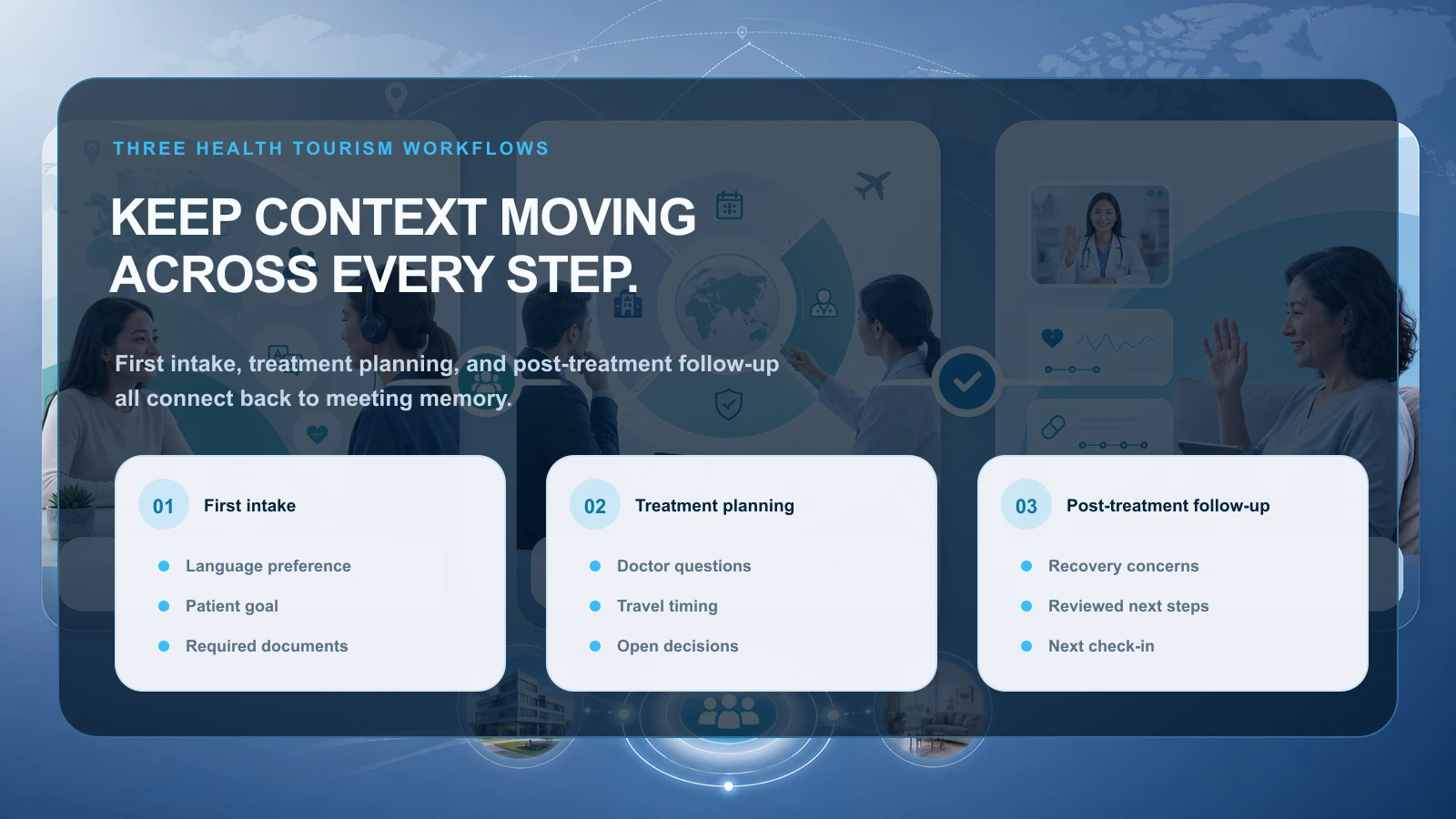
Workflow 1: First patient intake
A patient from Germany is considering treatment in Turkey. They prefer German for the live call and German for written follow-up. The coordinator speaks Turkish and English. The doctor needs a clear intake summary before reviewing the case.
With MeetBridge:
- The patient schedules through a booking link and answers intake questions.
- The consultation runs with live translation.
- The patient explains concerns in their own language.
- The coordinator confirms required documents.
- The transcript and summary preserve the conversation.
- The doctor receives structured context for review.
- The patient receives clear next steps in their preferred follow-up language after internal review.
Workflow 2: Treatment planning call
A patient has already sent documents. The clinical team needs to explain whether additional information is needed before travel planning.
With MeetBridge:
- The team reviews the previous meeting memory before the call.
- The patient joins with live translation.
- The doctor or coordinator explains what is still missing.
- The patient uses teach-back to confirm the next step.
- Action items are assigned after the call.
- Follow-up separates clinical review items from travel planning tasks.
Workflow 3: Post-treatment follow-up
The patient has returned home and joins a follow-up consultation. They have questions about recovery expectations and what information to send back to the clinic.
With MeetBridge:
- The team opens the previous consultation record.
- The patient explains symptoms or concerns in their own language.
- The team flags any clinical questions for qualified review.
- The transcript preserves the discussion.
- The summary lists what the patient should send, who will review it, and when the next check-in should happen.
The value is not only live translation. The value is continuity.
Metrics health tourism teams can track
To understand whether live translation is improving consultations, track operational outcomes, not only language coverage.
Useful metrics include:
| Metric | What it shows |
|---|---|
| Intake completion rate | Whether patients provide enough context before the call |
| Repeat-question rate | Whether patients have to explain the same issue multiple times |
| Time from consultation to follow-up | How quickly the team sends a useful next step |
| Missing document rate | Whether requested files are listed clearly |
| Doctor clarification requests | Whether clinical reviewers receive enough context |
| Follow-up response rate | Whether patients understand and respond to next steps |
| No-show rate for next consultation | Whether patients remain confident and engaged |
| Coordinator handoff quality | Whether the next team member can continue from the record |
| Patient satisfaction feedback | Whether patients felt understood and guided |
The goal is not to prove that translation exists. The goal is to prove that the patient journey is easier to understand and easier to manage.
Common mistakes in multilingual health tourism consultations
Mistake 1: Treating live translation as the whole solution
Live translation helps during the call. But intake, transcript, summary, action items, and follow-up determine whether the consultation becomes a reliable workflow.
Mistake 2: Depending on family members for sensitive translation
Family members can support the patient emotionally, but they may omit, soften, or misunderstand details. For sensitive medical topics, teams should use appropriate professional review and clear communication processes.
Mistake 3: Sending follow-up without reviewing the record
A fast follow-up is useful only if it is accurate. Teams should review the transcript and ensure qualified staff approve clinical or safety-critical content.
Mistake 4: Mixing operational tasks with medical guidance
Travel dates, hotel details, payment reminders, and document uploads should be clearly separated from treatment guidance, medication instructions, recovery expectations, or risk discussion.
Mistake 5: Asking “Do you understand?” and stopping there
Patients may say yes out of politeness, stress, or embarrassment. Ask them to explain the next step in their own words.
Mistake 6: Losing the patient’s preferred language after the call
A patient may speak one language in the live meeting but receive follow-up in another. Capture both live language preference and written follow-up language.
Mistake 7: Not defining escalation rules
Every team should know when AI translation is not enough and when to involve qualified medical interpreters, clinicians, legal review, or emergency guidance.
For more meeting workflow mistakes across multilingual teams, read Common Mistakes That Break Multilingual Meetings.
Live translation vs translated captions for health tourism
Translated captions can help patients follow along, especially in one-way explanations. But health tourism consultations are usually interactive.
Patients need to ask questions. Coordinators need to clarify. Doctors may need the patient to describe details in their own words. The team may need to pause, review, and confirm.
That is why live translation is often stronger than captions alone for patient intake and follow-up.
| Use case | Captions may be enough | Live translation is better when |
|---|---|---|
| General clinic webinar | Patients mostly listen | Patients ask personal questions |
| Procedure overview video | The content is one-way | The team needs to clarify eligibility or documents |
| First intake call | Usually not enough | The patient needs to explain goals, history, concerns, and timing |
| Treatment planning | Usually not enough | The team must confirm requirements, open questions, and next steps |
| Post-treatment follow-up | Usually not enough | The patient needs to describe recovery concerns and receive reviewed next steps |
For a full framework, read Live Translation vs Translated Captions: What Is the Difference?.
Security, privacy, and patient trust
Health tourism consultations can include sensitive personal and health-related information. Any team using live translation, transcripts, summaries, or meeting memory should define clear policies for:
- What information is collected before the call.
- Which channels are approved for document sharing.
- Whether the meeting is recorded or transcribed.
- Who can access transcripts and summaries.
- How long meeting records are retained.
- Which content requires clinical review before being shared.
- How patient consent is captured.
- Which regulations apply based on patient location, clinic location, and service type.
Patients should not feel surprised by how their information is used.
MeetBridge provides a security overview for teams evaluating data handling, privacy, and workflow expectations. Health tourism organizations should still review their own legal, clinical, and compliance requirements before standardizing any AI translation workflow.
The takeaway
Live translation for health tourism consultations is not only about making a call easier to understand.
It is about making the patient journey easier to manage.
A strong workflow helps the patient speak in their own language, helps the team collect better intake context, helps doctors and coordinators review what happened, and helps follow-up become clearer after the call.
For health tourism teams, the best live translation system should support:
- Patient intake before the meeting.
- Live multilingual conversation during the consultation.
- Transcript and meeting memory after the call.
- meeting summaries and action items for follow-up.
- Clear handoffs between coordinators and clinical teams.
- Human review for sensitive medical, consent, legal, and safety-critical details.
That is how health tourism teams move from translated conversations to more reliable patient coordination.
See MeetBridge in action for health tourism
If your clinic, agency, or international patient team runs multilingual consultations, explore how MeetBridge connects the full workflow:
- Health tourism solution: patient intake, treatment planning, doctor coordination, and follow-up consultations.
- Live translation: help patients and teams understand each other while speaking naturally.
- Booking links: collect patient context before the consultation.
- Transcripts and meeting memory: preserve consultation details for review and continuity.
- meeting summaries and actions: turn meetings into summaries, decisions, tasks, and follow-up context.
- Product overview: see the full multilingual meeting workflow.
- Security overview: review security and data handling information.
To evaluate MeetBridge for your health tourism team, contact sales or review pricing.
FAQ
What is live translation for health tourism consultations?
Live translation for health tourism consultations helps patients, coordinators, doctors, and international patient teams communicate across languages during intake, treatment planning, doctor coordination, and follow-up meetings. The best workflow also preserves transcripts, summaries, decisions, action items, and next-step context after the call.
How does live translation improve patient intake?
Live translation lets patients explain concerns, goals, history, and questions in a language they know well. This can help coordinators collect clearer intake context and reduce repeated questions. The value increases when the live conversation is connected to transcripts, meeting memory, and structured follow-up.
Can live translation software replace medical interpreters?
Not in every situation. live translation software can support scalable communication, intake, coordination, and routine follow-up, but qualified medical interpreters or human review may still be needed for informed consent, diagnosis, treatment decisions, medication instructions, safety-critical guidance, legal requirements, or highly sensitive conversations.
Is live translation safe for treatment planning?
Live translation can support treatment planning communication, but it should not be the final authority for medical decisions. Clinical content, risk explanations, treatment recommendations, consent language, and safety-critical instructions should be reviewed and approved by qualified professionals before being used as final patient guidance.
Why are transcripts important in health tourism consultations?
Transcripts help teams review what the patient said, what questions were asked, what documents were requested, and what next steps were discussed. This is especially important when coordinators, doctors, travel teams, and follow-up staff all need different parts of the consultation record.
How can health tourism teams improve treatment follow-up?
Teams can improve follow-up by using structured summaries, action items, owners, deadlines, document lists, and review checkpoints. Follow-up should separate clinical questions from operational tasks and should be reviewed by qualified staff when it includes medical or safety-critical content.
What should a health tourism team collect before a multilingual consultation?
Useful pre-call context includes preferred spoken language, preferred written follow-up language, treatment interest, main concern, questions for the consultation, document status, travel window, participant roles, and consent or privacy requirements. Teams should collect only necessary information through approved and secure processes.
What is the role of MeetBridge in health tourism?
MeetBridge helps health tourism teams run multilingual patient consultations with live translation, booking context, transcripts, meeting memory, meeting summaries, decisions, action items, and follow-up workflows. It is designed to help teams move from live patient conversations to clearer coordination.
When should health tourism teams use human review?
Human review should be used whenever the conversation includes diagnosis, treatment recommendation, medication guidance, risk explanation, informed consent, legal requirements, urgent symptoms, or sensitive patient concerns. generated outputs should be reviewed before they become final patient instructions.
Related posts
Continue reading:
- Best Real-Time Meeting Translation Software in 2026
- Live Translation App for Meetings: What Business Teams Should Look For in 2026
- What Is an Live Meeting Translator and How Does It Work?
- Live Translation vs Translated Captions: What Is the Difference?
- What to Look for in Multilingual Meeting Software
- How to Run Multilingual Meetings Without Slowing Them Down
- How to Prepare for a Multilingual Customer Meeting
- Why Global Teams Need More Than Translated Captions
- How Multinational Companies Eliminate Language Barriers in Meetings
- Live Meeting Translation vs Human Interpreters for Business Calls
- Common Mistakes That Break Multilingual Meetings