 By MeetBridge Team
How Sales Teams Use Real-Time Meeting Translation to Win Global Buyers
Global sales teams use real-time meeting translation to run discovery, demos, negotiations, and follow-up across languages without slowing the buyer journey. This guide shows the practical workflow from booking context to live translation, transcripts, summaries, objections, decisions, and next steps.
How Sales Teams Use Real-Time Meeting Translation to Win Global Buyers
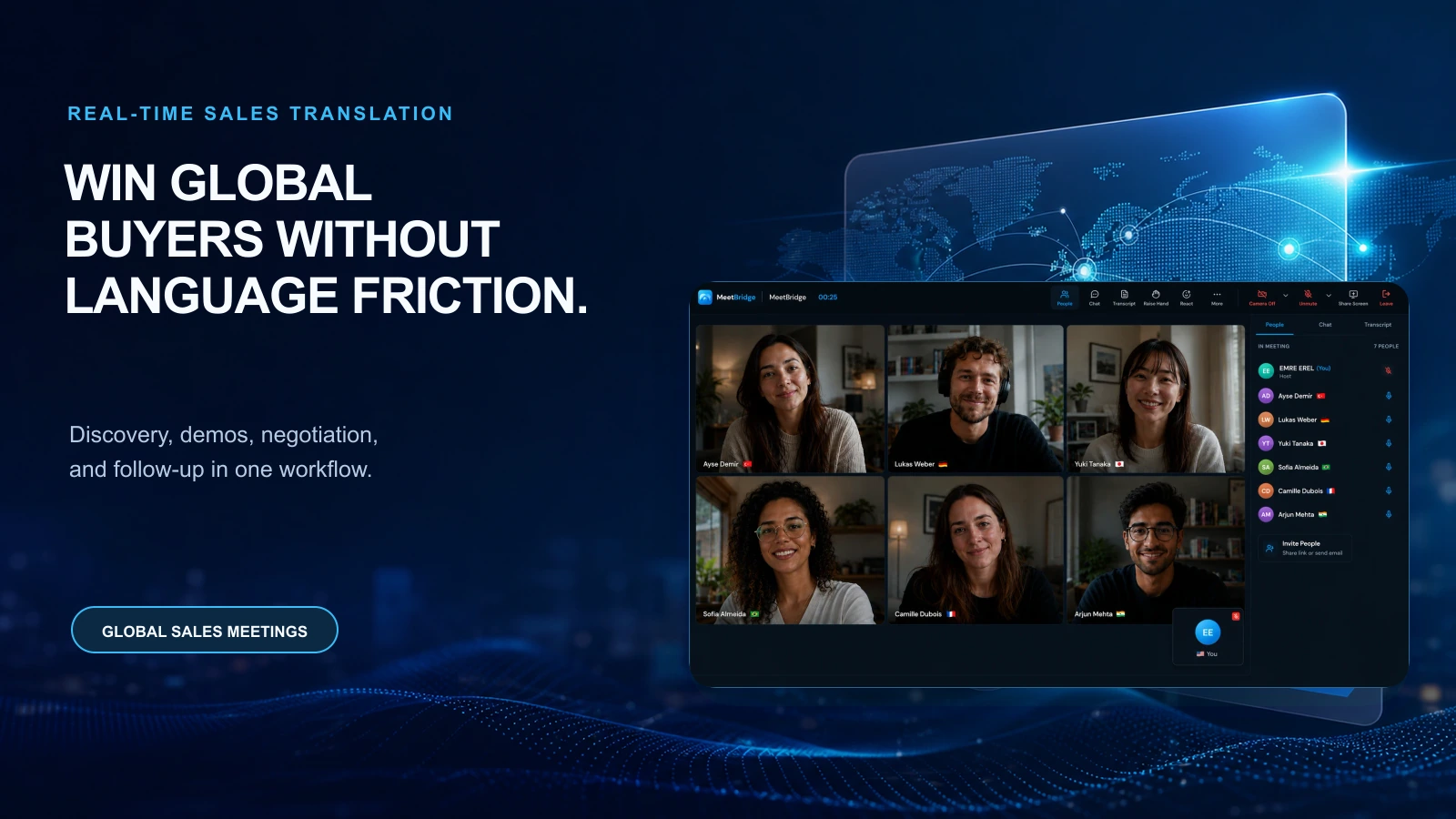
Real-time meeting translation is becoming a practical revenue tool for sales teams that sell across borders. It helps account executives, sales engineers, RevOps leaders, founders, and customer-facing teams speak with global buyers in the language they trust without slowing down discovery, demos, negotiation, or follow-up.
But the value is not only translation.
A global sales call is successful when the buyer understands the product, feels confident enough to ask detailed questions, shares real objections, confirms decision criteria, and leaves the meeting with a clear next step. Translation is one layer of that outcome. The full workflow also needs preparation, meeting memory, summaries, action items, stakeholder alignment, and fast follow-up.
That is where MeetBridge is built differently. MeetBridge combines live translation, transcripts and meeting memory, meeting summaries and actions, booking links, and sales meeting history in one workflow so teams can sell to international buyers with less language friction.
For sales teams, the goal is simple:
Help every buyer understand, respond, decide, and move forward in the language where they are most confident.
Why language friction costs sales teams more than they realize
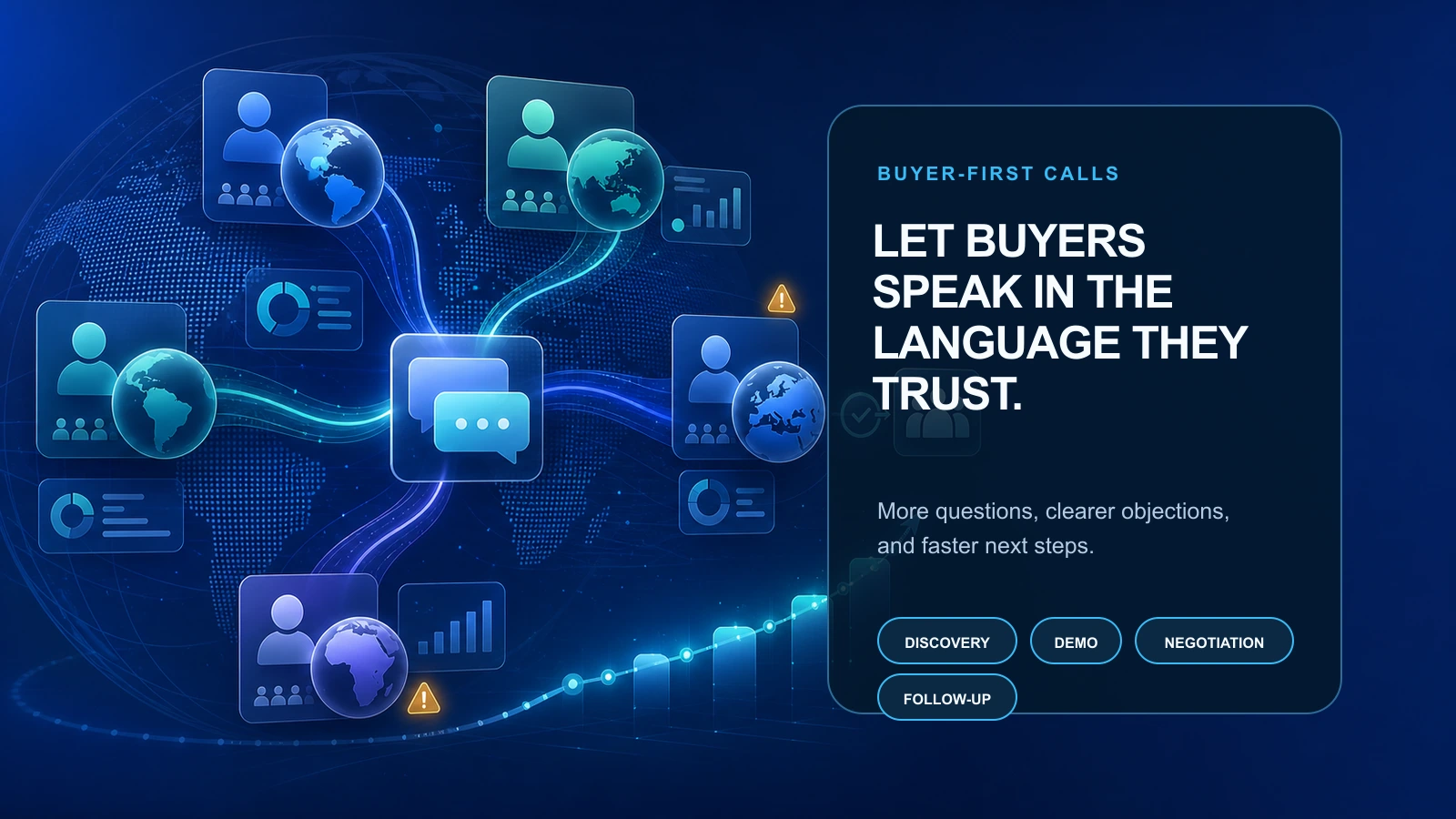
Sales teams usually notice language friction only when a call becomes visibly difficult. A buyer pauses too long. A technical stakeholder asks the same question twice. A procurement lead stays quiet. A champion says they understand, but the follow-up email reveals that the team missed an important condition.
In reality, language friction appears much earlier in the sales process.
It changes how buyers behave.
A buyer who is not fully comfortable in the meeting language may simplify questions, avoid nuance, or let a stronger English-speaking colleague dominate the conversation. A technical evaluator may understand the basic demo but miss limitations, security details, integration constraints, or implementation risks. A senior decision maker may join the call but avoid challenging the seller because the conversation is not happening in the language where they negotiate best.
That creates hidden pipeline risk:
- Discovery becomes shallow because the buyer cannot fully explain the problem.
- Demos feel positive but do not expose real objections.
- Champions struggle to communicate value internally after the call.
- Pricing and procurement details become easier to misunderstand.
- Handoffs to customer success lose context.
- Follow-up is slower because someone has to translate, summarize, and rewrite notes manually.
For global sales teams, language is not just a communication issue. It affects trust, deal velocity, qualification quality, stakeholder alignment, and forecast confidence.
A basic translated caption can help someone follow the conversation. But sales teams need more than comprehension. They need a system that turns multilingual conversations into reliable sales motion.
That is why real-time meeting translation for sales should be connected to the full meeting lifecycle: before the call, during the call, and after the call.
What real-time meeting translation changes in a sales call
A traditional multilingual sales motion often depends on one of four workarounds:
- Ask the buyer to speak in the seller's language.
- Bring a bilingual teammate into the call.
- Use translated captions and hope the buyer keeps up.
- Translate the recap after the meeting.
Each option can work in some situations. But none of them fully solves the revenue problem.
Asking the buyer to adapt may reduce the quality of discovery. Relying on a bilingual teammate creates bottlenecks. Captions may help comprehension but not necessarily conversation flow. Translating the recap after the call is useful, but it does not help the buyer participate confidently during the meeting.
Real-time meeting translation changes the live behavior of the call.
It helps sales teams:
- Let buyers ask questions in their strongest language.
- Keep discovery conversational instead of scripted.
- Reduce repeated explanations and awkward pauses.
- Give sales engineers clearer technical input.
- Capture objections while they are still fresh.
- Keep non-English stakeholders involved in the buying process.
- Move from call to recap faster because the transcript and summary already exist.
The most important change is confidence.
When buyers can speak naturally, they reveal more. They explain internal blockers more clearly. They ask the questions that actually decide the deal. They challenge pricing, implementation, legal, and security details instead of quietly postponing the decision.
That is good for the seller because real objections are better than polite silence.
A sales team that understands the real objection early can respond, qualify, align stakeholders, and create the right next step. A team that misses the objection may keep forecasting a deal that is already stuck.
Where sales teams use real-time meeting translation in the funnel
Real-time meeting translation is not only useful for first calls. The strongest sales teams use it across the full buyer journey, from inbound qualification to onboarding handoff.
1) Inbound qualification and first meetings
The first meeting sets the tone for the entire deal.
If the buyer has to struggle through a language they do not fully trust, the seller may receive a simplified version of the opportunity. The buyer may explain the problem at a surface level, avoid details, or fail to describe internal urgency.
With MeetBridge booking links, teams can collect context before the meeting starts: company background, role, preferred language, region, meeting goal, use case, and questions the buyer wants to cover. Then, during the live call, MeetBridge live translation helps both sides speak more naturally.
That creates a better first-call experience:
- The buyer enters the meeting with less anxiety.
- The seller knows the buyer's language preference and context.
- The conversation can move faster because basic details were collected before the call.
- The transcript preserves the buyer's requirements for follow-up.
For sales teams handling inbound interest from multiple countries, this can turn language from a qualification barrier into a qualification advantage.
2) Discovery calls with international buyers
Discovery is where language friction can do the most damage.
A strong discovery call is not only a list of questions. It is a conversation about pain, urgency, current process, stakeholders, budget, risk, decision criteria, and next steps. If the buyer cannot explain those details naturally, the seller may qualify the opportunity incorrectly.
Real-time meeting translation helps buyers describe their situation in their own language while the sales team follows the conversation in real time.
That matters in questions like:
- What problem are you trying to solve this quarter?
- What happens if you do nothing?
- Who else is involved in the decision?
- What systems do we need to integrate with?
- What objections do you expect from finance, legal, or security?
- What would make this project fail internally?
These questions are hard enough in one language. Across languages, the risk of vague answers increases. A live translation workflow helps the seller keep asking follow-up questions before the moment passes.
After the call, transcripts and meeting memory help the team review what the buyer actually said. That is especially valuable for sales managers, solution engineers, founders, and RevOps teams that were not on the call but need to understand the opportunity.
3) Product demos and sales engineering calls
Demos are where language friction becomes technical.
A buyer may understand the high-level value, but the deal often depends on specific details: workflow fit, integrations, data migration, permissions, reporting, security, implementation effort, and edge cases.
If the sales engineer and buyer do not share the same strongest language, small misunderstandings can become large deal risks.
Real-time meeting translation helps the demo stay interactive. The buyer can interrupt, ask for clarification, describe their current workflow, and challenge assumptions without waiting for a teammate to translate.
This is useful for:
- SaaS product demos with regional stakeholders.
- Technical discovery with IT or operations teams.
- Security and compliance reviews.
- Implementation planning calls.
- Partner sales calls where local teams join the conversation.
The key is not just translating the demo script. The key is preserving the buyer's questions.
A demo question often reveals the real decision criteria. For example:
- “Can your system support approval flows by region?”
- “How would this work for our German subsidiary?”
- “Can managers review translated meeting records after the call?”
- “What happens when two people speak at the same time?”
- “Can our customer success team use this after sales hands off the account?”
Those questions should not disappear into a messy note-taking process. With MeetBridge, the translated conversation stays connected to the transcript, summary, and action items so the team can follow up with the right proof points.
4) Multi-stakeholder buying committee calls
Global buyers rarely buy alone.
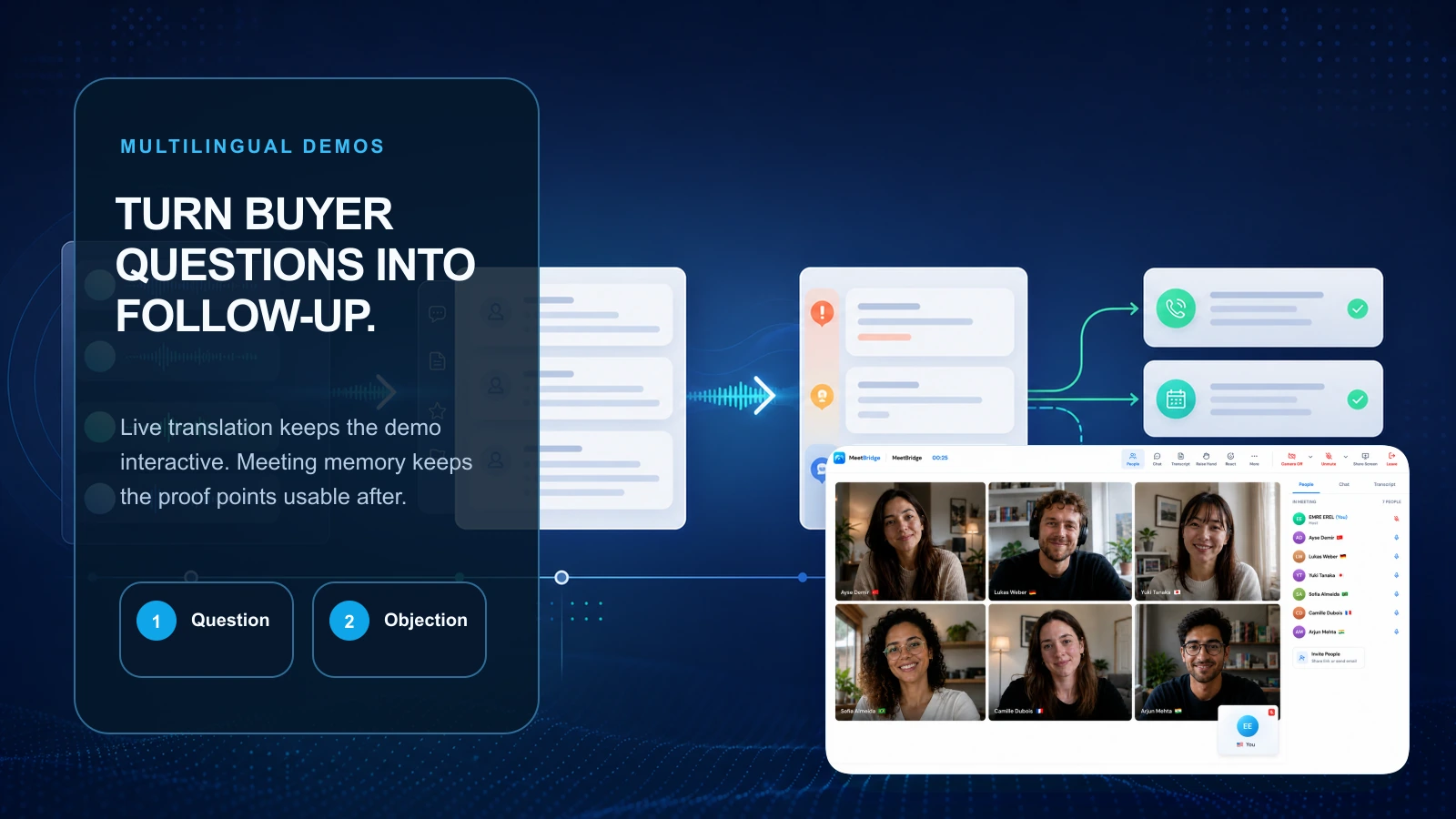
A serious B2B deal may involve a champion, economic buyer, technical evaluator, security reviewer, procurement lead, regional manager, implementation owner, and executive sponsor. Those stakeholders may not all share the same language fluently.
Without translation support, the meeting can become uneven. The most fluent speaker dominates. Other stakeholders listen quietly, then raise concerns later through private channels. By the time the seller hears the objection, the deal has already slowed down.
Real-time meeting translation helps more stakeholders participate during the actual call.
That gives the sales team better visibility into:
- Who is skeptical.
- Who is driving urgency.
- Who needs more proof.
- Which team owns implementation risk.
- Which stakeholder controls budget or approval.
- Which region has a different requirement.
For account executives and sales leaders, that is critical. A deal is easier to advance when the entire buying committee can engage in the same conversation instead of forcing the champion to translate everything after the meeting.
5) Pricing, negotiation, and procurement conversations
Pricing conversations are high-risk multilingual moments.
A small misunderstanding around scope, discount, seat count, contract term, payment schedule, renewal, cancellation, or implementation services can create friction later. Even when both sides act in good faith, the official recap may not match what each side understood.
Real-time meeting translation helps both sides keep the conversation moving. But sales teams also need the post-meeting record.
With MeetBridge meeting summaries and actions, teams can turn the meeting into clearer outputs:
- Pricing questions raised by the buyer.
- Objections that need internal approval.
- Contract terms that require follow-up.
- Open issues for legal, finance, or procurement.
- Next steps with owners and deadlines.
For negotiation, the safest workflow is not “trust the live translation and move on.” The safer workflow is “translate live, then review the transcript, confirm the summary, and send a precise follow-up.”
That is how sales teams reduce ambiguity without slowing the deal.
6) Mutual action plans and next steps
A multilingual sales call can feel successful and still fail after the meeting.
The buyer understood the demo. The seller answered the questions. Everyone agreed to continue. Then the recap takes two days, the internal team receives a partial summary, and the buyer's stakeholders are not sure what they are supposed to do next.
This is where real-time meeting translation must connect to action.
After a sales call, the team should be able to answer:
- What did the buyer ask for?
- What did we promise?
- What is still open?
- Who owns the next step?
- What is the deadline?
- What should the buyer receive in their language?
- What should the internal team know before the next call?
MeetBridge is designed to help teams move from conversation to follow-up without rebuilding the meeting manually. That means sales teams can shorten the gap between “great call” and “clear next step.”
7) Sales-to-CS handoff and onboarding
Winning the deal is not the end of the multilingual workflow.
If the handoff from sales to onboarding or customer success loses context, the customer may have to repeat requirements, clarify commitments, or correct assumptions that were already discussed during the sales cycle.
That is especially risky in global deals because details may have been explained in different languages across multiple meetings.
MeetBridge transcripts and meeting memory help preserve sales context for the teams that support the customer after the contract is signed.
That can include:
- Original pain points.
- Integration requirements.
- Stakeholder expectations.
- Timeline and launch goals.
- Risks raised during procurement.
- Promises made during negotiation.
- Open questions for onboarding.
For teams that sell globally, a clean multilingual handoff protects trust after the buyer becomes a customer.
The sales workflow: before, during, and after the translated meeting
Sales teams get the most value from real-time meeting translation when they treat it as a workflow, not a meeting add-on.
Here is a practical structure.
Before the meeting: collect context and reduce uncertainty
A better translated meeting starts before anyone joins the call.
Use booking and pre-meeting questions to collect:
- Preferred language.
- Country or region.
- Company size and role.
- Main use case.
- Current solution or process.
- Key questions for the call.
- Stakeholders joining the meeting.
- Technical or procurement topics to cover.
This helps the seller prepare examples, terminology, and questions that match the buyer's context. It also helps the buyer feel that the meeting was designed for them, not forced through a generic language setup.
MeetBridge supports this with booking links, which help teams receive meeting requests, ask custom questions, and bring participant context into the meeting workflow.
During the meeting: keep the buyer talking naturally
During the live call, the sales team should optimize for conversation quality.
Use these habits:
- Let the buyer speak in the language where they can explain nuance.
- Slow down only during critical commitments, pricing, or technical details.
- Avoid long monologues that overload the translation flow.
- Pause after complex answers so the buyer can ask a follow-up.
- Repeat final decisions clearly.
- Name owners and deadlines out loud.
- Confirm ambiguous terms before moving on.
Real-time meeting translation works best when the meeting has clean turn-taking and clear decision moments. The tool helps remove language friction, but the team still needs good sales discipline.
After the meeting: turn translated conversation into revenue action
After the call, review the output quickly while the context is still fresh.
A strong post-call process includes:
- Review the transcript for buyer requirements and objections.
- Confirm key terms, names, numbers, and dates.
- Use the summary to identify decisions and open questions.
- Turn next steps into action items with owners.
- Send a buyer-facing recap in clear language.
- Share internal context with sales engineering, leadership, or customer success.
- Schedule the next meeting or share a booking link.
This is where meeting summaries and actions matter. The team should not need to spend another hour reconstructing a call that was already captured.
What sales leaders should measure
Real-time meeting translation should not be evaluated only as a language feature. Sales leaders should measure whether it improves sales execution.
Useful metrics include:
| Sales outcome | What to measure | Why it matters |
|---|---|---|
| Discovery quality | More complete pain points, decision criteria, and stakeholder maps | Better qualification and forecasting |
| Demo effectiveness | Fewer repeated explanations and clearer technical questions | Stronger buyer confidence |
| Follow-up speed | Time from meeting end to recap or next-step email | Faster pipeline movement |
| Objection visibility | Number and clarity of objections captured after calls | Better coaching and deal strategy |
| Handoff quality | Fewer missing details between sales, SE, onboarding, and CS | Less post-sale friction |
| Buyer participation | More questions from non-native speakers and regional stakeholders | Better buying committee alignment |
| Forecast confidence | Fewer deals marked as healthy while hidden objections remain | Cleaner pipeline review |
The best indicator is not whether the tool translated every word perfectly. The best indicator is whether the team understands the buyer more clearly and moves to the next step faster.
Common sales mistakes with real-time meeting translation
Real-time translation can improve global sales meetings, but teams still need a thoughtful process. These are the mistakes to avoid.
Mistake 1: Treating translation as a replacement for sales discovery
Translation helps the buyer speak. It does not automatically create a strong sales conversation.
Sales teams still need to ask clear questions, listen actively, challenge assumptions, and confirm the business problem. A translated weak discovery call is still a weak discovery call.
Use translation to create more space for better discovery, not to hide poor qualification.
Mistake 2: Letting the most fluent speaker define the whole deal
In multilingual buying committees, the strongest English speaker may not be the final decision maker. They may also simplify or filter what other stakeholders think.
Real-time meeting translation gives sellers a way to hear more directly from the people who would otherwise stay quiet.
Ask targeted questions to each stakeholder:
- “From your region's perspective, what would block rollout?”
- “What would your team need to see before approving this?”
- “Which part of the workflow feels unclear?”
- “What would make this solution hard to adopt internally?”
Mistake 3: Relying only on live understanding
A sales call can feel clear in the moment and still create confusion afterward.
That is why the transcript, summary, and action items matter. The live translation helps the conversation happen. The meeting record helps the team act on it.
For a deeper framework, read What to Look for in Multilingual Meeting Software.
Mistake 4: Not confirming critical commercial details
In pricing, procurement, and legal conversations, small language differences matter.
Always confirm:
- Price and currency.
- Contract length.
- Discount conditions.
- Seat counts or usage limits.
- Implementation scope.
- Security requirements.
- Renewal and cancellation terms.
- Dates, owners, and deadlines.
Real-time translation helps the conversation move, but critical commitments should still be repeated clearly and captured in the follow-up.
Mistake 5: Sending follow-up from only one language group's point of view
A common problem in multilingual sales is that the follow-up email reflects what the seller thought happened, not what the buyer understood.
Use the meeting record to create a buyer-centered recap:
- Start with the buyer's goals.
- List the problems they described.
- Confirm the objections or risks they raised.
- Summarize the agreed next step.
- Assign owners and dates.
- Include any open questions.
This makes the buyer feel heard and reduces the chance of post-call confusion.
Practical playbooks for sales teams
Below are simple workflows sales teams can copy into their process.
Playbook 1: Multilingual discovery call
Goal: Understand the buyer's problem, urgency, decision process, and next step.
Before the call:
- Ask the buyer for preferred language and meeting goal.
- Collect role, company, region, and use case through the booking flow.
- Prepare a short glossary of product names, integration terms, and pricing language.
During the call:
- Let the buyer describe the problem in their own language.
- Ask follow-up questions when translation reveals vague or incomplete answers.
- Confirm decision criteria before the call ends.
- State the next step out loud.
After the call:
- Review transcript and summary.
- Capture pain points, stakeholders, objections, and timeline.
- Send a recap that reflects the buyer's own priorities.
- Create an action item for the next sales step.
Recommended MeetBridge workflow: B2B sales and SaaS plus live translation.
Playbook 2: Multilingual product demo
Goal: Help the buyer evaluate the product with enough clarity to move forward.
Before the call:
- Confirm which stakeholders are joining.
- Ask for the main workflows they want to see.
- Prepare demo examples that match the buyer's region or use case.
During the call:
- Keep demo sections short.
- Pause for translated questions after each major workflow.
- Ask technical stakeholders to explain their current process in their own language.
- Capture objections and missing proof points.
After the call:
- Share a recap with demo highlights and buyer questions.
- Assign follow-up for technical answers, security docs, pricing, or implementation details.
- Store the transcript and summary for the deal team.
Recommended MeetBridge workflow: transcripts and meeting memory plus meeting summaries and actions.
Playbook 3: Procurement and negotiation call
Goal: Reduce ambiguity around commercial terms and approval steps.
Before the call:
- Share a clear agenda.
- List open commercial questions.
- Confirm who can approve which topic.
During the call:
- Speak slowly during numbers, dates, contract terms, and commitments.
- Confirm each decision verbally.
- Mark unresolved issues clearly.
- Assign owners before the meeting ends.
After the call:
- Review transcript for price, scope, dates, and conditions.
- Send a structured recap.
- Confirm next legal, finance, or procurement action.
Recommended MeetBridge workflow: meeting summaries and actions plus meeting memory.
Playbook 4: Sales-to-customer-success handoff
Goal: Preserve buyer context after the deal is won.
Before the handoff:
- Pull key discovery, demo, and negotiation notes from the meeting history.
- Identify promises, risks, stakeholders, and timeline.
- Prepare a customer-facing onboarding context summary.
During the handoff:
- Confirm the customer's goals in their preferred language.
- Review what was agreed during the sales process.
- Clarify implementation expectations.
- Assign onboarding next steps.
After the handoff:
- Store the transcript and summary for the success team.
- Create action items for onboarding owners.
- Keep the customer journey connected from sales to success.
Recommended MeetBridge workflow: customer success plus transcripts and meeting memory.
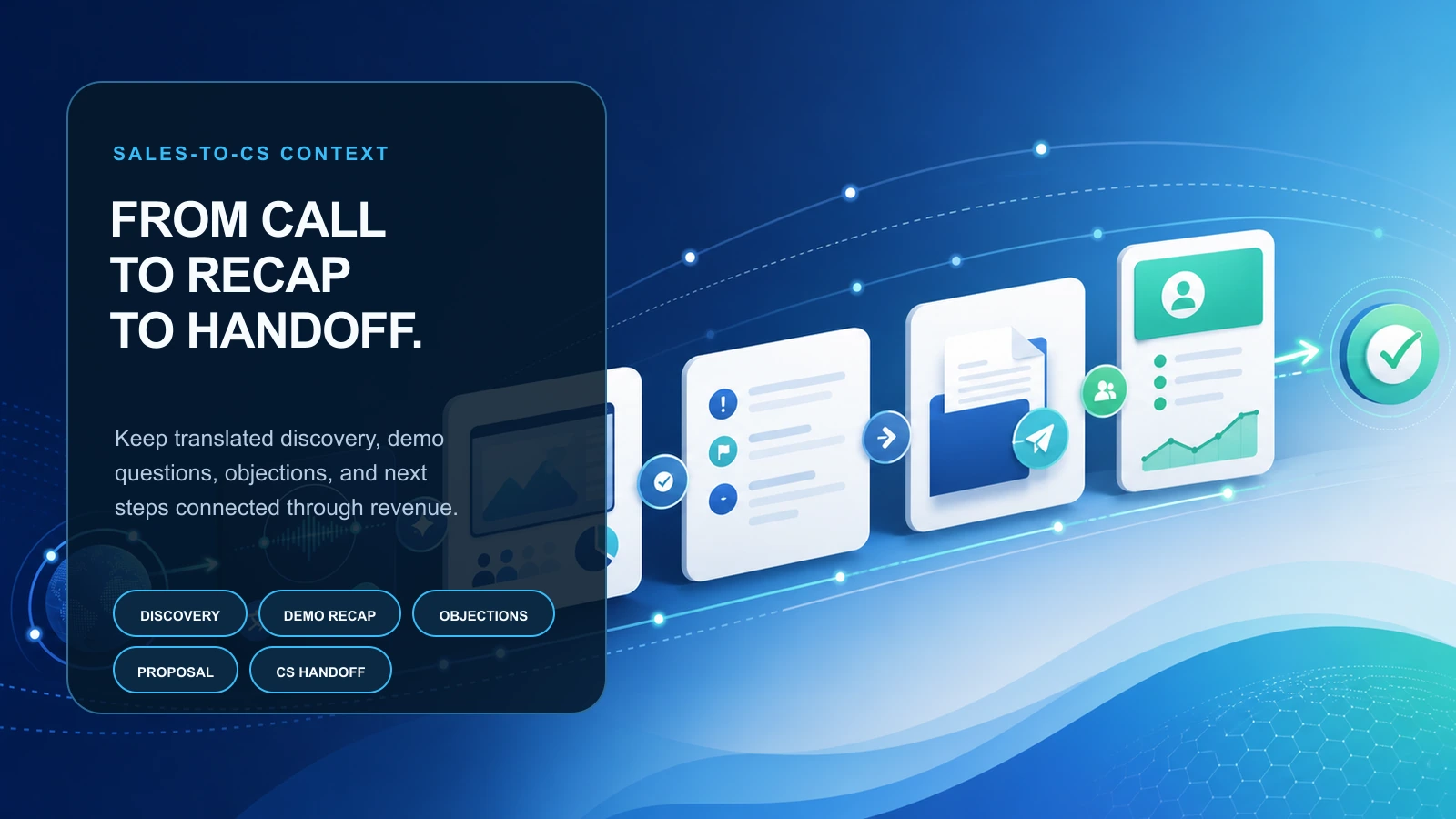
How MeetBridge fits global sales teams
MeetBridge for B2B sales and SaaS is built for sales leaders, account executives, sales engineers, and customer-facing SaaS teams running global discovery, demo, proposal, onboarding, renewal, and partner sales calls.
The difference is that MeetBridge is not just a language layer on top of a video call. It connects the sales meeting workflow:
- Booking links help collect buyer context before the meeting.
- Live translation keeps the conversation understandable while people speak.
- Transcripts and meeting memory preserve what was said for review and handoff.
- meeting summaries and actions help teams capture decisions, objections, tasks, owners, deadlines, and follow-up context.
- Mobile app helps customer-facing teams join and manage multilingual meeting workflows across devices.
For sales teams, this means the multilingual meeting does not disappear when the call ends. It becomes a record the team can use to write better recaps, prepare proposals, coach reps, support sales engineering, and hand off accounts with more confidence.
Example: how a global sales call works with MeetBridge
Imagine a SaaS company based in the United States selling to a buyer group in Türkiye, Germany, and Spain.
The account executive speaks English. The champion prefers Turkish. The technical evaluator is more comfortable in German. A regional manager joins from Spain and wants to understand rollout risk before approving the next step.
Without real-time meeting translation, the call may become fragmented. The champion summarizes for other stakeholders. The AE answers in English. The German technical evaluator waits until after the call to send questions. The Spanish manager leaves with partial understanding.
With MeetBridge, the team can run a clearer workflow:
- The buyer books through a meeting link and shares preferred languages, use case, and questions.
- During the call, participants speak naturally while the conversation is translated live.
- The AE asks discovery questions and hears buyer requirements in real time.
- The sales engineer answers technical questions without relying on a bilingual intermediary.
- Objections, requirements, and stakeholder concerns are preserved in the transcript.
- After the call, the team reviews the summary, action items, and open questions.
- The AE sends a recap that reflects what the buyer actually discussed.
- The next demo or proposal review is scheduled with context already attached.
The result is not only a translated meeting. It is a sales process that moves forward with less ambiguity.
What to include in a multilingual sales recap
A strong recap is one of the most important outputs of a translated sales meeting.
Use this structure after global buyer calls:
1) Buyer context
Summarize the buyer's company, region, stakeholders, and use case.
Example:
Your team is evaluating a multilingual meeting workflow for sales demos, onboarding calls, and regional customer success meetings across Türkiye, Germany, and Spain.
2) Problems discussed
List the pain points in the buyer's language and business context.
Example:
The team wants to reduce repeated explanations during international customer calls, improve follow-up speed, and preserve meeting records for stakeholders who cannot attend live.
3) Decision criteria
Capture what the buyer needs to see before moving forward.
Example:
Key criteria include live translation quality, transcript review, action item capture, security review, and a workflow that can support sales-to-CS handoff.
4) Objections or risks
Do not hide objections. Name them clearly.
Example:
Open questions include language performance in fast demo calls, internal rollout process, and whether meeting summaries can support managers who review calls after the meeting.
5) Agreed next steps
List owners and dates.
Example:
MeetBridge team will send a demo recap and pricing information by Friday. Buyer team will confirm the technical stakeholders for the next review call.
6) Next meeting context
Make the next call easier.
Example:
Next call should focus on sales demo workflows, transcript review, meeting summaries, and handoff from sales to customer success.
This is where a tool like MeetBridge creates leverage. The transcript and summary give the seller a stronger starting point, so the recap is faster and more accurate.
Real-time meeting translation vs human interpreters in sales calls
Human interpreters can be valuable for high-risk, formal, legal, or highly sensitive conversations. Some enterprise negotiations, regulated industries, and contractual discussions may still require human expertise.
But many recurring sales meetings need a faster, more scalable workflow:
- Inbound qualification.
- Discovery calls.
- Product demos.
- Sales engineering reviews.
- Partner sales calls.
- Customer onboarding handoffs.
- Renewal and expansion conversations.
For these meetings, real-time meeting translation helps teams move faster without waiting for interpreter scheduling or relying on bilingual teammates for every call.
The best approach is not always AI versus human. It is matching the risk of the meeting to the right workflow.
For a deeper comparison, read Live Meeting Translation vs Human Interpreters for Business Calls.
Real-time meeting translation vs translated captions for sales
Translated captions can be useful for webinars, enablement sessions, and one-way product presentations where the main goal is comprehension.
Interactive sales calls are different.
Discovery, demos, negotiation, and buying committee discussions depend on turn-taking, objections, nuance, and live response. The buyer should not only read a delayed text stream. They should be able to participate confidently.
That is why sales teams should evaluate whether a tool supports:
- Live conversation flow.
- Multiple stakeholders.
- Natural buyer questions.
- Reviewable transcripts.
- Clear summaries and action items.
- Follow-up that reflects the actual conversation.
For more on this difference, read Live Translation vs Translated Captions: What Is the Difference? and Why Global Teams Need More Than Translated Captions.
A buyer-first checklist for sales teams
Before rolling out real-time meeting translation across your sales organization, use this checklist.
Meeting setup
- Do reps know when to offer translated meetings?
- Can buyers share preferred language before the call?
- Are booking questions collecting enough context?
- Are reps trained to explain the translation experience simply?
Live call quality
- Can buyers ask questions naturally?
- Does translation support fast discovery without awkward pauses?
- Are sales engineers able to follow technical questions?
- Are stakeholders with different language preferences able to participate?
Sales process quality
- Are objections captured in the transcript?
- Are decision criteria visible after the call?
- Are next steps turned into action items?
- Are managers able to review calls for coaching and deal strategy?
Follow-up quality
- Does the recap reflect the buyer's actual words and priorities?
- Are pricing, dates, and commitments confirmed clearly?
- Can the team share context with sales engineering, leadership, or CS?
- Is the next meeting scheduled with the right context?
Risk control
- Are critical terms, names, and numbers reviewed before being sent externally?
- Does the team know when a human interpreter or legal review is still required?
- Is meeting data handled according to the team's security and privacy expectations?
For more evaluation guidance, read Best Real-Time Meeting Translation Software in 2026 and Live Translation App for Meetings: What Business Teams Should Look For in 2026.
The sales leader's takeaway
Global buyers do not only want to understand your pitch. They want to explain their problem, ask detailed questions, challenge risk, involve their stakeholders, and trust the next step.
Real-time meeting translation helps sales teams create that experience.
The strongest sales teams will not treat translation as a novelty feature. They will use it as part of a complete revenue workflow:
- Prepare better with booking context.
- Run discovery in the buyer's strongest language.
- Keep demos interactive.
- Capture objections and decision criteria.
- Review transcripts after the call.
- Turn summaries into action items.
- Send faster, clearer follow-up.
- Preserve context for onboarding and customer success.
That is how real-time meeting translation helps sales teams win global buyers: not by translating words alone, but by helping every multilingual sales conversation become a clearer path to revenue.
See MeetBridge for global sales meetings
If your sales team runs discovery calls, demos, proposal reviews, renewal conversations, onboarding handoffs, or partner meetings with international buyers, explore how MeetBridge connects the workflow:
- B2B sales and SaaS: run global demos, discovery calls, proposal reviews, renewals, customer onboarding, and partner sales calls.
- Live translation: keep multilingual sales conversations understandable while people speak.
- Transcripts and meeting memory: preserve buyer questions, objections, requirements, chat, and timeline context.
- meeting summaries and actions: capture decisions, tasks, owners, deadlines, and follow-up context.
- Booking links: collect buyer context before the first call.
To evaluate MeetBridge for your global sales team, contact sales or review pricing.
FAQ
What is real-time meeting translation for sales teams?
Real-time meeting translation for sales teams is software that helps sellers and buyers understand each other during live calls across different languages. In a business-ready workflow, it should also support transcripts, meeting memory, summaries, decisions, action items, and follow-up so the sales team can act on what was discussed.
How does real-time translation help sales teams win global buyers?
It helps buyers speak in the language where they are most confident, which can improve discovery, demo participation, objection handling, and stakeholder alignment. When connected to transcripts and summaries, it also helps sales teams follow up faster and preserve deal context.
Is real-time meeting translation better than translated captions for sales calls?
For interactive sales calls, real-time meeting translation is usually a better fit than basic translated captions because sales depends on live dialogue, questions, objections, and decisions. Translated captions may be enough for one-way presentations or webinars, but discovery, demos, and negotiations need a stronger meeting workflow.
Can sales teams use real-time meeting translation for product demos?
Yes. Real-time meeting translation is especially useful for demos with international stakeholders, technical evaluators, sales engineers, and regional decision makers. It helps buyers ask detailed questions during the demo and helps the sales team capture requirements, objections, and follow-up items afterward.
Does real-time meeting translation replace bilingual sales reps?
Not always. Bilingual reps are still valuable for relationship building, regional nuance, negotiation, and cultural context. Real-time meeting translation helps teams scale multilingual coverage so every global sales call does not depend on one bilingual teammate being available.
Should sales teams still use human interpreters?
Sometimes. Human interpreters may still be appropriate for highly sensitive negotiations, legal conversations, regulated situations, or executive discussions where interpretation risk is high. For recurring sales meetings such as discovery, demos, onboarding handoffs, and partner calls, real-time meeting translation can be a faster and more scalable workflow.
What should sales leaders look for in real-time meeting translation software?
Sales leaders should look for live translation quality, low-latency conversation flow, buyer language preferences, speaker-aware transcripts, searchable meeting history, summaries, action items, clear follow-up, and workflows that support sales engineering, RevOps, and customer success handoffs.
How does MeetBridge support sales teams?
MeetBridge supports global sales teams with live translation, booking context, transcripts and meeting memory, meeting summaries and actions, and meeting history. That helps teams run discovery, demos, proposal reviews, renewals, customer onboarding, and partner sales calls across languages.
Related posts
Continue reading:
- Live Translation App for Meetings: What Business Teams Should Look For in 2026
- Best Real-Time Meeting Translation Software in 2026
- What Is an Live Meeting Translator and How Does It Work?
- Live Translation vs Translated Captions: What Is the Difference?
- Why Global Teams Need More Than Translated Captions
- How to Run Multilingual Meetings Without Slowing Them Down
- What to Look for in Multilingual Meeting Software
- How to Prepare for a Multilingual Customer Meeting