
 By MeetBridge Team
How to Run Multilingual Sales Calls Without Slowing Down the Deal
Learn how to run multilingual sales calls that protect buyer nuance, capture objections, create fast follow-up, and keep global deals moving.

How to Run Multilingual Sales Calls Without Slowing Down the Deal
Multilingual sales calls can unlock new markets, larger pipeline, and stronger buyer relationships. They can also slow down a deal if the meeting workflow is not designed for speed.
The problem is rarely language alone.
A sales call slows down when the buyer hesitates to ask questions, when the account executive repeats every answer twice, when a sales engineer misses the real technical objection, when follow-up takes too long, or when the recap does not reflect what the buyer actually said.
In cross-border sales, translation is only one part of the job. The real goal is to keep the deal moving while everyone understands the conversation, trusts the process, and leaves with clear next steps.
That requires a different way to run sales meetings.
A multilingual sales call should help the team:
- Discover pain without forcing the buyer into a second language.
- Explain value without slowing the conversation into sentence-by-sentence interpretation.
- Capture objections, decision criteria, timeline, budget, and stakeholders accurately.
- Turn the meeting into a fast recap, action list, and next step.
- Preserve context for sales engineers, managers, legal, procurement, onboarding, and customer success.
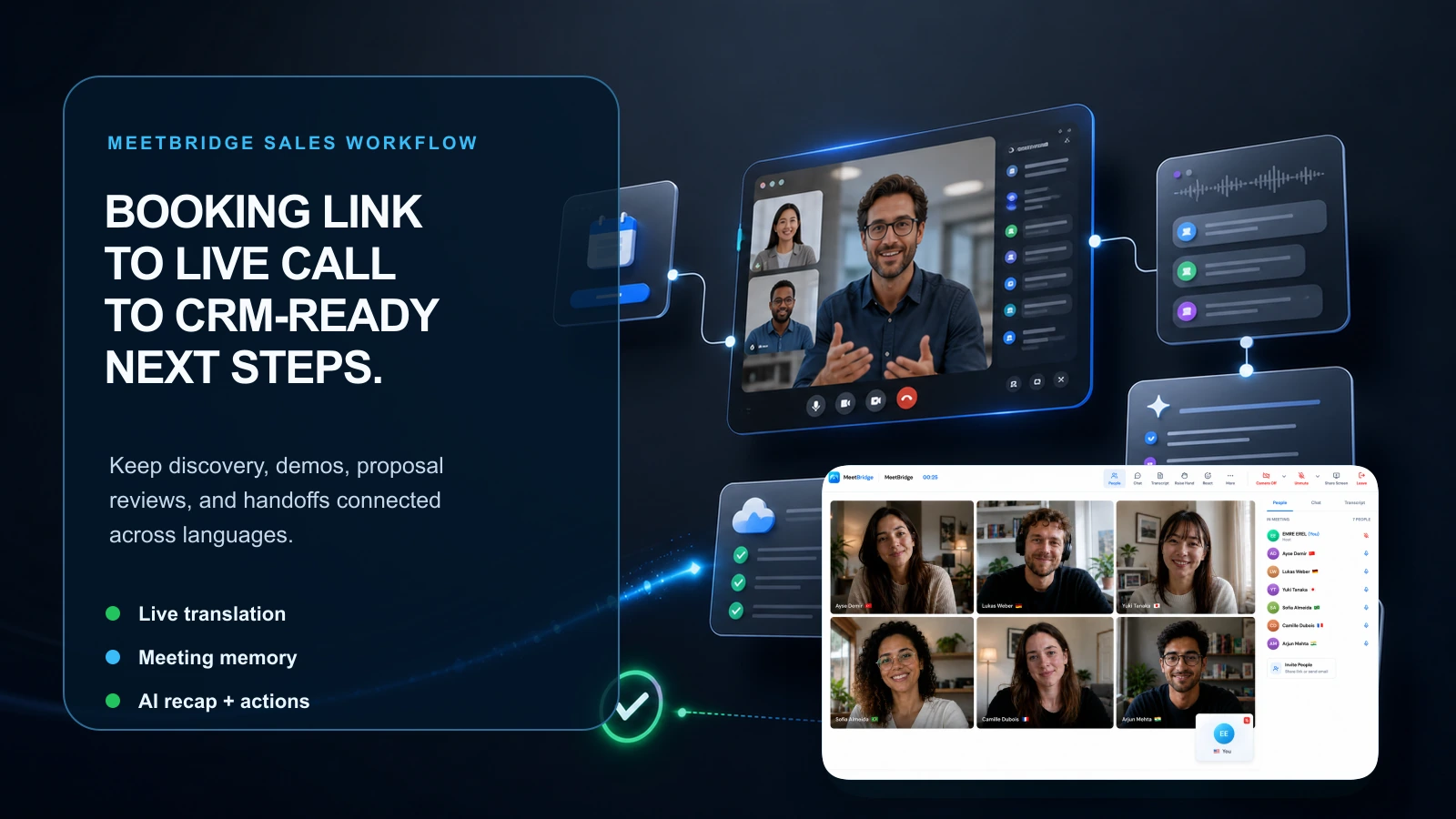
That is the workflow MeetBridge is built for. MeetBridge connects live translation, transcripts and meeting memory, meeting summaries and actions, and booking links so sales teams can run global discovery calls, demos, proposal reviews, renewals, and follow-up without losing momentum.
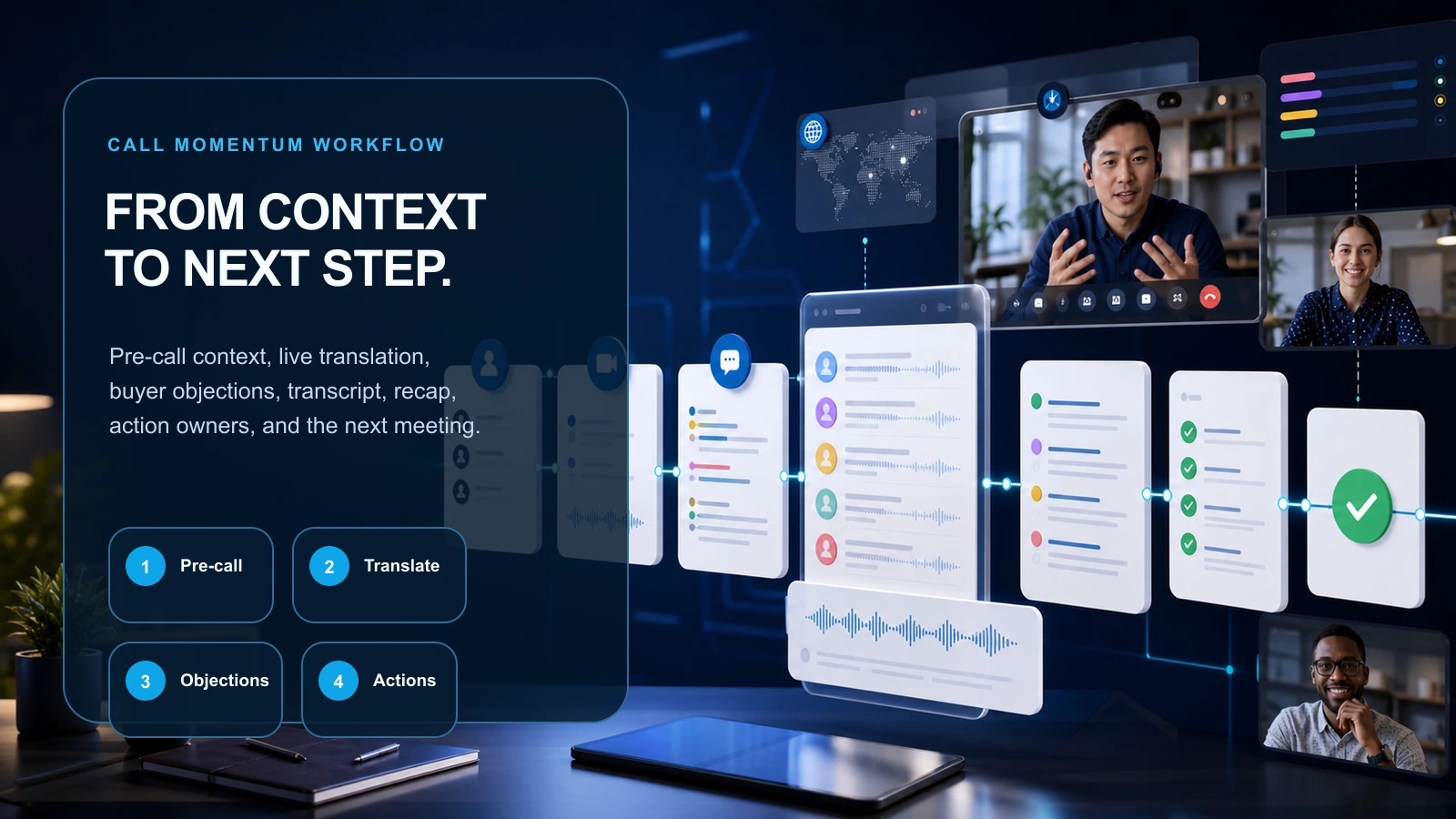
Why multilingual sales calls slow down
A sales call should create movement. The buyer should leave with a clearer problem, clearer value, clearer next step, and more confidence in the vendor.
Language friction can interrupt that movement in subtle ways.
| Sales moment | What can go wrong in a multilingual call | Business impact |
|---|---|---|
| Discovery | Buyer simplifies answers because speaking a second language feels difficult | The seller misses pain, urgency, and buying triggers |
| Demo | Product explanation becomes too slow or too generic | The buyer does not connect features to their real workflow |
| Objection handling | The objection is translated loosely or summarized too early | The team responds to the wrong concern |
| Technical validation | Sales engineer misses a requirement, integration detail, or constraint | Proposal accuracy suffers later |
| Proposal review | Pricing, timeline, or scope details are unclear | Procurement or legal creates delay |
| Follow-up | Recap is late, incomplete, or written from one language group’s perspective | The deal loses trust and urgency |
| Handoff | Customer success receives shallow context | Onboarding starts with repeated questions |
This is why multilingual selling needs more than a bilingual teammate or a generic caption tool.
The sales team needs a meeting system that protects speed and accuracy at the same time.
For a broader category overview, read Best Real-Time Meeting Translation Software in 2026.
The sales principle: reduce language friction without reducing buyer nuance
Many teams try to solve multilingual sales calls by simplifying the conversation.
They speak slower. They avoid nuance. They shorten discovery. They skip deeper objections. They move quickly to the deck. They ask fewer follow-up questions because they do not want to create confusion.
That feels efficient in the moment, but it damages the deal.
The buyer’s nuance is where the sale happens.
You need to hear:
- The exact pain behind the project.
- The internal reason the buyer is evaluating now.
- The stakeholder who will block or approve the deal.
- The operational cost of doing nothing.
- The technical requirement that will decide fit.
- The procurement step that can delay signature.
- The emotional signal that the buyer trusts or does not trust your team.
A good multilingual sales workflow should not flatten those details. It should make them easier to express, capture, and act on.
That is the difference between “we translated the call” and “we advanced the deal.”
The quick framework: before, during, and after the call
The fastest multilingual sales calls are not improvised. They are designed as a workflow.
| Stage | Goal | What to do |
|---|---|---|
| Before the call | Reduce uncertainty before translation starts | Collect language preference, role, agenda, questions, use case, and meeting objective |
| During the call | Keep the conversation natural and sales-focused | Use live translation, short sections, clear turn-taking, objection confirmation, and decision checkpoints |
| After the call | Move immediately into execution | Generate transcript, summary, objections, action items, owners, deadlines, and next-step email |
MeetBridge supports this end-to-end workflow for B2B sales and SaaS teams, especially when sales teams need to move from global discovery to demo, proposal, onboarding, renewal, or handoff without waiting for manual notes.
1) Prepare the sales context before the meeting starts
A multilingual sales call gets slower when the seller has to discover basic context live.
Before the call, collect the information that helps the meeting start with clarity:
- What language does the buyer prefer to speak?
- What language do they prefer to listen in?
- What company, role, and region are they from?
- What problem are they trying to solve?
- What product area or workflow do they want to discuss?
- Who else will join the meeting?
- Is this discovery, demo, proposal review, procurement, onboarding, or renewal?
- What should happen after the meeting?
This is not just administrative work. It improves sales velocity because the first ten minutes do not disappear into context collection.
With MeetBridge booking links, sales teams can collect meeting requests, add custom questions, and bring context into the meeting workflow before the call begins.
That matters because translation works better when the meeting has context. If the seller already knows the buyer’s role, objective, and likely topics, the call can start with a sharper opening:
“Thanks for joining. I saw you’re evaluating this for your support team in Germany and Spain. Let’s use the first ten minutes to understand your current workflow, then we’ll focus the demo on multilingual customer conversations and follow-up.”
That opening is faster than a generic multilingual meeting because it tells the buyer: we know why you are here, we are prepared, and the call will respect your time.
For a customer-facing preparation checklist, read How to Prepare for a Multilingual Customer Meeting.
2) Open the call with language expectations
Do not wait for confusion to appear. Set the language workflow at the beginning.
A strong opening sounds like this:
“You can speak in the language you are most comfortable with. We’ll keep the conversation moving, and I’ll pause to confirm important details like budget, timeline, decision process, and next steps.”
This does three things:
- It gives the buyer permission to speak naturally.
- It reduces the pressure to perform in a second language.
- It tells the buyer that important details will be confirmed, not guessed.
That is important because many international buyers can speak English well enough for a meeting, but not well enough to express complex pain, political context, or technical objections with full confidence.
When buyers speak in the language they trust, discovery improves.
3) Use live translation for conversation, not passive listening
Translated captions can help a buyer follow a presentation. But sales calls are not presentations. They are decision conversations.
A discovery call needs back-and-forth. A demo needs reactions. A proposal review needs negotiation. A renewal call needs risk signals. A technical validation call needs precise questions and clarifications.
If the buyer is only reading translated captions, they may understand the general message but still hesitate to interrupt, challenge, clarify, or negotiate.
A sales-focused live translation workflow should support:
- Buyer questions in their preferred language.
- Seller responses without long pauses.
- Sales engineer explanations during technical discussion.
- Objection handling in real time.
- Clarification before the call moves to the next topic.
- Transcript review after the meeting.
That is why MeetBridge live translation is positioned as part of the meeting room, not as a disconnected translation layer.
For a practical comparison, read Live Translation vs Translated Captions: What Is the Difference?.
4) Keep the meeting structure tighter than usual
A multilingual sales call should feel natural, but it should not be loose.
Loose sales calls slow down because participants are already managing extra cognitive load. They are listening across languages, reading translated meaning, watching the product, and trying to decide whether they trust your team.
Use a tighter structure:
- Confirm the buyer’s goal.
- Run focused discovery.
- Summarize the pain back to the buyer.
- Demo only the relevant workflow.
- Pause for objections.
- Confirm decision process and timeline.
- Assign next steps before the call ends.
The important move is to summarize at transitions.
Instead of saying:
“Okay, let’s move to the demo.”
Say:
“Let me make sure I understood. Your team is losing time because Spanish-speaking customers explain issues in detail, but the internal support team receives only a short English summary. The demo should focus on live understanding, transcript review, and follow-up actions. Is that right?”
This does not slow the deal. It speeds it up because the seller prevents the wrong demo.
5) Run discovery in the buyer’s strongest language
Discovery quality determines sales quality.
In multilingual sales, discovery often gets weaker because buyers simplify their answers. They may say “yes, that is correct” when the real answer is more complex. They may avoid explaining internal politics. They may not challenge the seller because challenging in a second language feels uncomfortable.
Let the buyer explain the problem in their strongest language.
Ask questions that invite detail:
- “What happens today when a customer speaks a language your team does not cover?”
- “Where does the process slow down?”
- “What does your team do manually after those calls?”
- “Who feels the impact when follow-up is unclear?”
- “What would need to change for this project to become urgent?”
- “What would make your team confident enough to move forward?”
Then confirm the answer in a structured way:
“So the problem is not only translation during the call. The bigger issue is that your team loses the original context after the meeting, and follow-up depends on manual notes. Correct?”
That confirmation gives the buyer a chance to correct nuance before the seller builds the rest of the call on a false assumption.
6) Do not make the bilingual teammate the meeting bottleneck
Many companies rely on a bilingual employee to support multilingual sales calls.
That can work for occasional calls, but it does not scale well.
The bilingual teammate often becomes responsible for too many jobs at once:
- Translating the buyer’s words.
- Explaining product details.
- Taking notes.
- Catching objections.
- Clarifying cultural nuance.
- Writing the recap.
- Updating the CRM.
- Supporting the handoff.
That person becomes the bottleneck. The account executive loses direct connection with the buyer. The sales engineer may not hear the full technical context. The buyer may feel they are speaking through a gatekeeper instead of directly with the vendor.
A better workflow lets the team speak more directly while using AI to support live understanding and meeting records.
That does not mean human language support is never useful. For sensitive, regulated, legal, or high-risk negotiations, human interpreters or qualified review may still be the right choice.
But for recurring sales calls, live translation plus transcript, summary, and action capture can reduce dependency on one bilingual teammate for every meeting.
For a deeper framework, read Live Meeting Translation vs Human Interpreters for Business Calls.
7) Protect the deal by confirming the details that matter
In sales, some details are too important to leave to memory.
During a multilingual call, confirm these details explicitly:
| Detail | Why it matters |
|---|---|
| Business pain | Prevents the seller from solving the wrong problem |
| Decision criteria | Shows what the buyer will use to compare vendors |
| Timeline | Determines urgency and next-step cadence |
| Budget range | Helps avoid late-stage misalignment |
| Procurement path | Reveals steps that can slow the deal |
| Stakeholders | Shows who must be involved before signature |
| Technical requirements | Prevents scope, integration, and security surprises |
| Success metric | Defines what value means to the buyer |
| Next meeting | Keeps the opportunity moving |
Use confirmation language that feels collaborative, not robotic:
“I want to confirm this because it affects the proposal. You need the first team live by the end of August, and procurement needs security documentation before legal review. Is that correct?”
This is especially important across languages because the cost of a small misunderstanding increases as the deal progresses.
8) Capture objections in the buyer’s words
Objections are not just barriers. They are instructions.
A buyer’s objection tells the seller what must be true for the deal to move forward.
Common multilingual sales objections include:
- “Our team is worried adoption will be difficult.”
- “We already use another meeting tool.”
- “We need to understand security before we invite external customers.”
- “This sounds useful, but we do not know who would own it internally.”
- “We need proof that it works with our real languages.”
- “We cannot slow down sales or support calls.”
- “The budget is possible, but timing is complicated.”
If these objections are translated loosely or summarized too quickly, the seller may respond to the wrong issue.
A transcript helps the team return to the buyer’s exact language and understand the real concern.
With MeetBridge transcripts and meeting memory, sales teams can review what the buyer said, preserve context across follow-up, and avoid rebuilding the opportunity from memory after the call.
That matters when a manager, sales engineer, founder, or customer success lead needs to understand why the buyer is hesitating.
9) Demo around the buyer’s workflow, not your product menu
Multilingual demos slow down when the seller tries to show everything.
The buyer is already processing language, product, value, and risk. A broad feature tour increases cognitive load.
Instead, anchor the demo around the pain you confirmed in discovery.
A better multilingual demo structure:
- Restate the buyer’s current problem.
- Show the exact workflow that solves it.
- Pause and ask the buyer to react in their own language.
- Confirm whether the workflow fits their team.
- Capture objections before moving to the next feature.
For example:
“You said the biggest issue is not only understanding customers live, but creating a reliable follow-up record after the call. I’ll show that workflow first: live translation, transcript, meeting summary, decisions, and action items.”
Then connect the demo to product pages naturally:
- Live translation for the live customer conversation.
- Transcripts and meeting memory for review after the call.
- meeting summaries and actions for decisions, owners, and next steps.
- Booking links for pre-call context and scheduling.
This keeps the demo sales-focused instead of product-heavy.
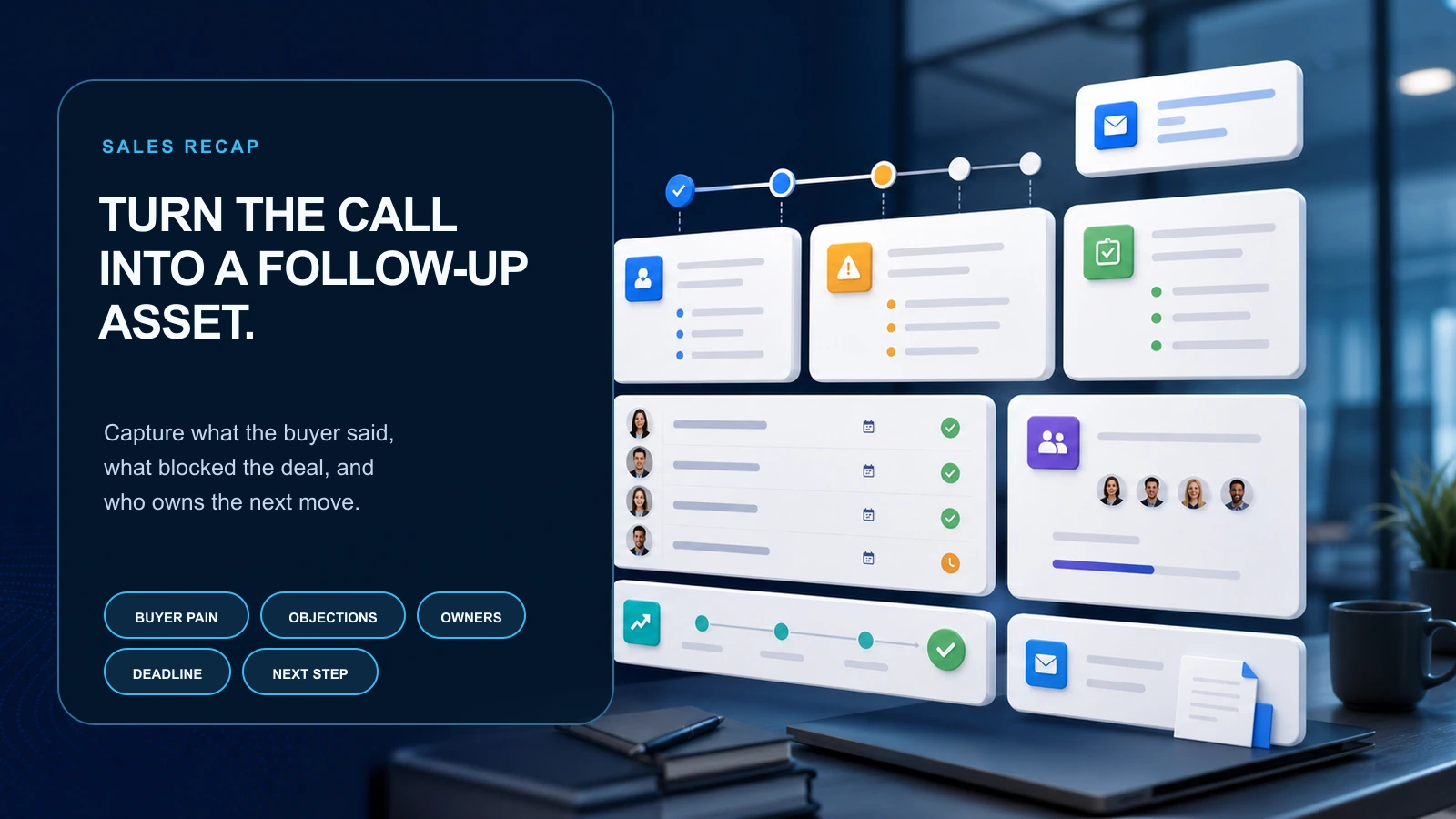
10) Turn every sales call into a follow-up asset
A multilingual sales call loses momentum when follow-up is delayed.
The buyer took the call. They explained the problem. They asked questions. They shared objections. If the recap arrives two days later with generic notes, the deal slows down.
The follow-up should be created from the meeting record while context is fresh.
A strong multilingual sales recap includes:
- The buyer’s goal.
- Current pain and impact.
- Key objections or risks.
- Product areas discussed.
- Decision criteria.
- Stakeholders involved.
- Documents to send.
- Actions owned by your team.
- Actions owned by the buyer.
- Date and goal of the next meeting.
MeetBridge meeting summaries and actions help turn the multilingual conversation into structured output that the sales team can act on. The goal is not just a meeting summary. The goal is a faster next step.
For a broader workflow argument, read Why Global Teams Need More Than Translated Captions.
The multilingual sales call playbook
Use this playbook to keep a global sales call fast without sacrificing nuance.
Before the call
- [ ] Confirm the buyer’s preferred speaking and listening language.
- [ ] Collect company, role, region, and meeting objective.
- [ ] Ask one or two pre-call questions about pain or use case.
- [ ] Prepare key terms, product names, and industry vocabulary.
- [ ] Decide which product workflow to demo first.
- [ ] Define the meeting outcome: discovery, demo, technical validation, proposal review, renewal, or procurement.
- [ ] Align internal roles: account executive, sales engineer, manager, note reviewer, or follow-up owner.
During the call
- [ ] Explain the language workflow at the start.
- [ ] Let the buyer speak in the language they trust.
- [ ] Use short sections: discovery, recap, demo, objection, next step.
- [ ] Confirm important details live.
- [ ] Pause after technical explanations.
- [ ] Ask the buyer to correct your summary.
- [ ] Capture objections as buying criteria.
- [ ] Confirm next steps before the meeting ends.
After the call
- [ ] Review the transcript.
- [ ] Turn the summary into a buyer-ready recap.
- [ ] Pull out objections, decision criteria, and stakeholders.
- [ ] Assign owners and deadlines.
- [ ] Send requested documents quickly.
- [ ] Update CRM with the real meeting context.
- [ ] Prepare the next call using meeting memory.
Scripts that keep the call moving
Sales teams do not need complex language to run better multilingual meetings. They need simple phrases that prevent ambiguity.
Opening script
“You can speak in the language you are most comfortable with. We’ll keep the conversation moving, and I’ll confirm important details before we make decisions or assign next steps.”
Discovery confirmation
“Let me make sure I understood the core problem. Your team can handle the live conversation, but the follow-up record is inconsistent, so details get lost after the call. Is that accurate?”
Demo transition
“Based on what you shared, I’ll skip the general overview and show the workflow that matches your use case: live translation, transcript, summary, and action items.”
Objection clarification
“I want to understand this correctly. Is your concern about translation quality during the call, or about whether your team can trust the meeting record afterward?”
Timeline confirmation
“Before we close, let’s confirm timing. You want to evaluate this with two regions this month, review security next week, and decide before the next quarterly planning cycle. Correct?”
Next-step close
“We’ll send the recap, security overview, and a proposed pilot plan. Your team will confirm the language pairs and invite the regional managers to the next call. Let’s schedule that now.”
These scripts reduce friction because they make the sales process explicit.
How to handle common multilingual sales scenarios
Scenario 1: Global discovery call
The buyer can explain the problem in English, but not with enough nuance. They use short answers and avoid detail.
What to do:
- Invite them to switch to their preferred language.
- Ask open discovery questions.
- Summarize back the pain in structured terms.
- Confirm whether the pain is urgent, expensive, or politically important.
- Save the transcript for follow-up.
MeetBridge workflow: B2B sales and SaaS plus live translation.
Scenario 2: Product demo with multiple stakeholders
The economic buyer speaks one language. The technical evaluator speaks another. The account executive and sales engineer speak English.
What to do:
- Set the call goal clearly.
- Demo one workflow at a time.
- Pause after technical sections.
- Ask each stakeholder to react in their preferred language.
- Capture technical requirements and decision criteria separately.
MeetBridge workflow: live translation plus transcripts and meeting memory.
Scenario 3: Proposal review
The buyer wants to discuss pricing, rollout, security, and timeline. Misunderstanding one term can create delay.
What to do:
- Slow down only for critical commitments.
- Confirm numbers, dates, owners, and dependencies.
- Write the agreement into the recap.
- Assign internal and buyer-side actions before ending the call.
MeetBridge workflow: meeting summaries and actions plus security overview.
Scenario 4: Sales-to-customer-success handoff
The deal closes, but the customer success team was not in every call. Important language context may disappear.
What to do:
- Review previous meeting records.
- Extract pain, success criteria, risks, promised timelines, and key stakeholders.
- Share the transcript and summary before onboarding.
- Start the onboarding call with context instead of repeating discovery.
MeetBridge workflow: transcripts and meeting memory plus customer success.
What not to do in multilingual sales calls
Do not treat translation as a side task
If translation depends on whoever happens to be bilingual, the meeting becomes fragile. The person translating cannot also sell, listen, take notes, and manage the next step perfectly.
Do not rush through discovery
A multilingual call is not faster because the seller asks fewer questions. It is faster when the seller asks the right questions and confirms the answers clearly.
Do not demo before confirming pain
A generic demo is slower in a multilingual setting because buyers have to translate the product into their own context. Confirm the pain first, then demo the relevant workflow.
Do not ignore the transcript
The transcript is not just a record. It is a sales asset. It helps the team review objections, quote the buyer accurately, prepare proposals, update CRM, and hand off the account.
Do not let follow-up become generic
A multilingual buyer should receive a recap that reflects the actual conversation, not a generic template. The recap should show that the team understood the buyer’s goals, constraints, and next steps.
For more failure patterns, read Common Mistakes That Break Multilingual Meetings.
How to choose a live translation platform for sales calls
When evaluating tools, do not only ask whether the app translates speech.
Ask whether it supports the sales process.
| Evaluation area | Sales question to ask | Strong answer |
|---|---|---|
| Live translation | Can buyers speak naturally in their preferred language? | The conversation stays fast during discovery, objections, and Q&A |
| Latency | Does translation delay slow the deal? | Participants can respond without awkward waiting |
| Transcript | Can the team review exact buyer context? | Objections, requirements, and commitments are preserved |
| Meeting memory | Can future calls start with context? | Previous pain, stakeholders, and next steps are easy to retrieve |
| meeting summaries | Can the call become a sales recap quickly? | Summary includes pain, decision criteria, risks, and actions |
| Action items | Are next steps visible? | Owners and deadlines are clear before the next call |
| Booking context | Can the seller prepare before the call? | Language preference, role, questions, and meeting objective are collected |
| Security | Can customer meeting data be handled responsibly? | Access, policies, and security expectations are clear |
| Team workflow | Does it help AE, SE, manager, and CS work together? | The record supports demos, proposals, CRM updates, and handoffs |
This is why a dedicated multilingual meeting platform is stronger than a translation-only feature for sales teams.
For a general buyer checklist, read What to Look for in Multilingual Meeting Software.
How MeetBridge helps sales teams move faster
MeetBridge is designed for sales teams that need to sell across languages without slowing down discovery, demos, proposal reviews, renewals, and handoffs.
The workflow supports:
- Booking links to collect buyer context before the call.
- Live translation to keep the sales conversation natural.
- Transcripts and meeting memory to preserve buyer pain, objections, requirements, and commitments.
- meeting summaries and actions to turn the call into recap, owners, deadlines, and next steps.
- B2B sales and SaaS workflows for discovery, demos, proposals, onboarding, renewals, and partner sales calls.
This matters because sales teams do not only need to understand the buyer live. They need to respond, prove value, build trust, and move the opportunity forward.
MeetBridge helps sales teams reduce the common delays that appear in multilingual selling:
- Waiting for a bilingual teammate.
- Repeating answers because the buyer missed nuance.
- Sending slow or incomplete recaps.
- Losing objections between the call and the CRM.
- Handing customer success a shallow account history.
- Re-running discovery because the first call was not captured clearly.
The result is a faster path from conversation to follow-up.
Start with the MeetBridge product overview to see how the full multilingual meeting workflow connects.
A sample multilingual sales call agenda
Use this agenda for a 30-minute multilingual discovery or demo call.
| Time | Section | Purpose |
|---|---|---|
| 0–3 min | Language setup and meeting goal | Give permission to speak naturally and define the outcome |
| 3–10 min | Discovery | Understand pain, urgency, team, and current workflow |
| 10–12 min | Summary checkpoint | Confirm the problem before demoing |
| 12–22 min | Focused demo | Show only the workflow connected to the buyer’s pain |
| 22–25 min | Objections and questions | Invite buyer concerns in their preferred language |
| 25–28 min | Decision process and timing | Confirm stakeholders, procurement, security, and timeline |
| 28–30 min | Next steps | Assign owners, deadlines, and next meeting |
The most important parts are the summary checkpoint and the close. Those are where multilingual calls either gain speed or lose it.
A sample follow-up structure
After the call, send a recap that makes the buyer feel understood.
Use this structure:
Subject line
Recap: multilingual sales workflow discussion and next steps
Opening
Thanks for the conversation today. I’m sharing a short recap to confirm the main points and keep the next step clear.
Buyer goal
Your team wants to support multilingual customer conversations without depending on manual interpretation or losing follow-up context after the call.
Pain confirmed
The main challenge is not only live understanding. It is preserving the details after the meeting: objections, decisions, action items, and handoff context.
What we reviewed
- Live translation during customer conversations.
- Transcript and meeting memory after the call.
- meeting summaries, decisions, and action items.
- Booking context before the meeting.
Open questions
- Which language pairs should be tested first?
- Who should join the pilot from sales and customer success?
- What security documents are needed before approval?
Next steps
- Our team sends the pilot plan and security overview.
- Your team confirms the two regions for the pilot.
- We schedule a follow-up call with the regional managers.
This structure is simple, but it protects momentum. It makes the next step clear and reduces the chance that the buyer has to re-explain the meeting internally.
The takeaway
A multilingual sales call should not feel like a slower version of a normal sales call.
It should feel like a better sales process: more inclusive discovery, clearer buyer context, stronger objection capture, faster follow-up, and better handoff.
To make that happen, sales teams need more than translation during the call. They need a workflow that connects preparation, live conversation, transcript, meeting memory, summary, actions, and next steps.
That is how global sales teams keep deals moving across languages.
See MeetBridge in action
If your sales team runs discovery calls, demos, proposal reviews, renewals, onboarding, or partner calls across languages, explore how MeetBridge supports the full workflow:
- B2B sales and SaaS: run global demos and buyer conversations without losing context.
- Live translation: keep the conversation understandable while people speak.
- Transcripts and meeting memory: preserve buyer pain, objections, and commitments after the call.
- meeting summaries and actions: turn sales conversations into next steps.
- Booking links: collect buyer context before the meeting starts.
- Product overview: see the complete multilingual meeting workflow.
To evaluate MeetBridge for your sales team, contact sales or review pricing.
FAQ
What is a multilingual sales call?
A multilingual sales call is a discovery, demo, proposal, renewal, or customer-facing sales conversation where participants speak or listen in different languages. The goal is not only to translate the conversation, but to keep the deal moving with clear discovery, objections, decisions, and follow-up.
How do you run multilingual sales calls without slowing down the deal?
Prepare language and buyer context before the call, use live translation for back-and-forth conversation, keep the agenda focused, confirm critical sales details, capture objections in the buyer’s words, and send a structured follow-up quickly after the meeting.
Are translated captions enough for sales calls?
Translated captions can help buyers follow a presentation, but they are often not enough for interactive sales conversations. Sales calls require questions, objections, clarifications, technical details, and next-step decisions. Live translation connected to transcripts and summaries is usually stronger for sales workflows.
Why are transcripts important in multilingual sales calls?
Transcripts help sales teams review what the buyer actually said. They preserve pain, objections, requirements, decision criteria, pricing details, stakeholder context, and commitments. This makes follow-up, CRM updates, proposal writing, and handoff more reliable.
How can sales teams avoid losing objections in translation?
Ask the buyer to explain the concern in their preferred language, repeat the objection back in structured terms, confirm whether you understood it correctly, and save the transcript so the team can review the exact context after the call.
Should sales teams use human interpreters or live translation software?
It depends on the risk and type of meeting. Human interpreters may be better for legal, regulated, or highly sensitive discussions. live translation software can be a strong fit for recurring discovery calls, demos, proposal reviews, customer conversations, and internal sales workflows when paired with transcripts, summaries, and clear confirmation steps.
How does MeetBridge help multilingual sales teams?
MeetBridge helps sales teams run global calls with live translation, booking context, transcripts, meeting memory, meeting summaries, decisions, action items, and follow-up workflows. It is built for sales teams that need multilingual conversations to turn into reliable next steps.
What should be included in a multilingual sales recap?
A strong recap should include the buyer’s goal, pain, objections, decision criteria, stakeholders, timeline, requested materials, next steps, owners, and deadlines. The recap should reflect the actual conversation, not a generic summary.
Related posts
Continue reading:
- Best Real-Time Meeting Translation Software in 2026
- Live Translation App for Meetings: What Business Teams Should Look For in 2026
- How to Run Multilingual Meetings Without Slowing Them Down
- How to Prepare for a Multilingual Customer Meeting
- Live Translation vs Translated Captions: What Is the Difference?
- What to Look for in Multilingual Meeting Software
- Why Global Teams Need More Than Translated Captions
- Common Mistakes That Break Multilingual Meetings
- How Multinational Companies Eliminate Language Barriers in Meetings
- Live Meeting Translation vs Human Interpreters for Business Calls