
 By MeetBridge Team
Real Estate Meeting Translator for Foreign Buyers
Learn how a real estate meeting translator helps agencies, developers, and property consultants run clearer multilingual meetings with foreign buyers, investors, legal teams, and follow-up workflows.
Real Estate Meeting Translator for Foreign Buyers
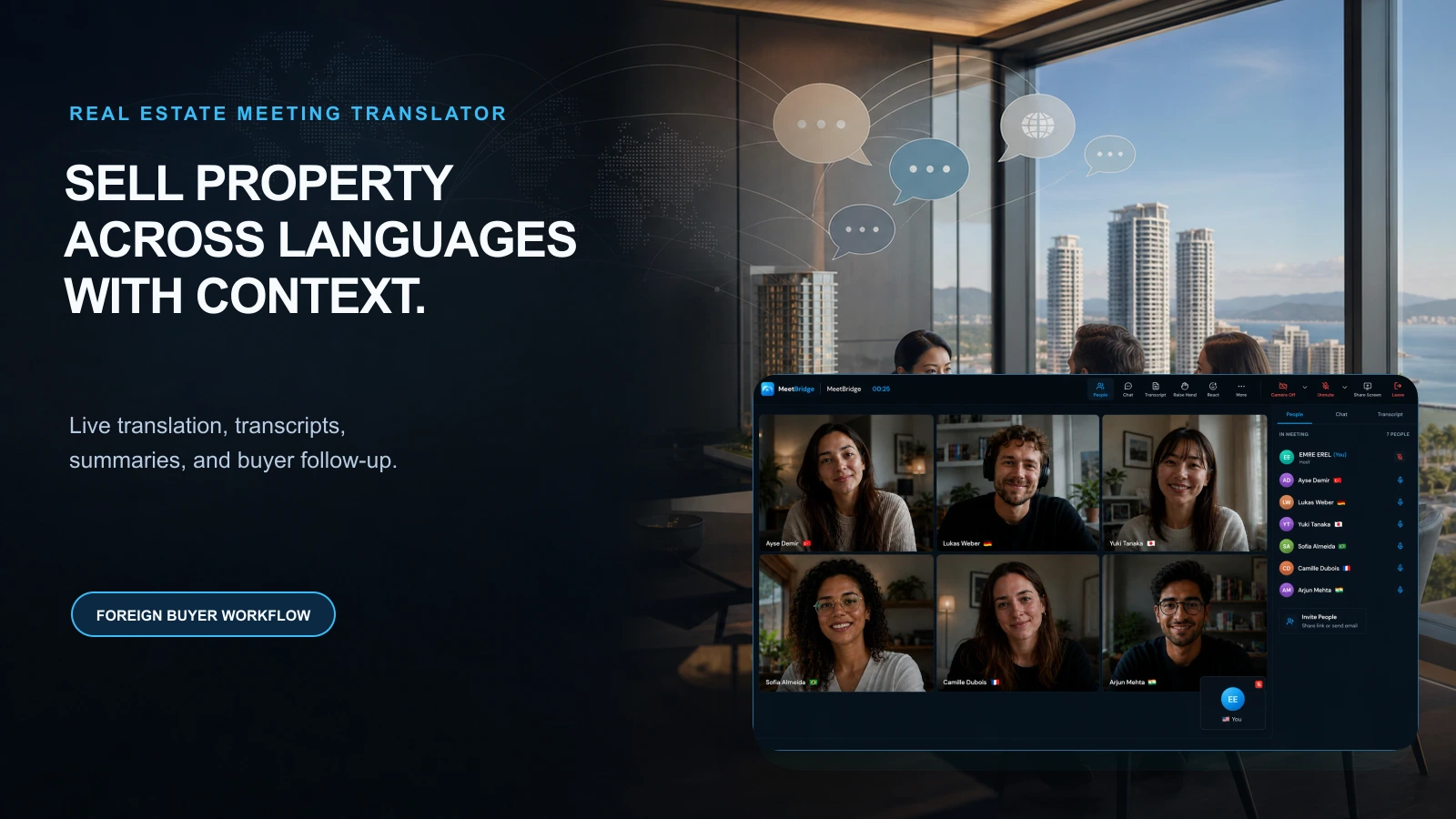
A real estate meeting translator should do more than help two people understand each other for a few minutes. For agencies, developers, property consultants, and investment advisors working with foreign buyers, the real goal is to make every property conversation clear enough to move the deal forward.
That is harder than it sounds.
Foreign buyer meetings are full of details that cannot be handled casually: budget, location, project timelines, payment plans, title deed steps, legal requirements, taxes, rental expectations, reservation conditions, handover dates, and documents that need to be collected before the next call. If the translation is weak, the buyer loses confidence. If the follow-up is weak, the team loses the opportunity.
A generic translation app may help with simple phrases. A business-ready real estate meeting translator should support the whole workflow: pre-meeting context, live translation, transcripts, summaries, decisions, action items, and follow-up.
That is where MeetBridge is designed differently. MeetBridge combines live translation, transcripts and meeting memory, meeting summaries and actions, booking links, and team meeting records in one workflow. For real estate teams, that means foreign buyer consultations, property presentations, investment calls, legal next-step meetings, and post-meeting follow-up can stay connected.
If your team works with international buyers, start with the MeetBridge real estate solution to see how multilingual property conversations fit into a complete meeting workflow.
What is a real estate meeting translator?
A real estate meeting translator is a live translation tool or meeting platform that helps property teams speak with buyers, investors, partners, and advisors across languages during real estate conversations.
In a basic version, it may translate speech or captions during a call.
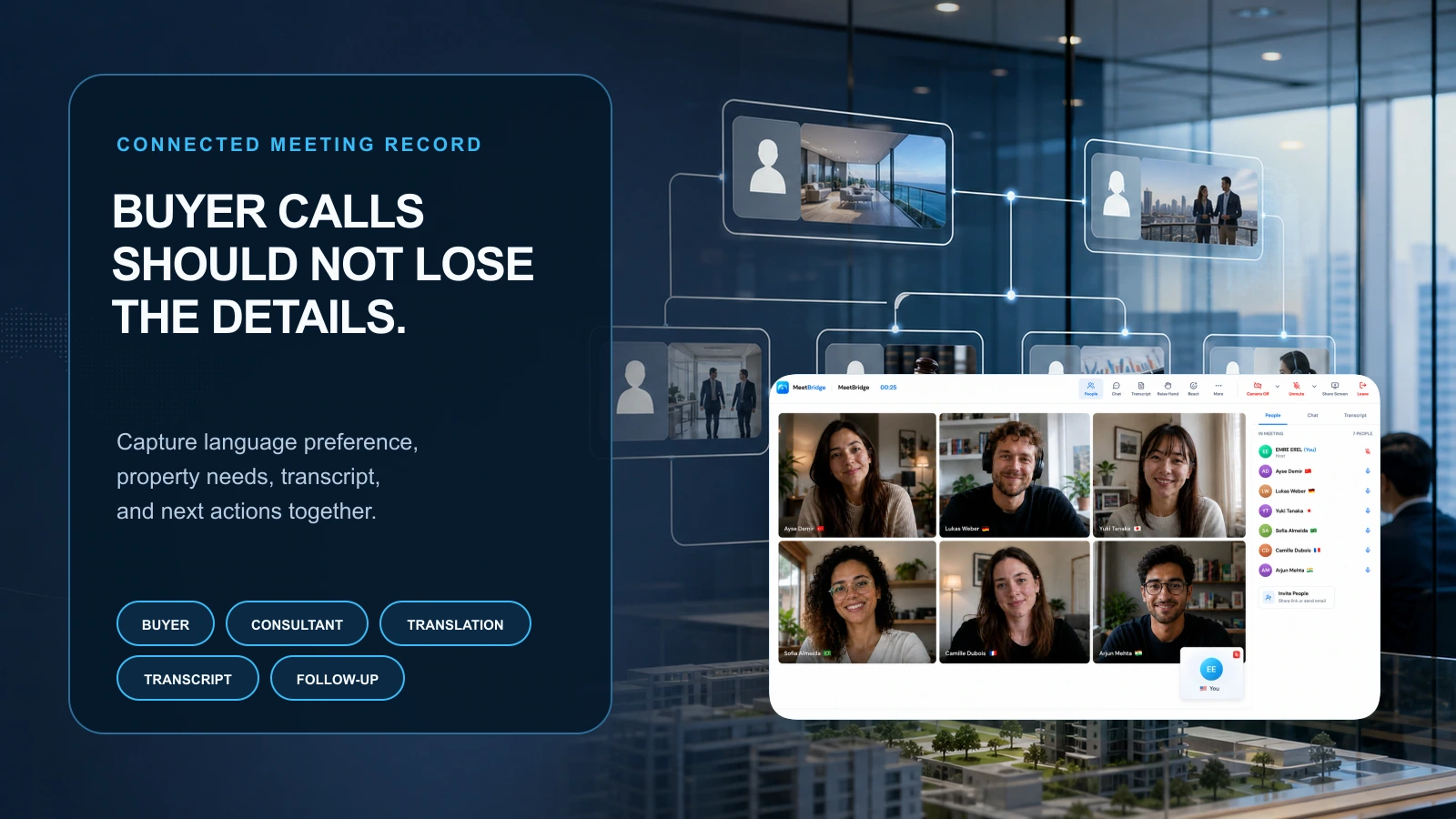
In a business-ready version, it should help the real estate team manage the entire multilingual meeting lifecycle:
- Before the meeting: collect buyer language preference, budget, property goals, location interest, investment timeline, and questions.
- During the meeting: translate the conversation in real time so the buyer can ask questions and the agent can explain details naturally.
- After the meeting: preserve the transcript, summarize buyer needs, capture decisions, assign next steps, and keep the follow-up organized.
That difference matters because real estate sales do not depend only on understanding words. They depend on trust, timing, documentation, and clear next steps.
A buyer may understand the translated answer during the call, but if the follow-up email misses their concern about payment plans, the deal can slow down. A developer may explain a handover timeline correctly, but if the consultant's notes are incomplete, the legal or after-sales team may receive the wrong expectation. A buyer may ask a detailed question about a location, but if nobody captures it, the next property recommendation may be irrelevant.
That is why a real estate meeting translator should be evaluated as a meeting system, not just as a translation feature.
For a broader category overview, read What Is an Live Meeting Translator and How Does It Work?. If you are comparing tools, read Best Real-Time Meeting Translation Software in 2026.
Why foreign buyer meetings are different
A local buyer can often visit an office, ask a question twice, bring a family member, and verify details in their own language. A foreign buyer usually has a different experience.
They may be joining from another country. They may not understand the local property process. They may be comparing several cities or countries at the same time. They may need help from a legal advisor, tax advisor, mortgage broker, developer, after-sales team, or family member who speaks another language.
That creates a meeting environment where every detail matters.
Common foreign buyer questions include:
- What is included in the listed price?
- Is the unit available now or under construction?
- What is the difference between net and gross area?
- What are the payment plan options?
- What deposit is required to reserve the property?
- What documents are needed before the next step?
- What legal steps happen before title transfer?
- What taxes, fees, or service charges should be expected?
- What is the rental potential or resale expectation?
- What happens if the buyer cannot travel immediately?
- Who will coordinate after the deposit or reservation?
A weak translation process creates avoidable risk at each point.
The risk is not only that the buyer misunderstands one sentence. The bigger risk is that the team leaves the meeting with different interpretations of the same conversation.
For example:
- The buyer thinks a payment date is flexible, but the team considers it fixed.
- The agent thinks the buyer prefers rental yield, but the buyer actually cares more about family relocation.
- The developer explains a delivery timeline, but the follow-up summary makes it sound guaranteed when it should be confirmed.
- The buyer asks for a legal document, but the request is not sent to the right internal person.
- The meeting feels positive, but the next email does not answer the buyer's actual objection.
A real estate meeting translator should help prevent this gap.
The real problem is not only language. It is lost context.
Many property teams think multilingual sales fail because of language. Language is part of the problem, but the deeper issue is context loss.
Context gets lost before the call when the team does not know the buyer's goal. It gets lost during the call when questions are translated informally or partially. It gets lost after the call when the follow-up depends on memory, WhatsApp notes, or a single bilingual teammate.
In real estate, context loss is expensive because buyer trust is fragile.
A foreign buyer is usually evaluating more than one property. They may be speaking with multiple agents. They may be nervous about buying in another country. They may need to explain the decision to a spouse, business partner, parent, or advisor. If your follow-up is slow or unclear, the buyer may assume the whole process will be difficult.
That is why the meeting record matters.
A strong workflow should preserve:
- Buyer language preference.
- Budget range and payment comfort.
- Location and lifestyle priorities.
- Investment goals and risk concerns.
- Questions about the specific project or unit.
- Legal, tax, mortgage, or documentation concerns.
- Stakeholders who need to join future meetings.
- Clear next steps, owners, and deadlines.
MeetBridge supports this by connecting the live conversation to transcripts and meeting memory, then helping teams move from notes to meeting summaries and actions.
Quick checklist: what real estate teams should look for
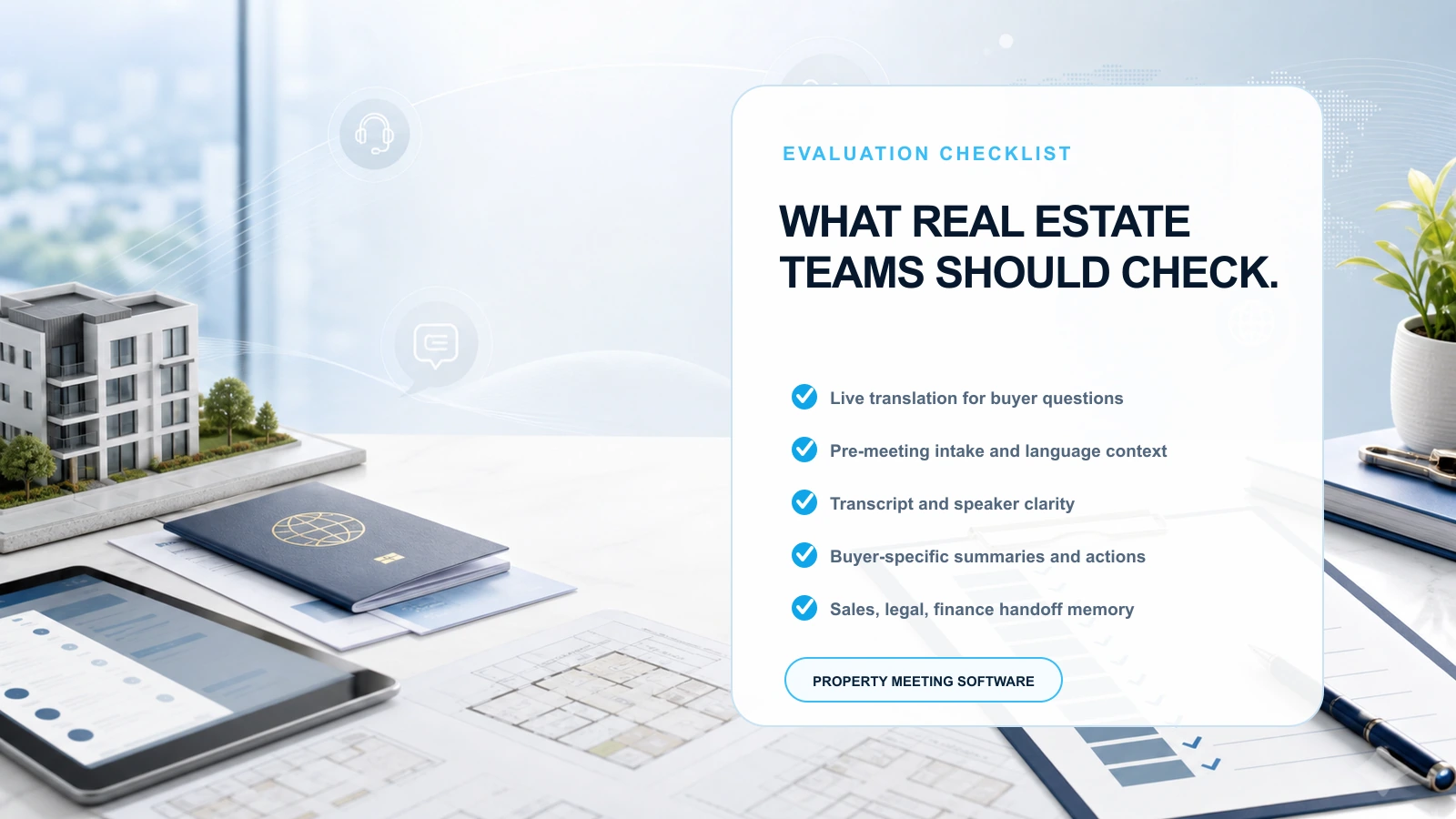
Use this table when comparing real estate meeting translators, live meeting translators, translated captions, human interpreters, and general translation apps.
| Evaluation area | What to look for | Why it matters in real estate |
|---|---|---|
| Live translation | Real-time translation that supports natural buyer questions and agent answers | Property meetings depend on trust, speed, and clear explanation |
| Guest experience | Easy access for foreign buyers, family members, lawyers, and partners | External participants should not struggle to join the meeting |
| Pre-meeting context | Booking questions for language, budget, location, timeline, and buyer goals | Agents need context before presenting properties |
| Transcript | Searchable record of what was said | Teams need to verify buyer requirements, objections, and commitments |
| Speaker clarity | Clear separation of buyer, agent, developer, lawyer, or advisor input | Multi-stakeholder calls become confusing without attribution |
| meeting summary | Summary focused on buyer needs, decisions, risks, open questions, and next steps | Generic notes do not help sales teams follow up well |
| Action items | Owners, deadlines, and next-step tasks | Real estate deals move through many handoffs |
| Legal-step support | A workflow that helps capture legal questions without pretending to be legal advice | Property purchases often require qualified professional review |
| Team memory | Meeting history across discovery, presentation, legal, and follow-up calls | Foreign buyer journeys usually take more than one meeting |
| Security | Clear access control and treatment of meeting records | Calls may include personal documents, pricing, and sensitive buyer details |
MeetBridge is built around these layers through live translation, booking links, meeting memory, and AI follow-up workflows.
1) Start before the meeting with buyer intake
Many multilingual real estate meetings fail before anyone speaks.
The agent joins without enough context. The buyer expects investment advice, but the team prepared a lifestyle presentation. The buyer wants to discuss legal steps, but no legal stakeholder is available. The buyer speaks one language, the spouse prefers another, and the meeting owner discovers this only after the call starts.
A better workflow starts with structured intake.
With MeetBridge booking links, real estate teams can collect meeting requests and custom questions before the conversation begins. That context can help agents enter the call prepared instead of spending the first half of the meeting rebuilding basic information.
Useful pre-meeting questions for foreign buyer calls include:
- What language would you prefer for the meeting?
- Are you buying for investment, relocation, vacation use, or family needs?
- Which city, district, or property type are you considering?
- What is your approximate budget range?
- Are you interested in ready-to-move, under-construction, or off-plan projects?
- Will anyone else join the meeting, such as a spouse, partner, lawyer, or advisor?
- What is your expected purchase timeline?
- Do you already have required documents available?
- What questions do you want answered during the call?
This is not only a scheduling improvement. It is a translation improvement.
When the meeting has context, the conversation is easier to guide. The agent can prepare the right vocabulary, property options, legal handoff plan, and follow-up materials. The buyer feels that the team understands their situation before the sales pitch begins.
For more on preparation, read How to Prepare for a Multilingual Customer Meeting.
2) Use live translation to keep property conversations natural
A foreign buyer consultation should not feel like a stop-start interpretation session.
The buyer needs to ask questions naturally. The agent needs to explain details without oversimplifying. The conversation may move quickly from location to payment plan, from floor plans to legal documents, from rental expectations to family needs.
If translation is too slow or awkward, several things happen:
- Buyers ask fewer questions.
- Agents simplify important explanations.
- Nuance disappears from objections.
- The meeting loses momentum.
- Trust drops because the buyer feels dependent on a language workaround.
MeetBridge live translation helps participants keep speaking in the language they know best while the conversation stays understandable. For real estate teams, that means the meeting can remain direct even when buyer, agent, developer, advisor, or legal stakeholder do not share the same language.
This matters most during high-value moments:
- Explaining why one district is better for rental yield while another is better for lifestyle.
- Comparing two payment plans.
- Clarifying the difference between reservation, deposit, contract, and title transfer.
- Discussing whether a buyer needs to travel or can complete some steps remotely.
- Handling objections about trust, risk, price, timing, or documentation.
- Confirming which unit, floor, view, or delivery date is being discussed.
Translated captions may help someone follow the general direction of a conversation, but real estate teams usually need more than captions. They need a meeting workflow that lets people speak, review, confirm, and follow up.
Read Live Translation vs Translated Captions: What Is the Difference? for a deeper breakdown.
3) Protect the details that change the deal
Real estate meetings are detail-heavy.
A buyer does not only ask, "Is this property good?" They ask about exact numbers, timelines, location tradeoffs, fees, documents, and risk. A meeting translator for real estate should help the team preserve these details instead of leaving them scattered across memory and chat.
Details that need special attention include:
- Project name and developer name.
- Unit number, floor, view, and orientation.
- Net area, gross area, and balcony or terrace details.
- Listed price, currency, payment plan, deposit, and reservation period.
- Delivery date, construction stage, and handover expectations.
- Included furniture, appliances, parking, storage, or amenities.
- Service charges, maintenance fees, taxes, and closing costs.
- Rental estimate, resale strategy, and occupancy assumptions.
- Legal steps, required documents, and professional review needs.
- Buyer concerns about travel, remote purchase, family approval, or financing.
Small misunderstandings can create large trust problems.
For example, if a buyer asks about "annual maintenance" and the follow-up only mentions "monthly fees," they may think the team is hiding costs. If a buyer asks whether the property is ready for immediate use and the answer is summarized too broadly, the next call may begin with frustration. If a buyer asks for a legal document and the action item does not reach the legal team, the deal can lose momentum.
A strong workflow does not pretend AI translation removes all risk. Instead, it gives the team a record they can review.
With transcripts and meeting memory, teams can return to the conversation after the call. With meeting summaries and actions, the team can turn key discussion points into clearer follow-up.
For sensitive legal, tax, immigration, financing, or contractual questions, teams should still involve qualified professionals and confirm critical details in writing. MeetBridge helps preserve and organize the meeting context, but it should not be used as a substitute for professional legal or financial advice.
4) Make the transcript the source of truth after the call
Foreign buyer meetings often involve multiple people who were not all present on the call.
The sales consultant may host the first meeting. A legal advisor may join the second. A developer representative may answer technical project questions. A finance contact may explain payment options. An after-sales team may handle handover, utilities, furnishing, or rental management later.
If the first call is not recorded as usable context, every later handoff becomes weaker.
The team may ask the buyer to repeat the same information. Internal stakeholders may receive incomplete notes. A bilingual teammate may become the single source of truth. Follow-up may reflect what one person remembered, not what the buyer actually said.
A transcript changes the process.
A good real estate meeting transcript helps the team answer:
- What did the buyer ask?
- Which property was discussed?
- What was promised or explicitly not promised?
- What objections came up?
- What documents were requested?
- What legal or tax topics need professional follow-up?
- Who needs to join the next meeting?
- What should the team send after the call?
MeetBridge transcripts and meeting memory keep meeting records reviewable and tied to follow-up context. That is especially useful when a buyer journey includes several calls across different stakeholders and languages.
For more on why translation alone is not enough, read Why Global Teams Need More Than Translated Captions.
5) Turn the meeting into buyer-specific follow-up
The sale is not won during the meeting. It is often won in the follow-up.
Foreign buyers want to see that the team understood them. They want a recap that reflects their goals, not a generic property brochure. They want clear next steps, not vague promises. They want to know who will send the floor plan, who will check availability, who will explain legal steps, and when the next conversation will happen.
A real estate meeting translator should help teams move from conversation to action.
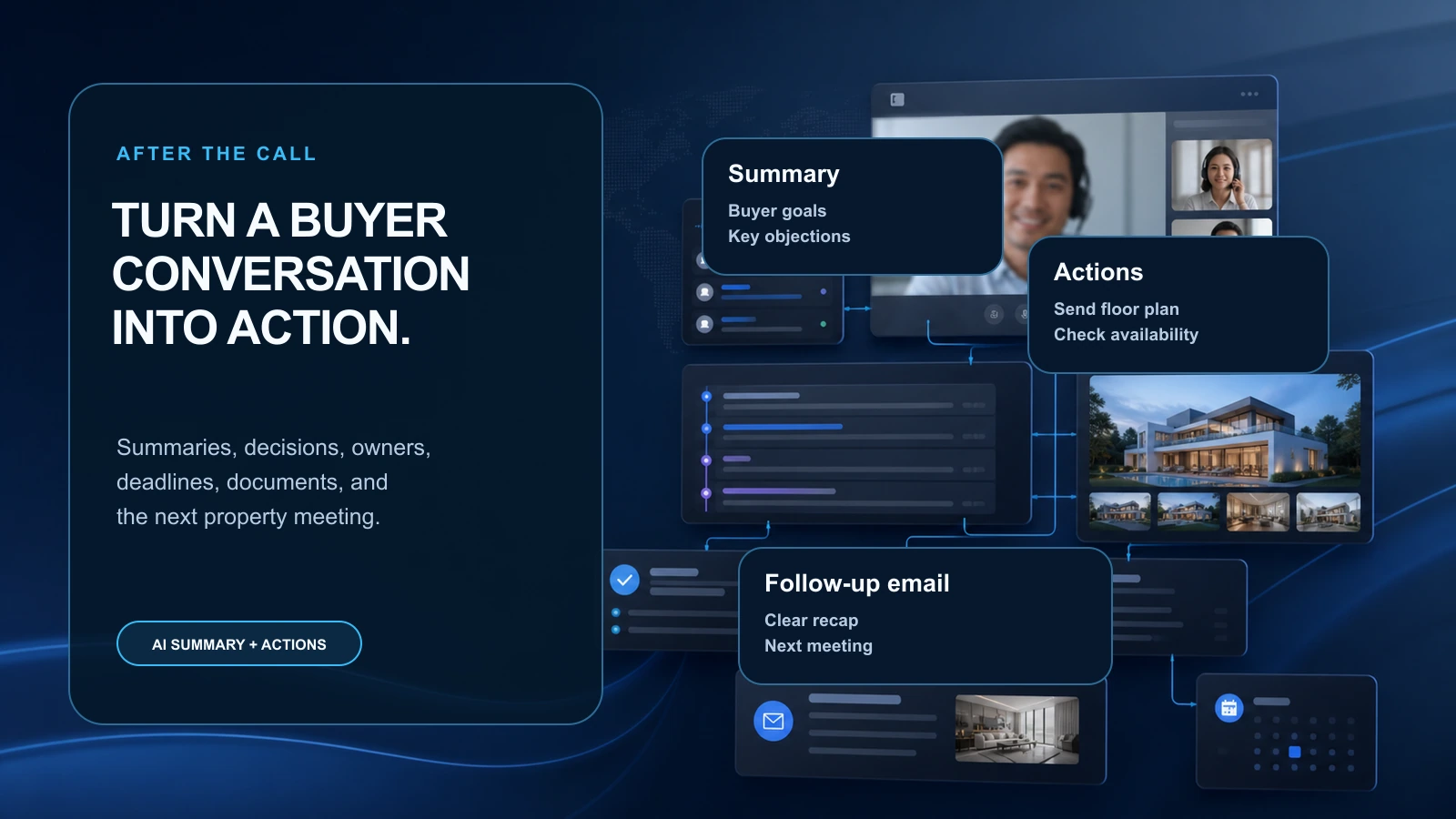
After a foreign buyer meeting, strong follow-up usually includes:
- A short summary of the buyer's goal.
- The exact properties or projects discussed.
- Price, payment plan, and availability items that need confirmation.
- Buyer questions that still need an answer.
- Documents or links to send.
- Next-step meeting recommendations.
- Internal owners for legal, finance, developer, or after-sales handoff.
- Deadlines for the team and the buyer.
MeetBridge meeting summaries and actions are built for this output layer. The goal is not just to summarize the meeting. The goal is to help the team understand what happened, what matters, and what should happen next.
That makes the difference between a translated call and a real business workflow.
6) Build a clearer handoff between sales, legal, finance, and after-sales
Real estate teams rarely operate as one person.
A foreign buyer journey may move through several roles:
- Lead qualification.
- Property consultant.
- Developer sales team.
- Legal advisor.
- Mortgage or finance contact.
- Documentation team.
- After-sales or handover team.
- Rental management or resale advisor.
Each handoff creates a chance for context loss.
The buyer may have already explained their budget, citizenship, timeline, family situation, rental goals, concerns, and preferred language. If the next team member cannot see that context, the buyer has to repeat everything. That makes the process feel less professional.
A good real estate meeting translator should support internal handoffs by preserving the meeting record.
The transcript shows what was said. The summary shows the outcome. The action items show who owns what. The meeting history helps the next person prepare before joining the buyer conversation.
MeetBridge is built as a connected meeting workflow from booking to follow-up, which makes it more useful for real estate teams than a translation tool that disappears when the call ends.
MeetBridge vs generic translation apps for real estate
A generic translation app can be useful for simple conversations. But foreign buyer meetings are not simple conversations. They are sales, advisory, operational, and trust-building conversations at the same time.
| Evaluation point | Generic translation app | MeetBridge |
|---|---|---|
| Primary use | Quick phrase or conversation translation | Multilingual business meetings with records and follow-up |
| Buyer intake | Usually separate from the translation tool | Booking links can collect context before the call |
| Live meeting | Translation may happen outside the meeting workflow | Live translation is part of the meeting experience |
| Property details | Often lost unless someone manually writes notes | Transcripts and meeting memory preserve what was discussed |
| Follow-up | Depends on manual notes | meeting summaries and actions help structure decisions and next steps |
| Handoffs | Hard to connect to sales, legal, finance, and after-sales | Meeting records support team review and continuity |
| Best for | Informal translation or short conversations | Foreign buyer consultations, property presentations, investment calls, legal next-step calls, and follow-up reviews |
The key difference is product shape.
A generic translation app asks, "Can we translate this conversation?"
MeetBridge asks, "Can this multilingual meeting produce a clear next step?"
That is the question real estate teams should care about.
Practical scenarios: where a real estate meeting translator helps
Scenario 1: Foreign buyer discovery call
A buyer from another country wants to understand whether your market fits their investment goals. The consultant speaks English. The buyer is more comfortable in Arabic, Turkish, Spanish, Russian, German, French, or another language.
The first call needs to uncover goals, budget, risk concerns, timeline, preferred location, family needs, and next-step readiness.
A translation-only tool may help the conversation happen. But the real value comes after the call, when the team needs to recommend the right properties and send a meaningful follow-up.
With MeetBridge, the team can run the call with live translation, then use the transcript and summary to capture buyer preferences and next steps.
Scenario 2: Remote property presentation
The buyer cannot travel yet, so the consultant presents a project remotely.
The meeting includes location, floor plans, views, amenities, delivery date, payment schedule, nearby schools or transport, rental potential, and comparison with other projects.
In this scenario, the buyer needs confidence. They may not buy immediately, but they need to trust that the consultant understands their questions.
A real estate meeting translator helps the buyer follow the presentation in their preferred language. Meeting memory helps the consultant return to exact questions when preparing the next set of recommendations.
Scenario 3: Legal next-step call
The buyer is interested, but the next step involves legal documents, reservation terms, title deed questions, tax questions, or power of attorney discussions.
This is where the risk level increases.
AI translation can support communication, but legal or contractual explanations should be reviewed by qualified professionals. The translation workflow should preserve what was discussed and identify what needs professional confirmation.
MeetBridge helps the team capture legal questions, action items, and required documents without relying only on memory.
Scenario 4: Payment plan and negotiation meeting
The buyer wants to compare payment plans or negotiate terms.
Numbers, dates, and conditions matter. The team needs to avoid ambiguity around deposit, installments, currency, deadlines, discounts, penalties, and refund conditions.
A real estate meeting translator should help keep the live conversation understandable while also giving the team a transcript and summary to verify the final understanding.
Critical financial or contractual details should always be confirmed in writing after the call.
Scenario 5: Developer, agent, and buyer call
A developer representative joins the meeting to answer detailed project questions. The agent manages the buyer relationship. The buyer asks questions in another language.
Without a structured workflow, this type of call becomes messy. The buyer asks the agent, the agent asks the developer, the developer answers, and the agent summarizes. Nuance can disappear at every handoff.
With live translation and a shared meeting record, the team has a better chance of keeping the conversation direct, reviewable, and actionable.
Scenario 6: Post-sale handover or after-sales meeting
The buyer has already purchased or reserved a property. Now the team needs to discuss handover, documents, utilities, furniture, rental management, maintenance fees, or local services.
This stage is critical for trust and referrals. A buyer who feels supported after the sale is more likely to recommend the team.
MeetBridge helps after-sales teams run multilingual support conversations while keeping follow-up items visible.
A better workflow for foreign buyer meetings
A strong real estate translation workflow should look like this.
Step 1: Collect buyer context before the call
Use booking links to ask the questions that matter: language, budget, property goal, location, timeline, and who will join.
Step 2: Prepare the meeting around the buyer's goal
Do not present every available property. Prepare the conversation around the buyer's stated need: investment yield, relocation, lifestyle, vacation use, citizenship or residency planning, family needs, or long-term resale.
Step 3: Run the meeting with live translation
Use live translation so the buyer can ask questions naturally and your team can explain details without forcing the conversation through one bilingual note-taker.
Step 4: Confirm critical details before the call ends
Before closing, confirm the most important points:
- Preferred property or project.
- Budget and payment comfort.
- Open questions.
- Documents to send or collect.
- Legal, tax, or finance questions needing professional review.
- Next meeting owner and timeline.
Step 5: Review the transcript
Use meeting memory to verify what the buyer asked and what your team promised.
Step 6: Send a buyer-specific summary
Use meeting summaries and actions to turn the call into a practical recap with next steps, owners, and deadlines.
Step 7: Keep the next meeting connected
Do not start from zero. Use the previous meeting record to prepare the next call.
That is how multilingual real estate teams can turn translation from a one-time language fix into a repeatable sales workflow.
Copy/paste checklist for your next foreign buyer call
Use this checklist before and after your next multilingual real estate meeting.
Before the meeting
- [ ] Buyer language preference is known.
- [ ] Buyer goal is clear: investment, relocation, vacation, family, rental, or resale.
- [ ] Budget range is collected.
- [ ] Preferred city, district, or property type is collected.
- [ ] Purchase timeline is known.
- [ ] Meeting participants are confirmed.
- [ ] Legal, tax, finance, or documentation questions are flagged.
- [ ] Relevant property materials are ready.
During the meeting
- [ ] Live translation supports natural buyer questions.
- [ ] The team confirms numbers, dates, and conditions carefully.
- [ ] Open questions are captured.
- [ ] Professional review topics are separated from sales explanations.
- [ ] Next steps are repeated before the call ends.
After the meeting
- [ ] Transcript is reviewed for important details.
- [ ] Summary reflects buyer-specific goals and objections.
- [ ] Action items have owners and deadlines.
- [ ] Property links, documents, or brochures are sent.
- [ ] Legal, finance, developer, or after-sales handoff is assigned.
- [ ] Next meeting is scheduled or clearly proposed.
For a broader software evaluation framework, read What to Look for in Multilingual Meeting Software.
When human interpreters are still the right choice
live meeting translation is useful for many recurring business conversations, but it does not replace every interpreter or professional advisor.
Real estate teams should consider qualified human support when the meeting involves:
- Legal representation or contractual signing.
- Certified interpretation requirements.
- Court, government, immigration, or notary processes.
- High-value negotiations where exact language has legal consequences.
- Tax, mortgage, or regulated financial advice.
- Complex disputes or cancellation discussions.
- Any situation where local law requires a specific professional process.
The practical approach is not "AI versus humans." The better approach is matching the risk of the conversation to the right workflow.
MeetBridge can support foreign buyer consultations, property presentations, follow-up reviews, and internal handoffs. For legal, tax, financing, or regulated decisions, teams should involve qualified professionals and confirm final details through the appropriate documents.
For a deeper comparison, read Live Meeting Translation vs Human Interpreters for Business Calls.
Why MeetBridge is a strong fit for real estate teams
MeetBridge is strongest where language blocks revenue, trust, or urgency. Real estate fits that pattern perfectly.
Foreign buyers need to understand the conversation as it happens. Real estate teams need to keep the details organized after it ends. A good meeting is not only one where everyone understood the property presentation. It is one where the buyer's questions, concerns, documents, and next steps are visible to the team.
MeetBridge helps real estate teams:
- Speak with foreign buyers in multilingual meetings.
- Explain property details, pricing, timelines, and next steps more clearly.
- Capture buyer questions, preferences, objections, and required documents.
- Review transcripts before sending follow-up.
- Turn meetings into summaries, decisions, and action items.
- Keep sales, legal, finance, developer, and after-sales handoffs connected.
Explore the dedicated real estate solution, then review the full MeetBridge product overview to see how booking, live translation, transcripts, summaries, and actions work together.
The takeaway
A real estate meeting translator is not just a convenience tool for foreign buyer calls. It is a trust layer.
Foreign buyers need to understand property details, compare options, ask sensitive questions, and feel confident that the team understood them. Real estate teams need to capture those details, follow up quickly, and coordinate across sales, legal, finance, developer, and after-sales workflows.
That is why translation alone is not enough.
The best real estate meeting translator should help your team prepare the meeting, translate the live conversation, preserve the transcript, summarize the outcome, assign next steps, and keep the buyer journey moving.
That is the workflow MeetBridge is built for.
See MeetBridge in action
If your agency, development company, property consultancy, or investment advisory team works with foreign buyers, explore how MeetBridge connects the full multilingual meeting workflow:
- Real estate solution: run foreign buyer consultations, project presentations, investment calls, legal next-step meetings, and follow-up reviews.
- Live translation: keep buyer conversations understandable while people speak.
- Transcripts and meeting memory: preserve property details, buyer questions, and meeting context.
- meeting summaries and actions: turn calls into clear follow-up, decisions, and next steps.
- Booking links: collect buyer context before the meeting starts.
- Security overview: understand how meeting records and business context should be handled.
To evaluate MeetBridge for your real estate team, contact sales or review pricing.
FAQ
What is a real estate meeting translator?
A real estate meeting translator is a live translation tool or meeting platform that helps property teams communicate with buyers, investors, advisors, and partners across languages during real estate meetings. A business-ready option should also support transcripts, summaries, decisions, action items, and follow-up.
How does a real estate meeting translator help foreign buyers?
It helps foreign buyers ask questions in the language they know best and understand property details during the meeting. It also helps the real estate team preserve buyer requirements, objections, legal questions, documents, and next steps after the call.
Is translated captioning enough for foreign buyer meetings?
Translated captions can help people follow a conversation, but they are usually not enough for serious real estate workflows. Foreign buyer meetings need a reviewable transcript, buyer-specific summary, action items, and handoff context for sales, legal, finance, developer, or after-sales teams.
Can MeetBridge be used for remote property presentations?
Yes. MeetBridge can support multilingual property presentations where buyers join remotely and need to understand location, project details, payment plans, delivery timelines, and next steps. The meeting record can then help the team prepare follow-up materials.
Can AI translation replace a human interpreter in real estate?
Not always. AI translation can support many recurring buyer consultations and property presentations, but qualified human interpreters or professional advisors may still be needed for legal, tax, financing, notary, government, certified, or contractual situations.
What should agents capture during foreign buyer calls?
Agents should capture buyer goal, budget, location preference, property type, timeline, language preference, stakeholders, objections, legal or finance questions, documents needed, properties discussed, and next steps with owners and deadlines.
Why is meeting memory important in real estate sales?
Foreign buyer journeys often include multiple calls and multiple stakeholders. Meeting memory helps the team avoid asking the buyer to repeat information and gives sales, legal, finance, developer, and after-sales teams a shared record of what happened.
How does MeetBridge help after the meeting?
MeetBridge connects the live conversation to transcripts, summaries, decisions, and action items. That helps teams move from multilingual conversation to buyer-specific follow-up without rebuilding the meeting from memory.
Is MeetBridge only for real estate agencies?
No. MeetBridge also supports teams in B2B sales and SaaS, HR and international hiring, customer success, consulting, health tourism, and export and operations. The real estate workflow is especially useful for foreign buyer consultations, investor calls, and property follow-up.
What is the best real estate meeting translator for foreign buyers?
For teams that need more than simple translation, MeetBridge is a strong fit because it connects live translation with booking context, transcripts, meeting memory, meeting summaries, decisions, actions, and follow-up. That makes it useful for real estate teams that need multilingual meetings to produce clear business outcomes.
Related posts
Continue reading:
- What Is an Live Meeting Translator and How Does It Work?
- Best Real-Time Meeting Translation Software in 2026
- Live Translation vs Translated Captions: What Is the Difference?
- Why Global Teams Need More Than Translated Captions
- What to Look for in Multilingual Meeting Software
- How to Run Multilingual Meetings Without Slowing Them Down
- Common Mistakes That Break Multilingual Meetings
- Live Meeting Translation vs Human Interpreters for Business Calls