 By MeetBridge Team
Live Translation for Client Meetings: How to Build Trust Across Languages
Learn how live translation for client meetings helps business teams build trust across languages with clearer conversations, better meeting records, decision-focused summaries, and reliable follow-up.
Live Translation for Client Meetings: How to Build Trust Across Languages
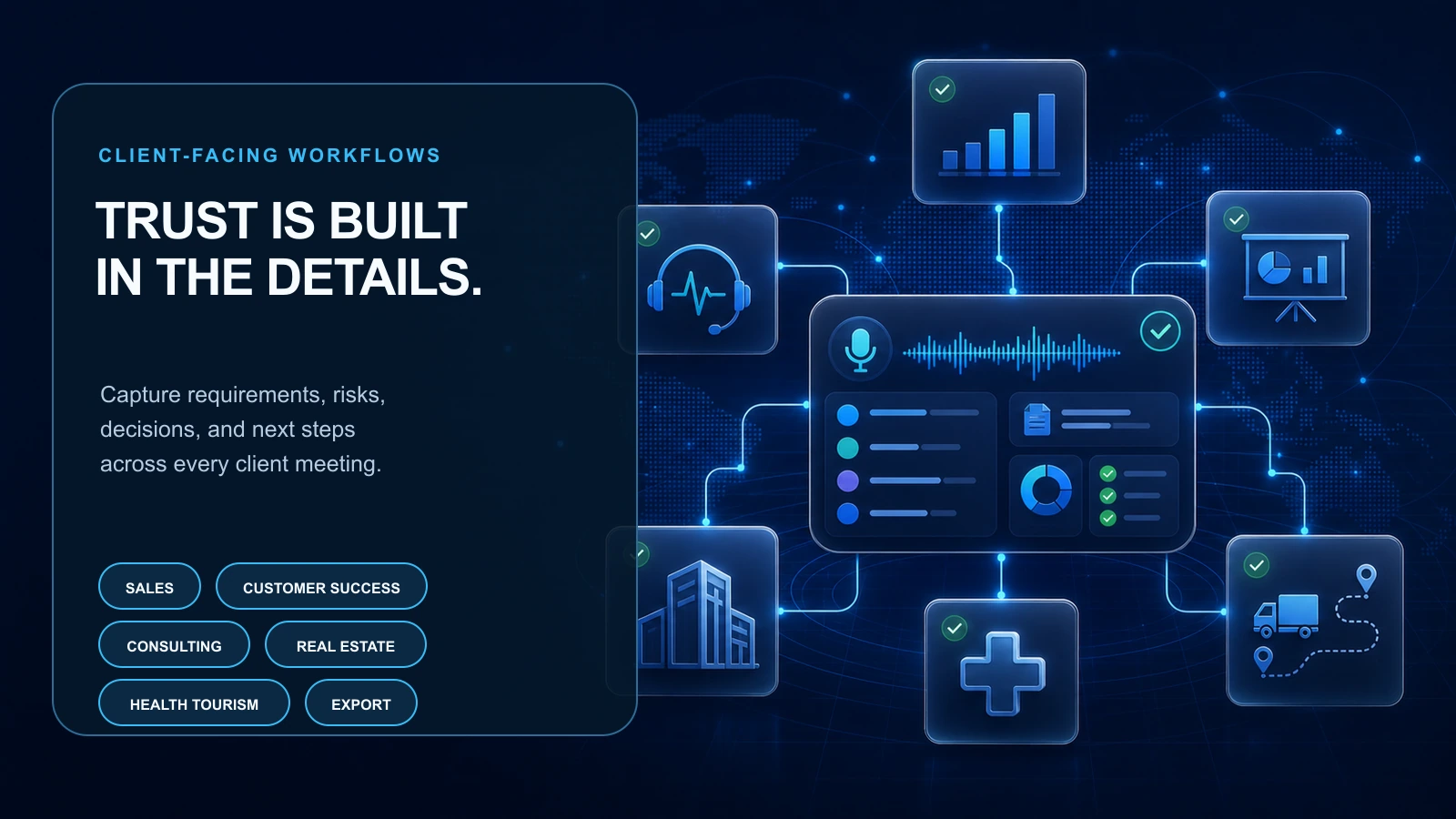
Client trust is built in the details: how quickly you understand the question, how clearly you answer, how accurately you capture commitments, and how reliably you follow up after the call.
When everyone speaks the same language fluently, that trust can form naturally. When the client speaks one language and your team works in another, the meeting becomes more fragile. A small delay, a simplified answer, a missed objection, or a vague follow-up can make the client wonder whether your team truly understood what mattered.
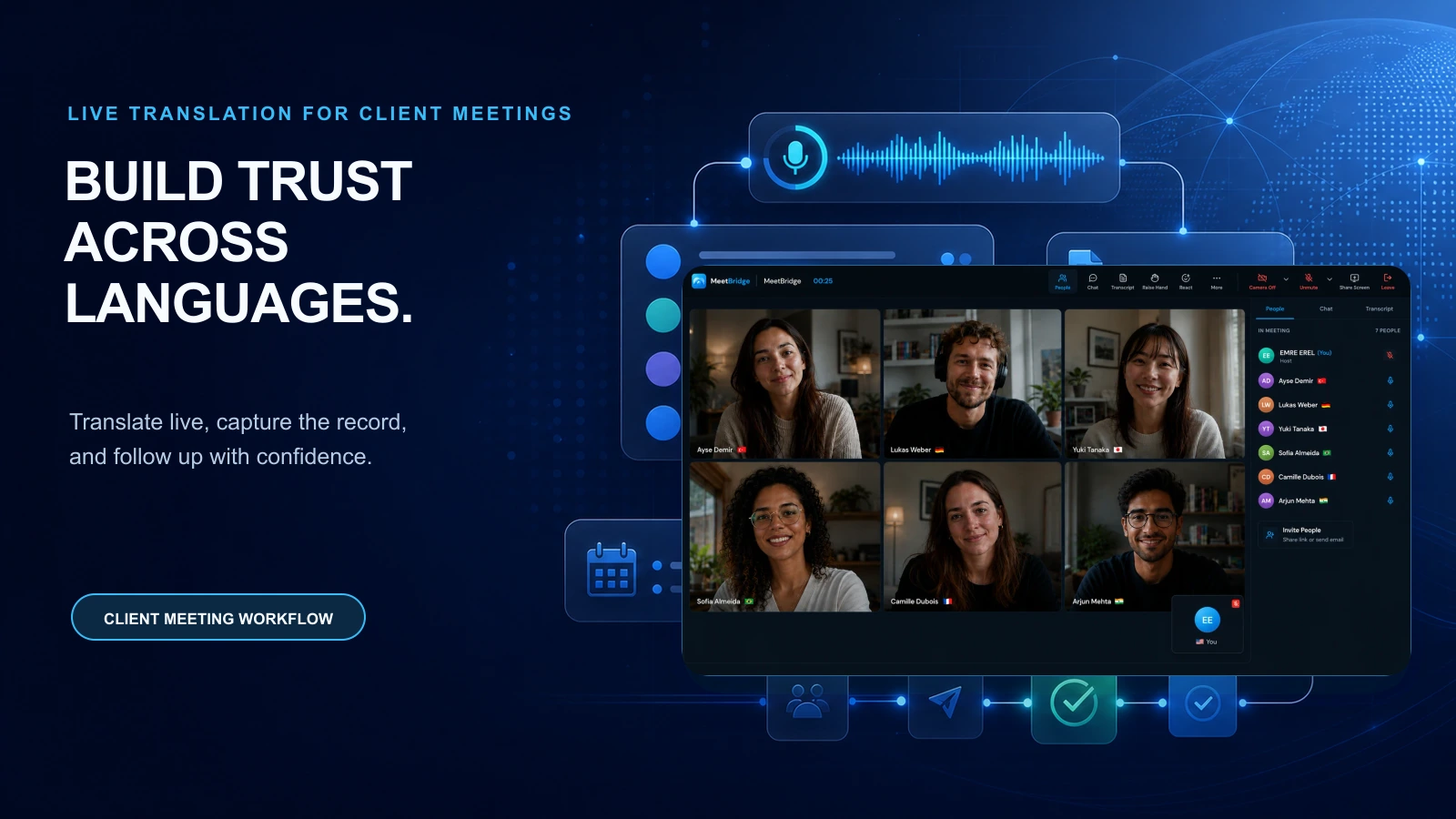
That is why live translation for client meetings is becoming a business workflow, not just a convenience feature.
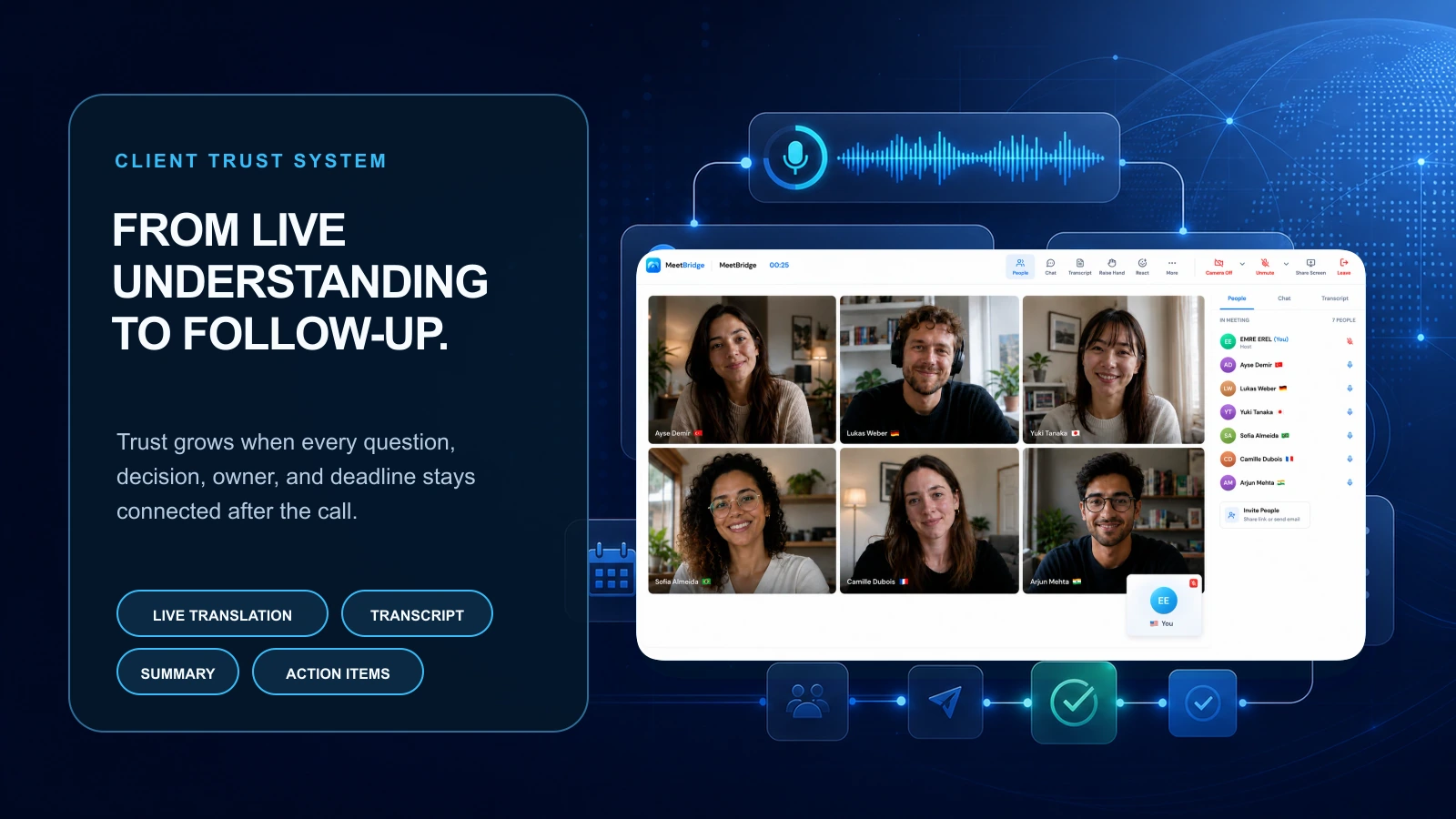
A strong live translation setup helps clients speak in the language they trust most while your team keeps the conversation moving. But translation alone is not enough. In real client meetings, trust also depends on the record after the meeting: the transcript, summary, decisions, action items, owners, deadlines, and next-step context.
That is where MeetBridge is built differently. MeetBridge combines live translation, transcripts and meeting memory, meeting summaries and actions, booking links, and meeting history so client-facing teams can turn multilingual conversations into clear follow-up.
Why language affects trust in client meetings
Clients do not only evaluate what you say. They evaluate how safe it feels to say what they really mean.
In a multilingual client meeting, language friction can change the entire relationship dynamic. The client may simplify their questions. They may avoid nuance because they are unsure whether it will translate correctly. They may agree politely even when they are not fully aligned. Your team may miss a weak signal: hesitation, concern, urgency, confusion, or a hidden blocker.
That is risky because client meetings often include business-critical details:
- Pricing and budget expectations.
- Contract terms and procurement constraints.
- Technical requirements and implementation risks.
- Treatment, travel, or service expectations.
- Property, investment, or legal next steps.
- Delivery dates, logistics, quality requirements, and documentation.
- Renewal concerns, escalation details, and promised actions.
When those details move across languages, the meeting needs more than basic comprehension. It needs a system that helps both sides feel understood and produces a record everyone can trust.
A client-facing team should be able to answer four questions after every multilingual meeting:
- Did the client feel comfortable speaking naturally?
- Did our team understand the real meaning behind the client’s words?
- Did we capture the important details accurately?
- Did the follow-up reflect the same reality for both sides?
If the answer to any of those is unclear, trust is already at risk.
The old way: relying on bilingual teammates, delayed notes, and “we understood enough”
Many teams start with informal translation because it feels simple.
A bilingual account manager joins the call. A teammate translates key parts. Someone writes notes in one language and later rewrites them in another. The client receives a recap after the meeting, but the recap is based on memory, partial notes, or one person’s interpretation.
That can work once or twice. It does not scale across recurring client meetings.
The old workflow creates predictable problems:
- The bilingual teammate becomes a bottleneck. Meetings depend on one person’s availability, accuracy, and context.
- The meeting slows down. Clients wait for interpretation, repeat details, or avoid deeper discussion.
- Nuance disappears. Objections, uncertainty, and cultural signals may get summarized too aggressively.
- The follow-up is delayed. Teams spend extra time translating notes, clarifying points, and rebuilding context.
- The official record becomes biased. The final recap may reflect what one language group heard, not what everyone agreed.
- Accountability becomes weaker. Decisions and action items are harder to confirm when the meeting record is incomplete.
For low-stakes conversations, that may be acceptable. For sales, onboarding, consulting, patient intake, real estate, supplier, and customer success meetings, it creates business risk.
If your team is already seeing these patterns, read Common Mistakes That Break Multilingual Meetings. The core issue is usually not only translation quality. It is the absence of a repeatable multilingual meeting workflow.
The new standard: live translation plus trusted follow-up
Live translation for client meetings should not be evaluated as a standalone feature. It should be evaluated as part of the client trust journey.
A strong workflow looks like this:
- Before the meeting: collect context, agenda, language preferences, client questions, and key terms.
- During the meeting: translate the conversation live so the client and team can speak naturally.
- At decision moments: confirm critical details clearly: scope, price, dates, responsibilities, risks, and next steps.
- After the meeting: preserve the transcript, generate a useful summary, capture decisions and action items, and send a recap the client can confirm.
- Before the next meeting: return to the meeting memory so the relationship continues with context.
That workflow changes the client experience.
Instead of feeling like they are speaking through a slow handoff, the client can participate directly. Instead of waiting days for a rewritten recap, they receive clear next steps. Instead of wondering whether the team understood, they can see that their questions, objections, and commitments were captured.
This is why MeetBridge treats translation as one layer of a complete meeting system. The product overview shows how booking, live multilingual meetings, transcripts, meeting summaries, actions, and meeting history connect in one workflow.
A trust framework for multilingual client meetings
Use this framework when designing or evaluating live translation for client meetings.
| Trust layer | What the client needs to feel | What can go wrong without a workflow | What to build into the meeting |
|---|---|---|---|
| Preparation | “They understand why I am here.” | The meeting starts with confusion, repeated context, or wrong assumptions. | Booking questions, agenda context, language preferences, and key terms. |
| Live conversation | “I can speak naturally.” | The client simplifies questions or avoids nuance. | Live translation that keeps the room moving while people speak. |
| Clarity | “They understood the important details.” | The team misses objections, requirements, numbers, or risks. | Explicit confirmation of commitments, scope, dates, and next steps. |
| Record | “There is a shared source of truth.” | Notes are incomplete, one-sided, or written from memory. | Speaker-aware transcripts, chat context, and meeting memory. |
| Follow-up | “They will do what they said.” | Recaps are late, vague, or inconsistent with the conversation. | meeting summaries, decisions, action items, owners, deadlines, and next meeting links. |
The point is simple: trust is not created by translation alone. Trust is created when the client sees that understanding becomes action.
1) Prepare before the client joins the call
The fastest way to lose trust is to make the client repeat context that your team should already know.
Preparation matters even more in multilingual meetings because context helps everyone interpret meaning. If the client is discussing a product module, a property, a treatment plan, a legal step, a shipment delay, or a custom proposal, the team should not discover that context halfway through the call.
Before a multilingual client meeting, collect:
- The client’s preferred language.
- The meeting goal.
- The client’s main question or problem.
- Relevant documents, product names, account details, or project references.
- Any industry terms, acronyms, or names that could be mistranslated.
- The expected decision or next step.
- Who needs the follow-up after the meeting.
MeetBridge supports this preparation layer with booking links. Teams can receive meeting requests, ask custom questions, and bring participant context into the meeting workflow before the call starts.
This is especially valuable for client-facing teams:
- B2B sales and SaaS teams can collect use case, team size, timeline, and budget context before discovery or demo calls.
- Customer success teams can ask for onboarding goals, support issues, or escalation details before the meeting.
- Consulting services teams can collect goals, risks, and stakeholder context before advisory sessions or workshops.
- Real estate teams can ask about buyer budget, location preferences, investment goals, and legal questions.
- Health tourism teams can collect patient intake context and coordination details before first consultations.
- Export and operations teams can collect order, shipment, quality, documentation, or pricing details before supplier and customer calls.
Better preparation creates better translation, better questions, and better trust.
2) Let clients speak in the language they trust
Many client meetings become weaker when the client is forced to speak a second language.
They may use simpler phrasing. They may avoid complex concerns. They may say “yes” because disagreement feels harder. They may struggle to explain a risk, objection, symptom, requirement, or emotional concern with the precision they would use in their own language.
Live translation changes that dynamic.
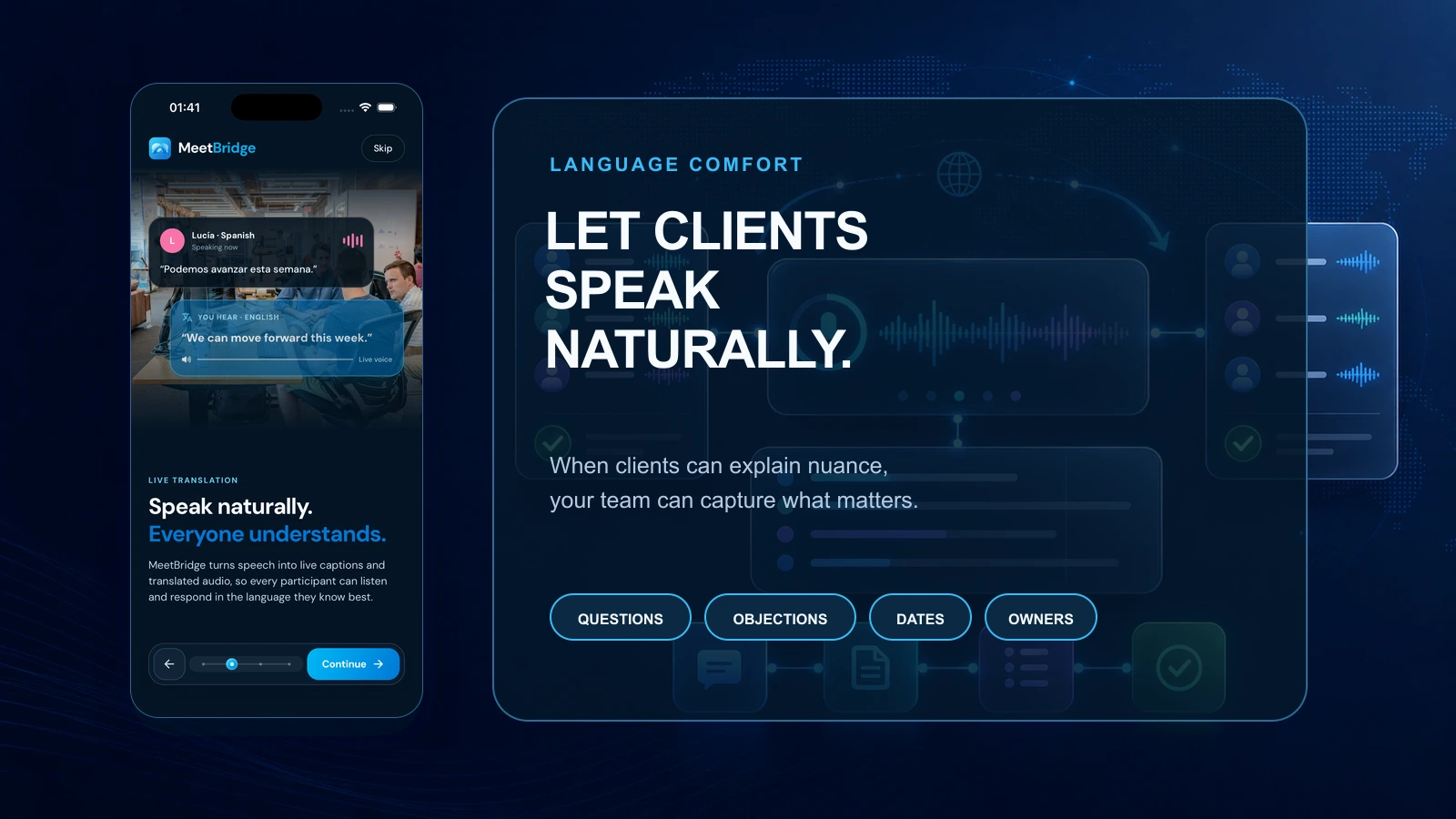
With MeetBridge live translation, multilingual participants can follow the conversation while people speak. That helps clients ask questions naturally and helps your team respond without waiting for manual interpretation.
For client-facing teams, that matters because trust often appears during unscripted moments:
- A buyer asks a difficult pricing question.
- A customer describes a confusing onboarding problem.
- A patient asks about expectations and next steps.
- An investor asks about risk, documents, or timing.
- A supplier pushes back on delivery terms.
- A consulting client challenges an assumption in a workshop.
Those moments cannot be handled well if the client feels limited by language. The goal is not only to translate words. The goal is to make the client confident enough to participate fully.
For a broader comparison of live translation and captions, read Live Translation vs Translated Captions: What Is the Difference?.
3) Confirm critical details during the meeting
Live translation improves understanding, but it should not create overconfidence.
Every AI translation workflow can be affected by audio quality, accents, speaking speed, overlapping speech, names, acronyms, and domain-specific terminology. Human interpretation can also lose nuance. The safest client meeting workflow makes critical details explicit before the call ends.
Use a confirmation habit for anything that affects money, scope, timeline, legal process, medical coordination, delivery, or ownership.
Examples:
- “Let’s confirm the decision: the pilot starts on August 5 and runs for two weeks.”
- “To make sure we understood correctly, the main blocker is the integration timeline, not pricing.”
- “The next step is that our team sends the revised proposal by Friday, and your team reviews it next Tuesday.”
- “The shipment concern is about documentation, not product quality. Is that correct?”
- “Before we close, let’s repeat the agreed action items with owners and dates.”
This habit builds trust because it gives the client a chance to correct meaning in the moment.
It also improves the post-meeting record. A clearly stated decision is easier to capture in the transcript, summary, action list, and follow-up.
For higher-risk conversations, such as formal legal, medical, employment, safety, or certified interpretation scenarios, teams may still need qualified human professionals or human review. MeetBridge is strongest for recurring business workflows where teams need scalable live understanding, reliable meeting records, and clear follow-up.
4) Preserve the client meeting record
Trust can weaken after the meeting if the recap does not match what the client remembers.
This is common in multilingual client meetings. The live conversation may feel successful, but later the internal team asks:
- Did the client commit to that timeline or only say it was possible?
- Was the objection about price, contract terms, or implementation risk?
- Did we promise a custom integration or only agree to investigate it?
- Which stakeholder asked for the follow-up?
- What exact document does the client need before the next call?
If the team has no reliable meeting record, the answer depends on memory.
That is why transcripts and meeting memory are essential for client trust. MeetBridge helps teams preserve meeting transcripts and keep them connected to chat, timeline, decisions, and follow-up context.
A strong client meeting record should help teams review:
- What the client said.
- Who said it.
- Which terms, dates, prices, or requirements were mentioned.
- Which objections or concerns appeared.
- What the team promised.
- What was left open.
- What needs to happen next.
The meeting record protects both sides. The client gets a more accurate follow-up. The team gets a shared source of truth for internal handoffs, proposals, onboarding, implementation, support, or operations.
5) Turn the conversation into a follow-up the client can trust
A multilingual client meeting does not end when the call ends. It ends when the client receives a clear follow-up and knows what will happen next.
The follow-up is where trust either compounds or disappears.
A weak follow-up says:
Thanks for the meeting. We discussed your requirements and will get back to you soon.
A trusted follow-up says:
Thanks for the meeting. Here is what we agreed: the pilot will cover the Turkish and German teams first; security review is still open; your team will send data residency questions by Thursday; our team will send the revised implementation plan by Friday; next meeting is scheduled for Tuesday.
That second version reduces anxiety. It shows the client that your team understood, captured, and acted.
MeetBridge supports this layer with meeting summaries and actions. Instead of rebuilding the meeting manually, teams can move from transcript to summary, decisions, tasks, follow-up context, and next steps.
For client-facing teams, the most useful follow-up usually includes:
- A short meeting summary.
- Numbered decisions.
- Action items with owners and due dates.
- Open questions or risks.
- Links to documents, proposals, or next resources.
- A next meeting time or booking link.
- A note asking the client to confirm or correct anything important.
That final confirmation is important. In multilingual relationships, trust grows when clients know they can correct meaning before it becomes a delivery issue.
Practical scenarios: where live translation builds client trust
Live translation for client meetings is useful in many industries, but the trust mechanics are different by meeting type.
Scenario 1: Cross-border sales discovery
A prospect speaks Spanish. The sales team works in English. A technical stakeholder joins from Germany.
Without live translation, the client may simplify their needs, and the sales team may miss objections or decision criteria. The follow-up might focus on features instead of the actual buying reason.
With MeetBridge, the team can use live translation during the call, preserve the discussion with transcripts and meeting memory, and turn objections into clear follow-up using meeting summaries and actions.
Recommended workflow: B2B sales and SaaS.
Scenario 2: Multilingual onboarding or customer success call
A customer is onboarding a regional team that prefers another language. The success manager needs to explain setup, collect blockers, and align on next steps.
The customer’s trust depends on whether they can ask questions freely and whether the team captures configuration needs correctly.
MeetBridge helps customer success teams run onboarding, training, support, and review meetings with multilingual customers while keeping follow-up visible.
Recommended workflow: Customer success plus How to Prepare for a Multilingual Customer Meeting.
Scenario 3: Consulting workshop with international stakeholders
A consulting team runs a strategy workshop with stakeholders across languages. The meeting includes assumptions, risks, decisions, and next-step ownership.
If language friction slows participation, the workshop may look aligned while important disagreement remains hidden.
MeetBridge helps consultants preserve client context, capture decisions, and turn workshop discussion into action items.
Recommended workflow: Consulting services.
Scenario 4: Real estate consultation with a foreign buyer
A foreign buyer needs to understand property details, pricing, location, legal next steps, payment plans, and documentation.
Trust is fragile because the buyer may be making a high-value decision remotely and across languages.
Live translation helps the buyer ask questions in the language they know best. Meeting memory helps the real estate team preserve preferences, objections, and document requirements after the call.
Recommended workflow: Real estate.
Scenario 5: Health tourism first consultation
An international patient wants to understand treatment options, expectations, requirements, and next steps before traveling.
This type of meeting can include sensitive details, so teams should be careful, transparent, and use qualified professionals where appropriate. At the workflow level, the patient needs to feel understood and the coordination team needs a reliable record for handoff.
MeetBridge helps health tourism teams collect context, translate concerns and explanations live, and preserve consultation details for follow-up coordination.
Recommended workflow: Health tourism.
Scenario 6: Export, supplier, or distributor meeting
An export team discusses pricing, shipment timing, product quality, customs documents, or distributor expectations with a client or supplier in another language.
One vague phrase can create expensive confusion later.
Live translation helps both sides discuss details directly. Transcripts and summaries help the team confirm pricing, order, shipment, and quality decisions after the meeting.
Recommended workflow: Export and operations.
How to run a trust-building multilingual client meeting
Use this playbook for any client-facing meeting where language can affect clarity, confidence, or follow-up.
Before the meeting
Define the meeting outcome in one sentence.
Examples:
- “Confirm whether the client is ready for a pilot and identify remaining blockers.”
- “Understand the customer’s onboarding issue and agree on next steps.”
- “Explain treatment planning requirements and confirm follow-up documents.”
- “Review supplier pricing and agree on delivery timeline.”
Then prepare:
- Ask the client for their preferred language.
- Collect agenda context with a booking link or intake form.
- List important names, acronyms, product terms, legal terms, or technical phrases.
- Decide which details must be confirmed live: price, scope, owners, dates, risks, documents, requirements.
- Tell participants how the meeting will work: one speaker at a time for important points, clear confirmation at decision moments, and a written recap afterward.
During the meeting
Create a direct, respectful conversation.
- Let the client speak in their preferred language.
- Keep explanations clear and avoid unnecessary idioms.
- Pause at important moments to confirm meaning.
- Ask the client to correct anything that sounds unclear.
- Restate decisions and action items before ending the call.
- Use the live transcript or translated context to catch names, numbers, and dates.
This is not about making the meeting robotic. It is about reducing ambiguity while keeping the conversation human.
After the meeting
Send a structured recap quickly.
Include:
- What happened.
- What was decided.
- What your team will do.
- What the client will do.
- Open questions or risks.
- Dates, documents, or next meeting details.
- A request for the client to confirm or correct the summary.
Then store the transcript, summary, and action items in a place your team can review before the next interaction.
This is where MeetBridge’s connected workflow matters: live translation supports the call, meeting memory preserves the record, and meeting summaries and actions help move the relationship forward.
What to look for in live translation software for client meetings
When choosing a tool, do not evaluate only language count. Evaluate the full client trust workflow.
| Evaluation question | Why it matters for client trust |
|---|---|
| Can clients join easily without complex setup? | External participants should not feel friction before the meeting starts. |
| Can clients speak in their preferred language? | Trust increases when clients can explain needs, concerns, and objections naturally. |
| Does translation support fast back-and-forth discussion? | Client meetings depend on interaction, not passive listening. |
| Can the tool handle names, acronyms, product terms, and domain language? | Misunderstood terminology can change the meaning of commitments. |
| Is there a transcript after the call? | The team needs a shared source of truth. |
| Are decisions and action items captured? | Trust depends on execution, not only understanding. |
| Can follow-up happen quickly? | Delayed recaps weaken momentum and confidence. |
| Can the team review meeting history before the next call? | Clients trust teams that remember context. |
| Is access and data handling clear? | Client meetings may include sensitive commercial, operational, HR, or patient context. |
MeetBridge is designed around this complete workflow. It helps global teams run multilingual meetings with real-time translation, structured meeting records, and clear follow-up actions.
For a broader buying guide, read Live Translation App for Meetings: What Business Teams Should Look For in 2026 and Best Real-Time Meeting Translation Software in 2026.
Trust is also a security conversation
Client trust is not only about language. It is also about how meeting context is handled.
Client meetings can include pricing, contracts, procurement details, patient intake, investment questions, supplier terms, roadmap discussion, credentials, product issues, or internal business plans. A live translation tool should not treat that context casually.
When evaluating any platform, ask:
- Who can access the meeting record?
- How are transcripts, summaries, decisions, and action items handled?
- Can meeting records stay inside the right organization workspace?
- What data is created before, during, and after the call?
- How should your team handle sensitive or regulated conversations?
MeetBridge’s security overview frames security around the actual meeting context teams create: booking answers, participants, chat, transcripts, summaries, decisions, action items, and operational metadata.
For client-facing teams, the trust message should be simple: the meeting is easier to understand, easier to review, and handled as business context.
When live translation may not be enough
Live translation is powerful, but it is not a universal replacement for every interpretation need.
Use extra caution when the meeting involves:
- Formal legal commitments.
- Employment disputes or sensitive HR topics.
- Medical diagnosis, treatment decisions, or consent workflows.
- Safety-critical instructions.
- High-stakes negotiations where tone and cultural mediation are central.
- Certified interpretation requirements.
In those cases, a human interpreter, qualified reviewer, or hybrid workflow may be appropriate.
A hybrid approach can still benefit from MeetBridge. A human professional can support live nuance, while MeetBridge helps preserve transcripts, summaries, decisions, action items, and follow-up context so execution does not depend only on memory.
For more on this choice, read Live Meeting Translation vs Human Interpreters for Business Calls.
The takeaway
Live translation for client meetings is not just about making words understandable. It is about making the client relationship easier to trust.
The best multilingual client meeting workflow helps teams:
- Prepare with context before the call.
- Let clients speak in the language they trust.
- Keep the conversation direct and natural.
- Confirm critical details in the moment.
- Preserve the transcript and meeting memory.
- Summarize decisions, risks, and next steps.
- Assign owners and deadlines.
- Send clear follow-up the client can confirm.
- Return to the client relationship with context before the next meeting.
That is why MeetBridge is built as a meeting workflow, not only a translation feature.
If your team meets with clients across languages, explore MeetBridge to connect live translation, meeting memory, meeting summaries, actions, booking context, and follow-up in one workspace.
See MeetBridge in action
MeetBridge connects the client meeting workflow from preparation to follow-up:
- Live translation: help clients and teams understand each other while people speak.
- Transcripts and meeting memory: preserve client context, objections, requirements, and commitments after the call.
- meeting summaries and actions: turn discussion into decisions, tasks, owners, and next steps.
- Booking links: collect meeting requests, client questions, and context before the call.
- Mobile app: support multilingual meeting workflows across web, iOS, and Android.
- Security overview: review how meeting context should be handled from booking to follow-up.
To evaluate MeetBridge for your client-facing team, contact sales or review pricing.
FAQ
What is live translation for client meetings?
Live translation for client meetings is software that translates spoken conversation during a client call so participants can understand each other across languages. Business-ready live translation should also support transcripts, summaries, decisions, action items, and follow-up so the meeting produces a reliable outcome.
How does live translation help build client trust?
Live translation helps clients speak in the language they know best, ask questions naturally, and understand answers during the call. Trust grows further when the conversation is captured in a transcript, summarized clearly, and turned into follow-up actions that match what was discussed.
Is live translation better than translated captions for client meetings?
For interactive, high-stakes client meetings, live translation is usually stronger because it supports faster back-and-forth conversation. Translated captions may be useful for passive comprehension, but they often do not solve decision capture, action items, or follow-up. Read Live Translation vs Translated Captions: What Is the Difference? for a deeper comparison.
What should a team send after a multilingual client meeting?
Send a short recap with the meeting summary, numbered decisions, action items with owners and due dates, open questions, risks, documents needed, and the next meeting step. Ask the client to confirm or correct anything important so misunderstandings are caught early.
Can MeetBridge help before and after the client meeting?
Yes. MeetBridge supports the workflow before, during, and after the meeting. Teams can collect context with booking links, run the meeting with live translation, review transcripts and meeting memory, and create meeting summaries and actions for follow-up.
Which client-facing teams benefit most from live translation?
Live translation is especially useful for sales, customer success, consulting, real estate, health tourism, export, operations, and global service teams. It is most valuable when language barriers affect revenue, trust, urgency, documentation, or follow-up quality.
Do client meetings still need human interpreters?
Sometimes. Human interpreters or qualified professionals may be appropriate for formal legal, medical, HR, safety, or highly sensitive conversations. For recurring business meetings where speed, records, summaries, and follow-up matter, live translation software like MeetBridge can help teams scale multilingual client communication.
How should we evaluate live translation software for client meetings?
Test real client scenarios, not generic demos. Evaluate live conversation flow, language pairs, accents, terminology, guest experience, transcript quality, summary usefulness, decision capture, action items, security posture, and follow-up speed.
Related posts
Continue reading:
- Live Translation App for Meetings: What Business Teams Should Look For in 2026
- How to Prepare for a Multilingual Customer Meeting
- Live Translation vs Translated Captions: What Is the Difference?
- What Is an Live Meeting Translator and How Does It Work?
- Why Global Teams Need More Than Translated Captions
- Best Real-Time Meeting Translation Software in 2026
- Live Meeting Translation vs Human Interpreters for Business Calls
- Common Mistakes That Break Multilingual Meetings
- How to Run Multilingual Meetings Without Slowing Them Down